
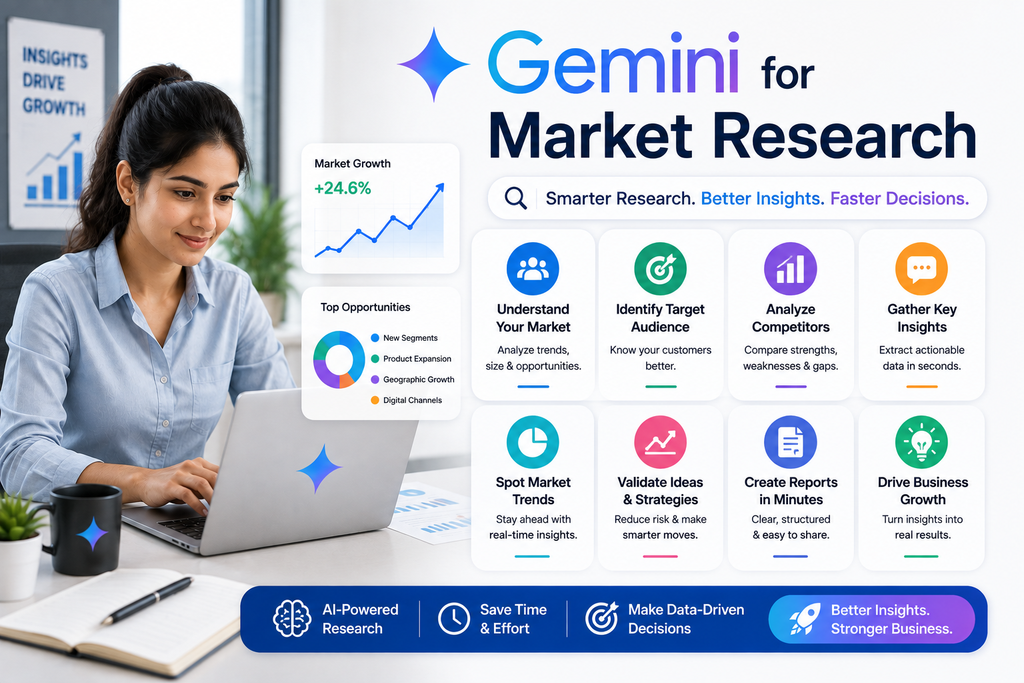
Market research helps businesses understand customers, competitors, trends, opportunities, and risks before making important decisions. But traditional research can take a lot of time. You may need to collect information from websites, reports, customer feedback, surveys, reviews, spreadsheets, and search results before you can identify meaningful patterns. This is where Gemini can help. You can use Gemini for market research to organize research questions, brainstorm customer segments, analyze provided data, compare competitors, summarize sources, identify patterns, create survey questions, generate research plans, and develop hypotheses for further validation.
Gemini marketing refers to using Google Gemini to support marketing research, content planning, audience analysis, campaign ideas, and other digital marketing activities. Marketers can use Gemini to brainstorm campaign concepts, analyze customer needs, create content ideas, develop marketing questions, summarize research, and explore different messaging approaches. For SEO, Gemini marketing can help identify relevant topics, search intent, keywords, and content opportunities, while GEO focuses on creating useful, context-rich information that AI-powered search systems can understand and reference. AEO can also benefit from Gemini by helping marketers structure content around common questions, provide direct answers, and develop conversational FAQs. When combined with accurate research, reliable data, and human judgment, Gemini marketing can help businesses streamline research and planning while creating more relevant and user-focused marketing strategies.
How Can You Use Gemini for Market Research?
You can use Gemini for market research to help with industry research, audience analysis, customer personas, competitor research, survey creation, trend analysis, review analysis, product research, market segmentation, pricing research, and research summaries.
For example:
Prompt:
“Act as a market research analyst. I am researching the [industry] market for a business selling [product/service] to [target audience] in [location]. Create a research plan covering market demand, customer needs, competitors, pricing, trends, barriers, and potential opportunities. Separate verified findings from assumptions and tell me which claims require current external sources.”
The most useful results come when you give Gemini a clear research objective and enough context.
What Is Gemini for Market Research?
Using Gemini for market research means using Google’s AI assistant to support different stages of the research process.
Gemini can help you:
- Define research questions
- Brainstorm customer segments
- Organize market information
- Compare competitors
- Summarize reports
- Analyze uploaded data
- Create survey questions
- Review customer feedback
- Generate research hypotheses
- Identify patterns
- Build research frameworks
- Prepare findings for presentation
Gemini should be treated as a research assistant, not as a replacement for real market data.
Why Use Gemini for Market Research?
Market research often involves large amounts of information.
Gemini can help make that information easier to organize and interpret.
Faster Research Planning
Instead of starting with a blank page, you can ask Gemini to create a structured research plan.
Better Organization
Gemini can categorize findings by customer segment, competitor, trend, opportunity, or risk.
Easier Data Summaries
If you provide reports, notes, survey responses, or other source material, Gemini can help summarize and compare them.
More Research Questions
Gemini can help uncover questions you may not have considered.
Faster Hypothesis Generation
It can suggest possible explanations for patterns in your data, which you can then validate.
Can Gemini Do Market Research?
Yes, Gemini can support market research workflows.
Google’s Deep Research feature can create a research plan and perform multi-source research, with Google Search included by default. Users can also add certain other sources depending on their setup.
However, you should still verify important findings.
Market conditions change, and AI-generated summaries can contain errors, outdated information, or unsupported assumptions.
30+ Best Gemini Prompts for Market Research
Replace anything inside [brackets] with information relevant to your market, business, audience, or research question.
1. Create a Complete Market Research Plan
Prompt:
“Act as a senior market research analyst. Create a complete market research plan for [business/product] targeting [audience] in [location]. Include research objectives, key questions, customer analysis, competitor analysis, pricing research, trends, risks, data sources, and a recommended research process.”
Best for: Starting a new market research project.
2. Research an Industry
Prompt:
“Create an industry research framework for [industry]. Cover market structure, customer segments, major business models, competitors, trends, barriers to entry, regulatory factors, and growth drivers. Clearly identify which findings require current external verification.”
3. Identify Target Customers
Prompt:
“Identify potential customer segments for [product/service]. For each segment, explain needs, pain points, motivations, buying triggers, objections, preferred channels, and information I should validate with real customer research.”
4. Create Customer Personas
Prompt:
“Create 3 provisional customer personas for [product/service] based on the following information: [data]. Include goals, pain points, motivations, objections, purchase triggers, and preferred communication channels. Clearly label any assumptions.”
5. Find Customer Pain Points
Prompt:
“Generate 20 potential pain points experienced by [audience] when dealing with [problem]. Group them by functional, emotional, financial, time-related, and trust-related concerns. Suggest ways to validate each pain point.”
6. Generate Customer Interview Questions
Prompt:
“Create 20 open-ended customer interview questions for [product/service]. Focus on current behavior, problems, alternatives, decision-making, frustrations, and desired outcomes. Avoid leading questions.”
7. Create a Customer Survey
Prompt:
“Create a customer research survey for [audience] about [topic]. Include screening questions, behavioral questions, satisfaction questions, preference questions, and optional demographic questions. Avoid biased wording.”
8. Improve Survey Questions
Prompt:
“Review these survey questions for bias, ambiguity, leading language, double-barreled questions, and unnecessary complexity. Explain each problem and rewrite the questions more neutrally: [survey].”
9. Analyze Survey Responses
Prompt:
“Analyze the following survey responses: [data]. Identify recurring themes, differences between groups, unusual responses, and possible follow-up questions. Separate direct observations from interpretations.”
10. Analyze Customer Reviews
Prompt:
“Analyze these customer reviews for [product/category]: [reviews]. Group feedback into positive themes, negative themes, recurring complaints, desired features, purchasing motivations, and language customers frequently use. Do not infer more than the reviews support.”
11. Find Customer Language
Prompt:
“Review the following customer feedback and extract phrases customers use to describe their problems, desired outcomes, objections, and buying motivations. Do not rewrite the phrases unless necessary for clarity: [feedback].”
This can help improve messaging because it uses real customer language rather than invented marketing terminology.
12. Analyze a Market Segment
Prompt:
“Analyze the [market segment] segment for [industry]. Cover likely customer needs, buying behavior, common alternatives, price sensitivity, barriers, and opportunities. Clearly label assumptions that require current data.”
13. Create Market Segmentation Ideas
Prompt:
“Suggest ways to segment the market for [product/service]. Include demographic, geographic, behavioral, psychographic, use-case, company-size, and customer-journey segmentation where relevant.”
14. Compare Customer Segments
Prompt:
“Compare these customer segments: [segments]. Evaluate their problem urgency, willingness to pay, accessibility, competition, potential retention, and fit with this offer: [offer]. Use only the information provided and clearly identify missing data.”
15. Create a Competitor Research Framework
Prompt:
“Create a competitor research framework for [industry]. Include products, pricing, positioning, customer segments, features, marketing channels, messaging, reviews, strengths, weaknesses, and differentiation.”
16. Compare Competitors
Prompt:
“Using only the competitor information below, compare [competitor A], [competitor B], and [competitor C]. Create a table covering target audience, pricing, features, positioning, strengths, weaknesses, and likely differentiators: [data].”
17. Find Competitor Gaps
Prompt:
“Based on the following competitor information, identify possible gaps in products, customer service, pricing, messaging, content, or audience coverage. Label each gap as evidence-based or hypothetical: [data].”
18. Analyze Competitor Reviews
Prompt:
“Analyze these competitor reviews: [reviews]. Identify recurring complaints, praised features, unmet needs, customer expectations, and potential opportunities for differentiation.”
19. Research Market Trends
Prompt:
“Create a framework for researching current trends in [industry]. Include technology changes, customer behavior, regulations, pricing, distribution, demographics, and competitive shifts. Tell me which sources would be most useful for validating each trend.”
20. Analyze Trend Data
Prompt:
“Analyze the following trend data: [data]. Identify meaningful changes, potential causes, anomalies, and areas requiring further investigation. Do not assume correlation proves causation.”
21. Generate Product Research Questions
Prompt:
“Create 25 market research questions to evaluate demand for [product idea]. Cover customer problem, existing alternatives, urgency, willingness to pay, purchasing behavior, barriers, and product expectations.”
22. Validate a Business Idea
Prompt:
“Create a market validation plan for this business idea: [idea]. Include target customer hypotheses, customer interviews, competitor research, demand indicators, pricing tests, landing-page experiments, and criteria for deciding whether to proceed.”
23. Evaluate Product-Market Fit Signals
Prompt:
“Create a framework for evaluating early product-market fit for [product]. Include customer retention, usage behavior, repeat purchases, referral signals, willingness to pay, satisfaction, and qualitative feedback.”
24. Research Pricing
Prompt:
“Create a pricing research plan for [product/service]. Include competitor pricing, willingness-to-pay research, customer interviews, packaging, price sensitivity, and testing methods. Do not invent recommended prices without sufficient data.”
25. Compare Pricing Models
Prompt:
“Compare subscription, one-time purchase, freemium, usage-based, and tiered pricing for [product]. Explain advantages, risks, customer fit, and what information I would need before choosing.”
26. Create a SWOT Analysis
Prompt:
“Create a SWOT analysis for [business/product] using only the information provided below. Separate internal strengths and weaknesses from external opportunities and threats. Flag any unsupported assumptions: [data].”
27. Create a PESTLE Analysis
Prompt:
“Create a PESTLE research framework for [industry/market], covering political, economic, social, technological, legal, and environmental factors. Identify which factors require current authoritative sources.”
28. Estimate Market Size Framework
Prompt:
“Create a framework for estimating the market size of [product/service]. Explain how to calculate TAM, SAM, and SOM, what data is needed, and which assumptions should be tested. Do not invent market-size numbers.”
29. Analyze Purchase Drivers
Prompt:
“Using the following customer data, identify the main factors influencing purchase decisions. Group them into price, quality, trust, convenience, features, service, brand, and urgency: [data].”
30. Analyze Purchase Barriers
Prompt:
“Analyze the following feedback and identify barriers preventing customers from purchasing [product]. Group them by price, trust, product fit, complexity, awareness, timing, and competition.”
31. Create a Market Opportunity Scorecard
Prompt:
“Create a market opportunity scorecard for evaluating [number] business opportunities. Include problem severity, market access, competition, willingness to pay, growth potential, operational difficulty, differentiation, and evidence quality.”
32. Analyze an Uploaded Report
Prompt:
“Analyze this market research report and summarize the key findings, methodology, important statistics, limitations, risks, and implications for [business]. Clearly distinguish the report’s findings from your interpretation.”
33. Summarize Multiple Sources
Prompt:
“Compare the following research sources about [topic]. Identify areas of agreement, disagreement, differences in methodology, dates, sample sizes, and limitations. Do not merge conflicting findings into a single conclusion without explanation: [sources].”
34. Create Research Hypotheses
Prompt:
“Based on the following evidence, generate 10 testable market hypotheses. For each hypothesis, explain the supporting evidence, what could disprove it, and the best validation method: [data].”
35. Create a Market Research Report
Prompt:
“Turn the following research notes into a structured market research report. Include executive summary, research objective, methodology, customer findings, competitor findings, market trends, opportunities, risks, limitations, and recommended next steps: [notes].”
36. Find Missing Research
Prompt:
“Review this market research summary and identify important unanswered questions, missing evidence, possible bias, weak assumptions, and areas requiring more research: [summary].”
37. Create an Executive Summary
Prompt:
“Turn this market research report into an executive summary for business decision-makers. Include the most important findings, supporting evidence, risks, limitations, and recommended actions: [report].”
Best Gemini Prompt for Market Research
If you want one reusable prompt, try this:
Prompt:
“Act as a senior market research analyst.
Business: [business]
Product/service: [offer]
Industry: [industry]
Target market: [location]
Target customer: [audience]
Research objective: [objective]
Existing information: [data]
Create a complete market research analysis covering:
- Market overview
- Target customer segments
- Customer needs and pain points
- Buying motivations
- Existing alternatives
- Competitor landscape
- Pricing considerations
- Market trends
- Barriers to entry
- Opportunities
- Risks
- Information gaps
- Research methods
- Recommended next steps
Clearly separate verified information, reasonable interpretation, and assumptions.
Do not invent statistics, market size, competitor revenue, customer numbers, pricing, or trends.
Identify all claims that require current external verification.”
How to Write Better Gemini Prompts for Market Research
A useful formula is:
Role + Research Goal + Market + Audience + Evidence + Questions + Constraints + Output
Role
Tell Gemini what perspective you need.
Example:
“Act as a market research analyst.”
Research Goal
Explain the decision you are trying to make.
Examples:
- Should we launch this product?
- Which customer segment should we target?
- What are customers unhappy with?
- How should we position our offer?
- Is this market attractive?
Market
Define the industry, location, product category, or niche.
Audience
Explain who you are researching.
Evidence
Provide real data whenever possible.
Examples:
- Reviews
- Survey responses
- Interview notes
- Competitor information
- Reports
- Sales data
- Search data
Questions
Specify what you want Gemini to investigate.
Constraints
Tell Gemini what it should not invent.
Example:
“Do not create fake market statistics.”
Output
Specify how the results should be organized.
For example:
“Create a table containing finding, evidence, confidence level, and recommended action.”
How to Use Gemini for Market Research Step by Step
Step 1: Define the Decision
Good market research starts with a decision.
For example:
“Should we launch this product?”
is more useful than:
“Tell me about this market.”
Step 2: Create Research Questions
Identify what you need to know.
Typical questions include:
- Who has this problem?
- How serious is the problem?
- What are customers currently using?
- What do they dislike?
- How much are they willing to pay?
- Who are the competitors?
- What trends are changing the market?
Step 3: Collect Reliable Sources
Use information such as:
- Official reports
- Industry publications
- Government data
- Competitor websites
- Customer interviews
- Surveys
- Reviews
- Internal sales data
- Analytics
Gemini can help analyze and organize this information.
Step 4: Use Gemini to Organize the Evidence
Ask Gemini to:
- Summarize
- Categorize
- Compare
- Extract themes
- Identify contradictions
- Find information gaps
Step 5: Separate Evidence From Assumptions
This is one of the most important steps.
Ask Gemini:
“Which conclusions are directly supported by evidence, and which are assumptions?”
Step 6: Validate Customer Problems
AI can suggest potential pain points.
Real customers should validate whether those problems actually matter.
Use:
- Interviews
- Surveys
- Sales calls
- Support conversations
- Reviews
Step 7: Analyze Competitors
Research actual competitors using current information.
Look at:
- Products
- Pricing
- Positioning
- Features
- Reviews
- Customer segments
- Marketing messages
Step 8: Test Important Hypotheses
Research should lead to tests.
For example:
If you believe customers want a specific feature, test that assumption before investing heavily in development.
Step 9: Document Limitations
Every research project has limitations.
These may include:
- Small sample size
- Outdated data
- Geographic limitations
- Selection bias
- Incomplete competitor information
- Self-reported customer behavior
Step 10: Make a Decision Based on Evidence
The goal of research is not to generate a long report.
The goal is to reduce uncertainty enough to make a better decision.
How to Use Gemini Deep Research for Market Research
Gemini’s Deep Research capability can be useful when you need to investigate a topic across multiple sources.
Google says Deep Research can create a research plan and, by default, includes Google Search as a source. Depending on your setup, you may also be able to add other supported sources or files.
A practical workflow is:
- Define your research question
- Ask for a research plan
- Review or edit the plan
- Run the research
- Read the sources
- Check dates and methodology
- Compare conflicting evidence
- Extract findings
- Identify missing information
- Validate critical conclusions separately
Deep Research can save time, but source quality still matters.
Gemini for Competitor Research
Gemini can help create competitor profiles and comparisons.
You can analyze:
- Product positioning
- Pricing
- Features
- Marketing messages
- Target audience
- Reviews
- Content strategy
- Strengths
- Weaknesses
However, competitors change their products and pricing frequently.
Always verify current information before making strategic decisions.
Gemini for Customer Research
Customer research is one of the most valuable applications of AI-assisted analysis.
If you provide real customer feedback, Gemini can help extract:
- Recurring problems
- Desired outcomes
- Objections
- Questions
- Complaints
- Product expectations
- Language customers use
This is generally more valuable than asking AI to invent a customer persona from nothing.
Gemini for Survey Research
Gemini can help you create and improve surveys.
It can identify:
- Leading questions
- Confusing wording
- Double questions
- Missing response options
- Poor question order
It can also help summarize survey responses after you collect them.
But survey quality depends heavily on who responds and how the sample was selected.
Gemini for Market Trend Analysis
Gemini can help organize trend information from reports and current sources.
Useful categories include:
- Technology
- Customer behavior
- Regulation
- Pricing
- Competition
- Distribution
- Demographics
- Economic conditions
Be careful with trend predictions.
A current pattern does not automatically mean the trend will continue.
Gemini for Product Research
You can use Gemini to research a new product idea by asking:
- Who might need it?
- What alternatives exist?
- What complaints do customers have?
- What features matter most?
- What purchasing barriers exist?
- What assumptions need testing?
Use these answers to guide real validation rather than replacing it.
Gemini for Small Business Market Research
Small businesses often have limited research budgets.
Gemini can help organize low-cost research using:
- Customer conversations
- Reviews
- Search results
- Competitor websites
- Public reports
- Surveys
- Internal business data
A small amount of high-quality real customer evidence can often be more useful than a large amount of speculative AI output.
Common Mistakes When Using Gemini for Market Research
1. Asking Gemini for Market Size Without Evidence
Avoid treating AI-generated market-size figures as factual.
Use reliable market data.
2. Treating Personas as Real Customers
AI personas are hypotheses until validated.
3. Using Only One Source
Strong research usually compares multiple sources.
4. Ignoring Publication Dates
Old market information can be misleading.
5. Confusing Correlation With Causation
Two variables moving together does not prove one caused the other.
6. Ignoring Sample Size
Ten reviews may not represent an entire market.
7. Creating Fake Precision
Avoid saying:
“The market has exactly 1.2 million customers”
unless reliable evidence supports it.
8. Ignoring Negative Evidence
Do not ask Gemini only to prove your business idea is good.
Look for reasons it could fail.
9. Relying Only on Secondary Research
Reports are useful, but direct customer research can reveal information that published reports miss.
10. Not Verifying Important Claims
Check critical findings before using them in business decisions.
Can Gemini Replace a Market Researcher?
Not completely.
Gemini can accelerate parts of the process, especially:
- Planning
- Summarization
- Categorization
- Brainstorming
- Data organization
- Drafting
But market research also requires:
- Choosing the right methodology
- Evaluating source quality
- Understanding bias
- Designing samples
- Interviewing customers
- Interpreting context
- Making business judgments
The strongest approach is often:
AI assistance + reliable evidence + human analysis
Is Gemini Good for Competitive Market Research?
Yes.
Gemini can be useful for organizing competitor information and comparing multiple companies.
For example, you can provide competitor pricing, positioning, features, and customer reviews, then ask Gemini to identify patterns and gaps.
For the strongest results, provide current information instead of relying on Gemini to remember every competitor accurately.
Can Gemini Analyze Customer Reviews?
Yes.
Review analysis is a useful market research task because the source material comes from actual customers.
Gemini can help identify:
- Common complaints
- Frequently praised features
- Customer expectations
- Desired improvements
- Purchase motivations
- Recurring language
You should still consider whether the review sample is representative.
Can Gemini Create Surveys?
Yes.
Gemini can help draft surveys and improve question wording.
A useful prompt is:
“Create 15 unbiased survey questions to understand why small business owners choose one email marketing platform over another. Focus on current behavior, priorities, problems, and purchasing decisions.”
Frequently Asked Questions
Is Gemini good for market research?
Yes. Gemini can help plan research, summarize sources, analyze provided data, organize customer feedback, compare competitors, create surveys, and develop research hypotheses.
How do I use Gemini for market research?
Start with a specific research objective. Give Gemini information about your market, audience, product, and available data, then ask it to perform a defined task such as analyzing reviews or creating a competitor comparison.
Can Gemini do real-time market research?
Gemini’s Deep Research feature can conduct research using current web sources, including Google Search by default. Important findings should still be checked against the original sources.
Can Gemini analyze competitors?
Yes. Gemini can help compare competitor products, pricing, positioning, reviews, features, and messaging when you provide or research current competitor information.
Can Gemini analyze customer reviews?
Yes. Gemini can summarize reviews and identify recurring complaints, praised features, customer expectations, and potential opportunities.
Can Gemini create market research surveys?
Yes. Gemini can help draft customer surveys, interview questions, and feedback forms while also identifying potentially biased wording.
Can Gemini estimate market size?
Gemini can help create a market-sizing framework, but you should not rely on invented AI-generated market-size numbers. Use verified data and clearly documented assumptions.
Can Gemini help validate a business idea?
Yes. Gemini can help build a validation plan, identify hypotheses, suggest customer questions, analyze competitors, and organize evidence. Real customer and market validation is still required.
Can Gemini replace traditional market research?
No. Gemini can speed up many research tasks, but reliable sources, customer evidence, sound methodology, and human interpretation remain essential.
Final Thoughts
Using Gemini for market research can make research faster, more organized, and easier to analyze.
Gemini can help with:
- Industry research
- Customer analysis
- Market segmentation
- Surveys
- Interviews
- Review analysis
- Competitor research
- Trend analysis
- Pricing research
- Product validation
- Research summaries
But the goal should not be to ask AI to invent a market report.
A stronger workflow is:
Define the decision → Create research questions → Collect reliable evidence → Use Gemini to organize it → Identify patterns → Test assumptions → Verify findings → Make a decision
Gemini can help reduce the time required to process information, but the quality of your market research still depends on the quality of your evidence.