
Competitor Analysis
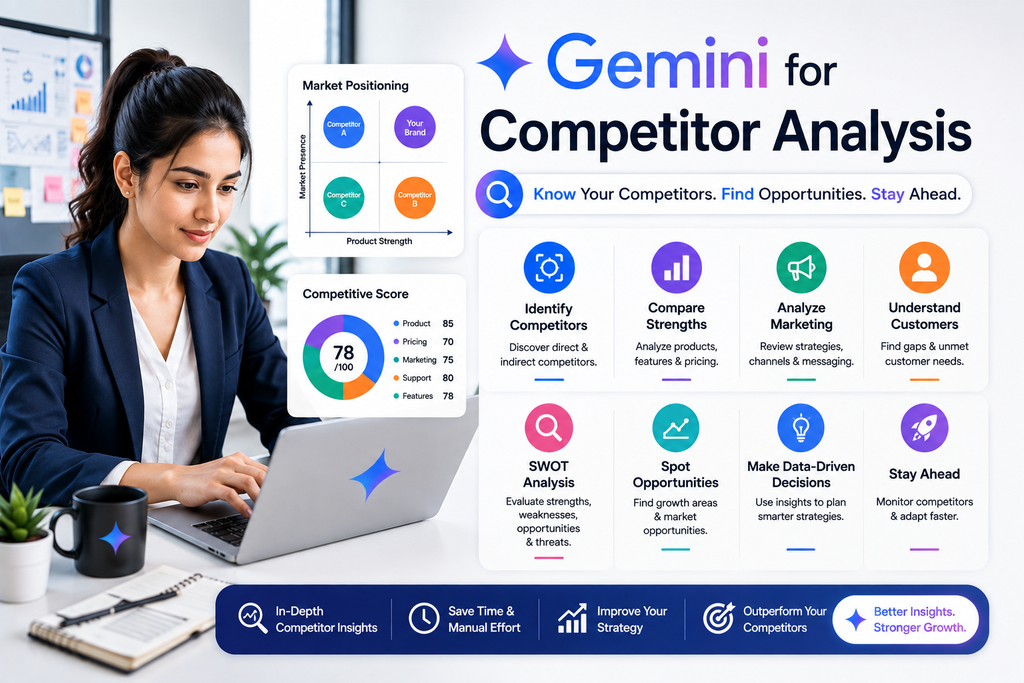
Understanding your competitors can help you make better decisions about products, pricing, content, SEO, marketing, positioning, and customer experience. But competitor analysis can become complicated quickly. You may need to compare websites, product pages, pricing plans, customer reviews, marketing messages, search visibility, social content, and other information across several businesses. This is where Gemini can help. You can use Gemini for competitor analysis to organize competitor information, compare products, analyze supplied reviews, identify messaging patterns, study content strategies, create SWOT frameworks, find possible market gaps, and summarize research.
Hi, I’m Gurudeep Singh, and in this guide, I’ll show you practical ways to use Gemini for competitor research, along with 30+ prompts you can customize for your business. The goal is not to copy competitors. The goal is to understand the competitive landscape and use that knowledge to create something more useful for your customers.
How Can You Use Gemini for Competitor Analysis?
You can use Gemini for competitor analysis to help compare competitor products, features, pricing, positioning, websites, content, SEO strategies, customer reviews, strengths, weaknesses, and marketing messages.
For example:
Prompt:
“Act as a competitive intelligence analyst. Compare these competitors: [competitors]. Analyze their target audiences, products, pricing, positioning, key features, marketing messages, customer reviews, strengths, weaknesses, and apparent differentiation. Use current reliable sources where available, cite important findings, and clearly separate verified facts from assumptions.”
Gemini is most useful when you define exactly what you want to compare.
What Is Competitor Analysis?
Competitor analysis is the process of researching businesses competing for similar customers, problems, products, search queries, or market opportunities.
A useful competitor analysis may examine:
- Products
- Services
- Features
- Pricing
- Positioning
- Target audience
- Marketing messages
- Website experience
- SEO
- Content
- Advertising
- Customer reviews
- Social media
- Distribution
- Strengths
- Weaknesses
The objective is not simply to create a list of competitors.
The objective is to understand why customers might choose one option over another and where opportunities for differentiation may exist.
What Is Gemini for Competitor Analysis?
Using Gemini for competitor analysis means using Google Gemini as an AI research and analysis assistant during the competitive research process.
Gemini can help you:
- Build competitor lists
- Create research frameworks
- Compare supplied competitor information
- Analyze websites and content
- Organize pricing information
- Compare product features
- Analyze customer reviews
- Identify positioning patterns
- Create SWOT analyses
- Find possible content gaps
- Generate research questions
- Summarize findings
- Create competitor scorecards
It can make the research process faster, but important information should still be verified.
Why Use Gemini for Competitor Analysis?
Faster Research Organization
Instead of manually organizing dozens of notes, you can ask Gemini to categorize information into products, pricing, customers, strengths, weaknesses, and opportunities.
Compare Multiple Competitors
Gemini can help convert information from several competitors into a consistent comparison framework.
Analyze Large Amounts of Text
Customer reviews, product descriptions, website copy, and reports can contain useful patterns that are difficult to identify manually.
Generate Better Research Questions
Gemini can identify areas you may have forgotten to investigate.
Find Possible Gaps
By comparing competitors side by side, you may discover underserved customer needs, weak messaging, content gaps, or product opportunities.
35+ Best Gemini Prompts for Competitor Analysis
Replace anything inside [brackets] with information about your market, company, competitors, or customers.
1. Create a Complete Competitor Analysis
Prompt:
“Act as a senior competitive intelligence analyst. Analyze [competitors] in the [industry] market. Compare target audience, positioning, products, features, pricing, marketing messages, content, customer reviews, strengths, weaknesses, and differentiation. Separate verified information from interpretation and assumptions.”
Best for: Building an overall competitor overview.
2. Identify Potential Competitors
Prompt:
“Help me create a framework for identifying competitors for [business/product] serving [audience] in [market]. Separate direct competitors, indirect competitors, substitutes, and emerging alternatives. Explain what evidence should be used before classifying each company.”
3. Separate Direct and Indirect Competitors
Prompt:
“Classify these companies as direct competitors, indirect competitors, substitutes, or unrelated businesses based on the following product and audience information: [data]. Explain each classification.”
4. Create Competitor Profiles
Prompt:
“Create a standardized competitor profile template covering company overview, target audience, products, pricing, positioning, features, channels, customer sentiment, strengths, weaknesses, and evidence sources.”
5. Compare Competitor Products
Prompt:
“Compare these competitor products using only the information provided: [data]. Create a table covering target customer, use case, features, benefits, limitations, pricing, and differentiation. Mark missing information as unknown instead of guessing.”
6. Compare Competitor Features
Prompt:
“Create a feature comparison matrix for [our product] and these competitors: [competitors]. Use the following verified product information: [data]. Mark each feature as available, unavailable, limited, or unknown.”
7. Analyze Competitor Pricing
Prompt:
“Compare the following competitor pricing information: [data]. Identify pricing models, entry prices, tiers, billing periods, included features, limitations, free options, trials, and potential differences in positioning. Do not fill missing prices with estimates.”
8. Compare Pricing Models
Prompt:
“Analyze the pricing models used by these competitors: [data]. Compare subscription, freemium, usage-based, tiered, and one-time pricing where relevant. Explain what customer segments each model may appeal to, labeling interpretations as hypotheses.”
9. Analyze Competitor Positioning
Prompt:
“Analyze the positioning statements and website copy of these competitors: [content]. Identify their target audience, primary problem, promised value, differentiators, emotional appeals, and positioning similarities.”
10. Analyze Competitor Messaging
Prompt:
“Compare the following competitor marketing messages: [content]. Identify recurring themes, benefits, pain points, claims, proof elements, CTAs, and tone. Suggest opportunities to communicate differently without copying their language.”
11. Analyze Competitor Homepages
Prompt:
“Analyze these competitor homepage texts: [content]. Compare opening message, value proposition, audience clarity, benefits, trust signals, product explanation, objections addressed, and CTA strategy.”
12. Compare Landing Pages
Prompt:
“Compare these competitor landing pages using the supplied content: [data]. Evaluate message clarity, offer, audience, benefits, proof, CTA, objections, page structure, and potential friction.”
13. Analyze Competitor Customer Reviews
Prompt:
“Analyze these verified customer reviews for [competitor]: [reviews]. Identify recurring positive themes, complaints, missing features, customer expectations, switching reasons, and language customers frequently use.”
14. Compare Customer Sentiment
Prompt:
“Compare customer feedback for these competitors: [reviews]. Group feedback into product quality, pricing, ease of use, support, features, reliability, onboarding, and overall value. Note sample-size limitations.”
15. Find Common Competitor Complaints
Prompt:
“Analyze these competitor reviews and identify recurring customer complaints. Rank themes by frequency within the supplied sample and include representative paraphrased examples. Do not generalize beyond the available data.”
16. Identify Competitor Strengths
Prompt:
“Using only this evidence, identify the strongest apparent advantages of [competitor]: [data]. For each strength, provide supporting evidence and explain why it may matter to customers.”
17. Identify Competitor Weaknesses
Prompt:
“Using the following verified information, identify potential weaknesses of [competitor]: [data]. Separate factual limitations from customer complaints and your own interpretation.”
18. Create a Competitor SWOT Analysis
Prompt:
“Create a SWOT analysis for [competitor] using only the following information: [data]. Separate internal strengths and weaknesses from external opportunities and threats. Flag assumptions.”
19. Create a Competitive SWOT Comparison
Prompt:
“Compare SWOT analyses for [our business] and [competitors] using this data: [information]. Identify meaningful differences and potential strategic implications without assuming that every competitor weakness is automatically an opportunity.”
20. Analyze Competitor SEO
Prompt:
“Create an SEO competitor-analysis framework for [competitors]. Include organic topics, search intent, content clusters, site architecture, internal linking, backlinks, SERP features, page types, and content quality. Mark which areas require current SEO-tool data.”
21. Find Competitor Keyword Gaps
Prompt:
“Using these exported keyword datasets for my website and competitors, identify potential keyword gaps: [data]. Group opportunities by search intent, topic cluster, business relevance, and funnel stage. Do not invent missing search-volume or difficulty data.”
22. Analyze Competitor Content
Prompt:
“Analyze these competitor content inventories: [data]. Identify major topic clusters, content formats, target audiences, funnel stages, publishing patterns, and topics covered repeatedly.”
23. Find Competitor Content Gaps
Prompt:
“Compare my website topics with these competitor topics: [data]. Identify potentially valuable topics that competitors cover and we do not, plus customer questions none of us appear to answer well.”
24. Find Differentiation Opportunities
Prompt:
“Based on this competitor research, identify possible differentiation opportunities in product, service, customer experience, pricing, positioning, content, and support. Rank each idea by evidence strength and explain what should be validated.”
25. Analyze Competitor Content Quality
Prompt:
“Evaluate these competitor articles using the same criteria: search intent satisfaction, originality, clarity, depth, examples, evidence, usability, freshness, and unanswered questions. Avoid judging quality based only on word count.”
26. Analyze Competitor Social Media
Prompt:
“Using the following competitor social media data, compare content themes, formats, posting patterns, engagement, CTAs, audience questions, and positioning: [data]. Distinguish direct observations from explanations for performance.”
27. Analyze Competitor Ads
Prompt:
“Analyze these competitor advertisements: [ad copy/data]. Identify hooks, pain points, benefits, offers, proof, CTAs, audience assumptions, and recurring creative angles. Suggest ways to differentiate rather than imitate.”
28. Analyze Competitor Email Marketing
Prompt:
“Analyze these competitor emails: [emails]. Compare subject-line approaches, content themes, offers, tone, personalization, CTA strategy, frequency where known, and positioning. Do not infer unavailable performance data.”
29. Analyze Competitor Brand Voice
Prompt:
“Analyze these samples from [competitor]: [content]. Describe their apparent brand voice using specific evidence. Evaluate tone, vocabulary, sentence style, emotional framing, complexity, and consistency.”
30. Compare Value Propositions
Prompt:
“Compare the value propositions of these competitors using the supplied homepage and product copy: [content]. Identify target customer, main problem, promised benefit, differentiator, and proof for each.”
31. Create a Competitive Positioning Map
Prompt:
“Using this verified competitor information, suggest meaningful dimensions for a competitive positioning map in [market]. Explain why each dimension matters and where each competitor may fall based only on supplied evidence.”
32. Create a Competitor Scorecard
Prompt:
“Create a competitor scorecard for [competitors]. Evaluate product fit, pricing, positioning, features, customer sentiment, content, distribution, support, and differentiation. Define objective scoring criteria before assigning any scores.”
33. Analyze a New Competitor
Prompt:
“A new competitor called [company] has entered our market. Create a research checklist to evaluate its product, customers, pricing, positioning, distribution, marketing, reviews, funding where publicly available, and potential impact on our business.”
34. Create Competitor Monitoring Questions
Prompt:
“Create a monthly competitor-monitoring checklist for [industry]. Include pricing changes, product launches, feature updates, positioning changes, new content, customer sentiment, partnerships, hiring signals, and other meaningful developments.”
35. Turn Competitor Research Into Actions
Prompt:
“Review this competitor analysis: [research]. Convert the findings into prioritized strategic actions for our business. For each action, provide evidence, expected benefit, risk, required validation, effort, and recommended priority.”
36. Challenge Your Competitor Analysis
Prompt:
“Act as a critical reviewer. Examine this competitor analysis and identify unsupported assumptions, confirmation bias, outdated information, weak evidence, missing competitors, and alternative interpretations: [analysis].”
37. Create an Executive Competitor Report
Prompt:
“Turn these competitor research notes into an executive report. Include competitive landscape, major competitors, customer insights, positioning, product differences, pricing, strengths, weaknesses, opportunities, risks, evidence limitations, and recommended actions: [notes].”
Best Gemini Prompt for Competitor Analysis
For a reusable competitor research workflow, use:
Prompt:
“Act as a senior competitive intelligence analyst.
Our business: [business]
Our product/service: [offer]
Industry: [industry]
Target audience: [audience]
Market: [location]
Competitors: [competitors]
Research objective: [objective]
Available evidence: [data/sources]
Analyze:
- Competitor overview
- Target customers
- Products and services
- Pricing
- Features
- Positioning
- Value propositions
- Marketing messages
- Website strategy
- SEO/content strategy
- Customer reviews
- Strengths
- Weaknesses
- Potential gaps
- Differentiation opportunities
- Threats
- Recommended next actions
For every important conclusion, classify it as:
- Verified fact
- Evidence-based interpretation
- Hypothesis
- Unknown
Do not invent revenue, traffic, market share, customer numbers, ad spend, rankings, pricing, features, or other unavailable data.
Identify information that requires current verification.”
How to Write Better Gemini Prompts for Competitor Analysis
A useful prompt formula is:
Goal + Competitors + Comparison Criteria + Evidence + Timeframe + Constraints + Output
Goal
Start by explaining why you are researching competitors.
For example:
“We are deciding how to position a new project management product.”
Competitors
Specify the companies you want to compare.
If you don’t know your competitors yet, first ask for a method to identify them.
Comparison Criteria
Tell Gemini what matters.
Examples:
- Pricing
- Features
- Positioning
- Customer reviews
- SEO
- Content
- Ads
- Customer experience
Evidence
Provide real competitor information whenever possible.
Timeframe
Competitor information changes.
When current information matters, specify the date or research period.
Constraints
Tell Gemini not to guess missing data.
Output
Specify how you want the comparison presented.
For example:
“Create a comparison table followed by the five most important strategic findings.”
How to Use Gemini for Competitor Analysis Step by Step
Step 1: Define Your Objective
Don’t research competitors without knowing why.
Your objective might be:
- Launch a new product
- Change pricing
- Improve positioning
- Build an SEO strategy
- Enter a new market
- Improve customer experience
- Develop new features
Your research should support a business decision.
Step 2: Identify the Right Competitors
Competitors can include:
Direct competitors: Sell a similar solution to a similar customer.
Indirect competitors: Solve the same problem differently.
Substitutes: Alternative ways customers can solve the problem.
This distinction matters because customers may compare your product with alternatives that do not look like traditional competitors.
Step 3: Define Comparison Criteria
Create a consistent framework.
For example:
- Target audience
- Product
- Features
- Pricing
- Positioning
- Customer sentiment
- Content
- Marketing
- Distribution
Compare every competitor using the same criteria where possible.
Step 4: Collect Current Information
Possible sources include:
- Official competitor websites
- Pricing pages
- Product documentation
- Public reports
- Customer reviews
- Search results
- Social channels
- Advertisements
- Industry publications
Use primary sources where possible for product and pricing claims.
Step 5: Give Gemini the Evidence
Rather than asking Gemini to guess, provide research material when possible.
Then ask it to:
- Compare
- Categorize
- Summarize
- Extract patterns
- Identify differences
Step 6: Analyze Customer Reviews
Customer reviews can reveal why people choose, dislike, or switch products.
Look for:
- Recurring complaints
- Praised features
- Missing functionality
- Support problems
- Pricing concerns
- Ease-of-use issues
- Desired outcomes
Step 7: Find Patterns
One isolated complaint does not necessarily indicate a major market gap.
Look for recurring evidence.
Step 8: Identify Differentiation Opportunities
Ask:
What can we do differently or better?
Possible opportunities might involve:
- Product
- Pricing
- Onboarding
- Support
- Positioning
- Education
- Content
- User experience
Step 9: Validate Opportunities
A competitor weakness does not automatically mean customers want your solution.
Validate important opportunities with customer research.
Step 10: Turn Research Into Action
The final competitor report should lead to decisions.
Prioritize recommendations based on:
Evidence + Customer Value + Strategic Fit + Impact + Effort
Gemini Deep Research for Competitor Analysis
Gemini’s research capabilities can be useful when competitor analysis requires information from multiple sources.
A useful Deep Research prompt could be:
Prompt:
“Research [competitors] in the [industry] market.
For each competitor, investigate:
- Target audience
- Main products
- Current pricing
- Key features
- Positioning
- Recent product developments
- Marketing messages
- Customer feedback
- Strengths
- Weaknesses
Prioritize primary sources for factual company and product claims.
Cite sources for major findings.
Include publication or update dates where available.
Separate facts from interpretation.
Finish with a comparison table and a list of unresolved questions.”
After receiving the report, inspect the important sources yourself.
Gemini for Competitor Website Analysis
Competitor websites can reveal how companies position themselves.
Look at:
- Homepage headline
- Subheadline
- Product explanation
- Target audience
- Benefits
- Features
- Proof
- Pricing
- CTAs
- FAQs
- Objections
Then compare those elements with your own website.
The goal is not to imitate the strongest competitor.
It is to understand what the market already communicates and determine how your message can be more useful and distinctive.
Gemini for Competitor SEO Analysis
Gemini can help organize SEO competitor research.
For example, you can analyze:
- Topics
- Keywords
- Search intent
- Content clusters
- Landing pages
- Comparison pages
- Guides
- FAQs
- Internal links
But Gemini should not be asked to invent competitor traffic, keyword rankings, backlink counts, or search volumes.
Use appropriate SEO tools or current search data for those metrics.
Gemini for Competitor Content Analysis
Content analysis can help you understand what competitors are publishing.
Ask:
- What topics do they cover?
- Who are they writing for?
- Which funnel stages do they target?
- Which formats do they use?
- Which questions do they answer?
- Where is their content weak?
- What questions remain unanswered?
Then use the findings to create better or more distinctive content, not merely more content.
Gemini for Competitor Review Analysis
Reviews are especially valuable because they can provide direct customer perspectives.
For example, suppose 500 verified reviews repeatedly mention that a competitor is difficult to set up.
You might investigate whether easier onboarding is a meaningful opportunity.
But context matters.
Check:
- Number of reviews
- Review dates
- Product versions
- Review platform
- Whether complaints are recurring
- Whether recent updates fixed the issue
Gemini for Competitor Pricing Analysis
Gemini can help organize pricing comparisons into a table containing:
| Factor | Your Business | Competitor A | Competitor B |
|---|---|---|---|
| Entry Price | Data | Data | Data |
| Free Plan | Data | Data | Data |
| Trial | Data | Data | Data |
| Pricing Model | Data | Data | Data |
| Main Tier | Data | Data | Data |
| Key Limitations | Data | Data | Data |
| Target Customer | Data | Data | Data |
Pricing can change frequently, so record when the information was collected.
Gemini for Competitor SWOT Analysis
Gemini can also organize research into SWOT:
Strengths
Internal advantages a competitor appears to have.
Weaknesses
Internal limitations supported by evidence.
Opportunities
External developments the business may benefit from.
Threats
External factors that could create challenges.
Be careful not to put every negative customer review under “weakness.”
A SWOT analysis should summarize meaningful patterns rather than isolated opinions.
Gemini for Competitive Gap Analysis
A gap is an area where existing options may not fully satisfy customers.
Potential gaps might involve:
- Missing feature
- Poor customer support
- Complicated onboarding
- Underserved audience
- Unanswered question
- Pricing structure
- Integration
- Geographic availability
- Content quality
However:
Competitor gap ≠ market opportunity
You still need evidence that enough customers care about the gap.
How Often Should You Analyze Competitors?
Competitor analysis should not be a one-time activity.
How frequently you need to review competitors depends on how quickly your market changes.
Fast-moving industries may require more frequent monitoring of:
- Pricing
- Product launches
- Features
- Messaging
- Partnerships
- Content
- Customer sentiment
For slower industries, quarterly or periodic reviews may be sufficient.
The goal is to monitor meaningful changes rather than obsess over every competitor action.
Common Mistakes When Using Gemini for Competitor Analysis
1. Asking Gemini to Guess Competitor Data
Never assume generated numbers are factual.
Verify them.
2. Using Outdated Pricing
Pricing changes frequently.
Check the competitor’s current pricing page.
3. Treating AI Interpretation as Fact
Separate:
Fact → Interpretation → Hypothesis
4. Copying Competitors
Competitor research should improve your strategy, not turn your business into a clone.
5. Ignoring Indirect Competitors
Customers may solve their problem using completely different approaches.
6. Focusing Only on Features
Customers may care about ease of use, support, trust, convenience, brand, and price as much as features.
7. Overgeneralizing Customer Reviews
A small sample may not represent the entire customer base.
8. Assuming a Competitor Weakness Is Your Opportunity
Validate whether customers actually care.
9. Collecting Research Without Taking Action
Competitor analysis should lead to decisions.
10. Tracking Everything
Focus on competitive changes relevant to your customers and strategy.
Can Gemini Find Your Competitors?
Gemini can help identify potential competitors when given enough information about your product, audience, market, and location.
However, you should verify whether each suggested company actually competes for the same customers or solves the same problem.
Can Gemini Analyze Competitor Websites?
Yes.
Gemini can help analyze supplied competitor website information for positioning, messaging, product features, target audience, benefits, CTAs, and content strategy.
For current competitor information, use up-to-date source material.
Can Gemini Analyze Competitor SEO?
Yes.
Gemini can help organize competitor SEO research, classify topics, identify content patterns, and analyze keyword datasets you provide.
For actual traffic, rankings, backlinks, and keyword metrics, use reliable SEO data sources.
Can Gemini Analyze Competitor Reviews?
Yes.
Gemini can help analyze review datasets to identify recurring complaints, praised features, desired improvements, customer expectations, and common language.
Can Gemini Find Competitor Weaknesses?
Gemini can identify potential weaknesses when supported by evidence such as product limitations, repeated customer complaints, pricing disadvantages, or unclear positioning.
Those findings should be validated before becoming the basis of a business strategy.
Frequently Asked Questions
Is Gemini good for competitor analysis?
Yes. Gemini can help compare competitor products, pricing, positioning, content, customer reviews, marketing messages, strengths, weaknesses, and potential gaps.
How do I use Gemini for competitor analysis?
Define your research goal and competitors, collect reliable information, provide it to Gemini, specify comparison criteria, and ask Gemini to separate facts from interpretations and assumptions.
Can Gemini find competitors?
Gemini can help identify potential direct, indirect, and substitute competitors. Each suggested competitor should be verified against your actual market and target audience.
Can Gemini compare competitor pricing?
Yes. Gemini can organize verified competitor pricing into tables and compare pricing models, tiers, features, trials, and limitations.
Can Gemini analyze competitor websites?
Yes. Gemini can analyze website content for positioning, value propositions, benefits, features, target audience, trust signals, and CTAs.
Can Gemini analyze competitor SEO?
Yes. Gemini can assist with competitor SEO research, especially when you provide keyword, content, or website data. Current ranking and traffic metrics should come from reliable SEO data sources.
Can Gemini analyze customer reviews?
Yes. Review analysis is a useful Gemini application because it can identify recurring complaints, positive themes, expectations, and customer language across a supplied dataset.
Can Gemini identify competitor weaknesses?
Yes, but weaknesses should be based on evidence rather than AI speculation. Use verified product information, customer feedback, and other reliable sources.
Can Gemini perform a SWOT analysis?
Yes. Gemini can organize verified competitor information into strengths, weaknesses, opportunities, and threats while clearly labeling unsupported assumptions.
Can Gemini replace competitor research tools?
Not entirely. Gemini can help organize, summarize, compare, and interpret research, while specialized tools and primary sources may still be needed for current SEO metrics, advertising data, financial information, traffic estimates, and other specialized datasets.
Final Thoughts
Using Gemini for competitor analysis can make competitive research easier to organize and interpret.
You can use it to analyze:
- Competitors
- Products
- Features
- Pricing
- Positioning
- Websites
- SEO
- Content
- Advertising
- Customer reviews
- Strengths
- Weaknesses
- Market gaps
But collecting competitor information is only the beginning.
A stronger workflow is:
Define the decision → Identify competitors → Collect current evidence → Compare consistently → Analyze customer feedback → Find patterns → Identify opportunities → Validate → Take action
And remember:
Competitor research should help you differentiate, not imitate.
The most useful competitive advantage may come from understanding customers better than your competitors do.