
AI Tools for SEO
SEO in 2026 involves much more than adding keywords to a page. Search marketers need to understand search intent, identify valuable topics, analyze competitors, improve technical performance, build useful content, earn authority, and optimize websites for both traditional search engines and AI-powered discovery experiences. Artificial intelligence can make many of these tasks faster. But with so many SEO platforms adding AI features, an important question is:
Which AI tools are actually best for SEO in 2026? Some of the most useful AI and AI-assisted SEO tools include Semrush, Ahrefs, Surfer SEO, ChatGPT, Google Gemini, Claude, Screaming Frog, and Frase. Each serves a different purpose. Semrush and Ahrefs are strong for SEO data and competitor research, Surfer SEO and Frase focus on content optimization, Screaming Frog supports technical SEO auditing, while ChatGPT, Gemini, and Claude can assist with research, search-intent analysis, content planning, writing, and workflow automation. This guide explains the best AI tools for SEO in 2026, their ideal use cases, how they compare, and how to build an effective AI-assisted SEO workflow.
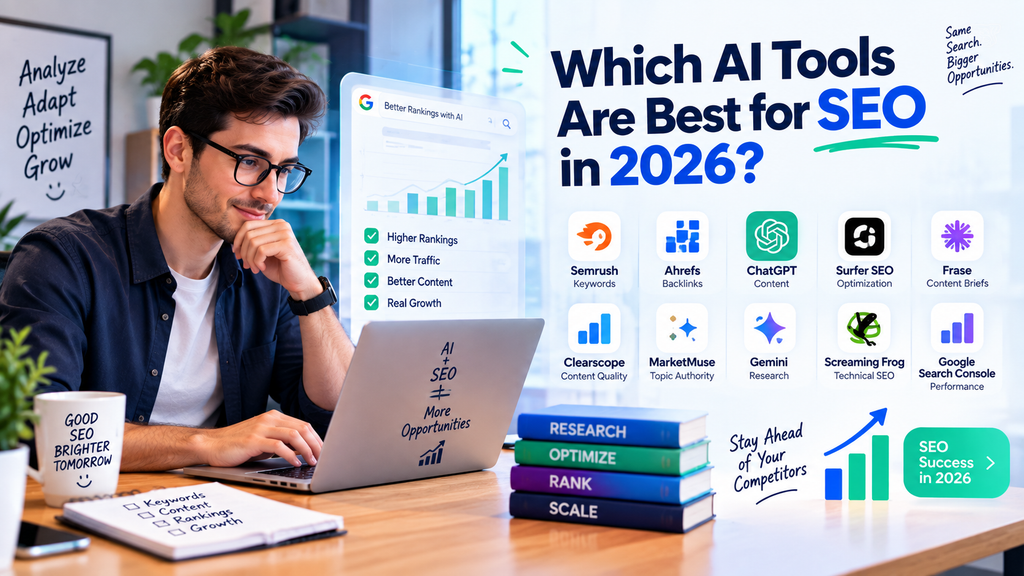
A ChatGPT SEO keywords content creator can help marketers develop search-friendly content by finding relevant keywords, understanding search intent, and creating engaging copy. ChatGPT can assist with blog posts, titles, meta descriptions, FAQs, and content ideas while keeping keywords naturally integrated. It can also support AEO and GEO by creating clear answers and context-rich content for AI-powered search. Using ChatGPT strategically can save time, improve content relevance, strengthen organic visibility, and attract more targeted website traffic.
Which AI Tools Are Best for SEO in 2026?
The best AI tools for SEO depend on the SEO task you need to complete.
| Tool | Best For |
|---|---|
| Semrush | All-in-one SEO and competitor research |
| Ahrefs | Keywords, backlinks and competitor analysis |
| Surfer SEO | SEO content optimization |
| ChatGPT | SEO planning, content and workflow assistance |
| Google Gemini | Research and Google-focused workflows |
| Claude | Long-form SEO content and analysis |
| Screaming Frog | Technical SEO auditing |
| Frase | Content briefs and SEO content optimization |
For most SEO professionals, the strongest approach is not relying on one AI tool.
Instead, combine reliable SEO data with AI assistants and human expertise.
What Are AI SEO Tools?
AI SEO tools are software platforms that use artificial intelligence, machine learning, natural-language processing, automation, or AI-assisted features to support search engine optimization.
They can help marketers analyze large amounts of information and complete repetitive SEO tasks more efficiently.
What Can AI SEO Tools Do?
Depending on the platform, AI SEO tools can assist with:
- Keyword research
- Search-intent analysis
- Keyword clustering
- Competitor research
- Content briefs
- Article outlines
- SEO writing
- Content optimization
- Internal linking
- Technical SEO
- Backlink research
- SERP analysis
- Schema markup
- Content refreshing
- SEO reporting
Do AI SEO Tools Automatically Improve Rankings?
No.
AI tools can improve the efficiency and quality of your SEO workflow, but they cannot guarantee rankings.
Search visibility depends on many factors, including content quality, relevance, website authority, technical performance, competition, backlinks, user experience, and search-engine systems.
What Is the Best Way to Use AI for SEO?
Use AI as an assistant rather than as a replacement for SEO strategy.
AI should help you research, analyze, create, and optimize faster while humans remain responsible for strategy, accuracy, originality, quality, and final decisions.
Why Are AI Tools Important for SEO in 2026?
SEO professionals work with large amounts of information.
A single SEO project may involve thousands of keywords, hundreds of pages, competitor websites, backlinks, search results, technical issues, and content opportunities.
AI can help organize and interpret this information faster.
How AI Makes SEO More Efficient
AI can help transform raw SEO data into actionable ideas.
For example:
Keyword data → Keyword clusters → Search intent → Content topics → Content briefs → Articles → Optimization → Performance analysis
This can significantly reduce repetitive manual work.
Which SEO Tasks Benefit Most From AI?
AI is particularly useful for:
- Large-scale keyword categorization
- Search-intent classification
- Content ideation
- Topic clustering
- Content outlines
- Metadata drafts
- FAQ generation
- Content repurposing
- Existing-page analysis
- Reporting summaries
Where Is Human SEO Expertise Still Necessary?
Human judgment remains important for:
- SEO strategy
- Business priorities
- Content quality
- Original research
- Fact-checking
- Link-building decisions
- Technical implementation
- Brand positioning
- User experience
- Editorial review
1. Semrush – Best All-in-One AI SEO Platform
Semrush is one of the most comprehensive SEO and digital-marketing platforms available.
It combines keyword research, competitive research, backlink analysis, rank tracking, site auditing, content tools, and AI-assisted features.
What Can You Use Semrush For?
SEO professionals can use Semrush for:
- Keyword research
- Keyword gap analysis
- Competitor research
- Rank tracking
- Backlink analysis
- Site auditing
- Content research
- Organic traffic analysis
- On-page SEO
- SEO reporting
Why Is Semrush Useful for AI SEO?
General AI assistants can suggest keywords, but dedicated SEO platforms provide search-related datasets and metrics.
Semrush can therefore be used to validate AI-generated ideas with SEO data.
Best Semrush SEO Workflow
A useful workflow is:
Keyword Research → Competitor Analysis → Search Intent → Keyword Clustering → Content Planning → Optimization → Rank Tracking
Use AI assistants alongside the data when you need help interpreting results or turning them into content strategies.
2. Ahrefs – Best for Keyword and Backlink Research
Ahrefs is another major SEO platform used for organic search research.
Its strongest use cases include backlink analysis, keyword research, competitor analysis, and content discovery.
What Can You Do With Ahrefs?
Ahrefs can help with:
- Keyword research
- Backlink analysis
- Competitor analysis
- Content-gap research
- Ranking analysis
- Link-building research
- Site auditing
- Content discovery
Why Are Backlinks Important?
Links can help search engines discover pages and understand relationships and authority across the web.
However, link quality matters more than simply collecting large numbers of backlinks.
Ahrefs vs Semrush for SEO
Both platforms are powerful.
Ahrefs is particularly popular for backlink and organic-search research, while Semrush offers a broad collection of SEO and digital-marketing capabilities.
The better option depends on your workflow, budget, required data, and preferred interface.
3. Surfer SEO – Best for SEO Content Optimization
Surfer SEO is designed primarily for content optimization.
It analyzes search results and provides recommendations that can help writers understand relevant topics and concepts associated with a query.
What Can Surfer SEO Help With?
Surfer SEO can assist with:
- Content optimization
- Content briefs
- On-page SEO
- Topic coverage
- Content structure
- Existing-content updates
How Should You Use Surfer SEO?
Write for users first.
Then use optimization recommendations to identify useful topics, concepts, or sections you may have overlooked.
Should You Always Aim for the Highest Content Score?
No.
Optimization scores are useful indicators, not ranking guarantees.
Do not sacrifice readability, accuracy, originality, or user experience simply to increase a software-generated score.
4. ChatGPT – Best General AI Assistant for SEO
ChatGPT can assist with many parts of an SEO workflow.
Its flexibility makes it particularly useful for brainstorming, organizing information, creating content structures, and automating repetitive language-based tasks.
How Can You Use ChatGPT for SEO?
SEO use cases include:
- Keyword brainstorming
- Keyword categorization
- Search-intent analysis
- Topic clusters
- Content briefs
- Article outlines
- FAQ generation
- Meta titles
- Meta descriptions
- Schema markup drafts
- Internal-link ideas
- Content editing
- Content repurposing
Is ChatGPT Good for Keyword Research?
ChatGPT can generate keyword ideas, but it should not be treated as a replacement for a dedicated keyword database.
Use it to discover possible directions.
Then validate important keywords using tools such as Semrush, Ahrefs, Google Search Console, or other reliable search-data sources.
Best ChatGPT SEO Workflow
A practical workflow is:
SEO Data → ChatGPT Analysis → Search Intent → Content Brief → Draft → Human Editing → Optimization → Fact-Checking → Publication
This allows AI to support the process without making unsupported assumptions about search data.
5. Google Gemini – Best for Research and Google-Centered Workflows
Google Gemini can be useful for research, brainstorming, analysis, summarization, and content planning.
For marketers already using Google’s ecosystem, it can fit naturally into research and productivity workflows.
How Can Gemini Help With SEO?
Gemini can assist with:
- Topic research
- Search-intent brainstorming
- Content planning
- Content summaries
- Audience questions
- Article structures
- Content improvement
- Research organization
Gemini vs ChatGPT for SEO
Both can help with many similar SEO tasks.
Instead of asking which platform is universally better, compare them using the same real-world SEO task.
What Should You Compare?
Evaluate:
- Research quality
- Accuracy
- Writing quality
- Context handling
- Integrations
- Workflow efficiency
- Pricing
- Ease of use
The best tool is the one that fits your SEO process.
6. Claude – Best for Long-Form SEO Content
Claude is particularly useful for working with long documents and detailed written material.
This makes it valuable for SEO professionals creating or analyzing comprehensive content.
What Can Claude Do for SEO?
Claude can help with:
- Long-form content
- Content briefs
- Document analysis
- Editing
- Content restructuring
- Research synthesis
- Content audits
- Topic analysis
Is Claude Good for SEO Blog Writing?
Yes.
Claude can help draft and improve long-form articles, but the output should still be reviewed for factual accuracy, originality, search intent, tone, and usefulness.
Best Claude SEO Use Case
Claude can be especially useful when updating a large article.
You can analyze the existing content, identify gaps, restructure sections, improve readability, and develop ideas for additional coverage.
7. Screaming Frog – Best for Technical SEO
Content is only one part of SEO.
Technical issues can prevent search engines from crawling, understanding, or efficiently processing a website.
Screaming Frog is a popular technical SEO crawler that helps professionals analyze websites at scale.
What Can Screaming Frog Find?
It can help identify issues involving:
- Broken links
- Redirects
- Page titles
- Meta descriptions
- Canonical tags
- Duplicate content
- Status codes
- Internal links
- Indexability
- Structured data
- Site architecture
Why Combine Technical SEO Data With AI?
Technical crawlers produce large datasets.
AI can help summarize, categorize, and prioritize findings after the data has been collected.
Example Technical SEO Workflow
Crawl Website → Export Issues → Categorize Problems → Prioritize Fixes → Implement Changes → Crawl Again
AI can assist with interpretation, but technical changes should be reviewed before implementation.
8. Frase – Best for SEO Content Briefs
Frase focuses on content research, briefs, and optimization.
It can help content teams understand what competing pages discuss and develop structured SEO content.
What Can Frase Help With?
Frase can assist with:
- SERP research
- Content briefs
- Topic research
- Article outlines
- Content optimization
- Content creation
Who Should Use Frase?
Frase can be useful for:
- SEO writers
- Bloggers
- Content marketers
- Agencies
- Editorial teams
Frase vs Surfer SEO
Both tools operate in the SEO content optimization space.
The best option depends on your preferred workflow, features, interface, and pricing.
Test both with your own content before deciding.
Best AI Tools for Different SEO Tasks
Different SEO problems require different tools.
| SEO Task | Recommended Tools |
|---|---|
| Keyword Research | Semrush, Ahrefs |
| Competitor Analysis | Semrush, Ahrefs |
| Backlink Analysis | Ahrefs, Semrush |
| Content Optimization | Surfer SEO, Frase |
| SEO Writing | ChatGPT, Claude |
| Research | Gemini, ChatGPT, Claude |
| Technical SEO | Screaming Frog |
| Content Briefs | Frase, Surfer SEO, ChatGPT |
| Topic Clustering | ChatGPT, Semrush |
| Rank Tracking | Semrush, Ahrefs |
| Site Auditing | Screaming Frog, Semrush, Ahrefs |
| Metadata Drafting | ChatGPT, Claude |
| Existing Content Updates | Surfer SEO, Claude, Frase |
Best AI Tools for Keyword Research
Keyword research remains one of the foundations of SEO.
AI can help discover ideas and organize keywords, while dedicated SEO tools provide important metrics.
Semrush for Keyword Research
Semrush can help identify:
- Related keywords
- Keyword variations
- Search intent
- Competition
- Keyword gaps
- Competitor rankings
Ahrefs for Keyword Research
Ahrefs can help analyze:
- Keyword ideas
- Search demand
- Ranking difficulty
- SERP competitors
- Related topics
- Organic opportunities
Can ChatGPT Generate Keywords?
Yes.
For example, you can provide a broad topic such as:
“AI tools for digital marketing”
ChatGPT can help expand it into categories such as:
- AI tools for SEO
- AI keyword research tools
- AI content optimization tools
- AI tools for social media
- AI marketing automation tools
- Free AI marketing tools
Always Validate Important Keywords
AI-generated keyword lists do not automatically provide reliable search volume or competition data.
Validate target queries using trusted SEO data before investing heavily in content.
Best AI Tools for SEO Content Writing
AI writing tools can speed up content creation significantly.
But speed should never replace quality.
Best Tools for SEO Writing
Useful options include:
- ChatGPT
- Claude
- Gemini
- Jasper
- Frase
What Makes an AI SEO Article Good?
A strong SEO article should:
- Answer the search query clearly
- Match search intent
- Provide useful information
- Demonstrate expertise
- Use logical headings
- Be easy to understand
- Include original insights where possible
- Avoid unnecessary repetition
- Be factually accurate
Avoid Publishing Raw AI Content
Always edit AI-generated drafts.
Add your own:
- Experience
- Examples
- Screenshots
- Tests
- Research
- Opinions
- Data
- Expert commentary
This creates content that provides more value than generic AI output.
Best AI Tools for SEO Content Optimization
Existing content can often be improved rather than replaced.
AI-assisted optimization platforms can help identify missing coverage and structural opportunities.
Surfer SEO
Best suited for content optimization and topic coverage.
Frase
Useful for research, content briefs, and optimization.
Semrush
Useful for combining SEO research with content analysis.
What Should You Optimize?
Focus on:
- Search intent
- Topic coverage
- Accuracy
- Headings
- Readability
- Internal links
- Useful examples
- Metadata
- Page structure
- User experience
Avoid Keyword Stuffing
Repeating keywords unnaturally does not make content better.
Use primary and related terms naturally where they improve clarity.
Best AI Tools for Competitor Analysis
Competitor research can reveal valuable SEO opportunities.
What Can You Analyze?
SEO competitor analysis can examine:
- Ranking keywords
- Top pages
- Backlinks
- Content gaps
- Search visibility
- Site structure
- Topic coverage
Best Tools for SEO Competitor Analysis
Semrush and Ahrefs are strong choices because they provide dedicated competitive search data.
AI assistants can then help organize and interpret exported findings.
Example Competitor Analysis Workflow
Identify Competitors → Analyze Keywords → Find Content Gaps → Analyze Backlinks → Review Top Pages → Prioritize Opportunities → Create Better Resources
The goal is not to copy competitors.
Use competitor information to understand the market and identify opportunities to provide greater value.
Can AI Tools Improve Google Rankings?
This is one of the most common questions about AI SEO.
The answer requires an important distinction.
AI tools cannot guarantee rankings.
However, they can help improve the activities that support SEO performance.
How AI Can Support Better SEO
AI can help you:
- Discover opportunities
- Understand search intent
- Build content briefs
- Improve content
- Find technical issues
- Analyze competitors
- Organize keywords
- Refresh old pages
- Improve workflows
What Actually Determines Rankings?
Search rankings can depend on many signals and systems, including:
- Relevance
- Content quality
- Search intent
- Website authority
- Links
- Technical accessibility
- Page experience
- Competition
- Freshness where relevant
- Search context
Focus on Users Instead of Algorithms
A sustainable SEO strategy focuses on creating pages that genuinely solve users’ problems.
AI should make that process more efficient, not turn SEO into mass production of low-value content.
AI SEO and AEO: Optimizing for Answer Engines
SEO is increasingly connected with Answer Engine Optimization, or AEO.
AEO focuses on making information easy for search and AI systems to identify, understand, and present as direct answers.
How Can AI Help With AEO?
AI can assist with:
- Question research
- FAQ creation
- Concise answers
- Content structuring
- Entity coverage
- Schema drafts
- Search-intent analysis
How Should AEO Content Be Structured?
A useful structure is:
Question → Direct Answer → Explanation → Evidence → Example → Related Questions
Keep Important Answers Clear
Avoid hiding the main answer behind unnecessary introductions.
Give users a clear response first and then provide supporting detail.
AI SEO and GEO: Optimizing for Generative Search
Generative Engine Optimization, or GEO, focuses on improving content for environments where AI systems generate or summarize answers from available information.
Traditional SEO and GEO overlap significantly.
How Can You Improve Content for GEO?
Focus on:
- Clear factual statements
- Original information
- Strong topical coverage
- Logical structure
- Reliable sources
- First-hand expertise
- Updated information
- Clear entities and relationships
Can AI Guarantee Inclusion in AI Answers?
No.
No legitimate SEO tool can guarantee that a particular page will be cited or surfaced by an AI system.
Build Citation-Worthy Content
Instead of trying to manipulate generative systems, create resources worth referencing.
Original research, statistics, experiments, expert insights, definitions, comparisons, and clearly supported claims can make content more useful to both humans and machines.
How to Build an AI SEO Workflow in 2026
Using AI without a process can create inconsistent results.
A structured workflow is more effective.
Step 1: Research the Topic
Use Semrush or Ahrefs to investigate search demand and competitors.
Step 2: Understand Search Intent
Analyze what users actually want when searching for the query.
Step 3: Build a Content Brief
Use SEO data plus ChatGPT, Claude, Frase, or another appropriate tool.
Step 4: Create the Content
Write manually or use AI to assist with the first draft.
Step 5: Add Original Value
Include experience, examples, research, screenshots, expert insights, or proprietary data.
Step 6: Optimize the Page
Use Surfer SEO, Frase, or your preferred SEO process.
Step 7: Perform Technical Checks
Use Screaming Frog or another crawler to identify technical problems.
Step 8: Publish and Monitor
Track rankings, clicks, impressions, conversions, and engagement.
Recommended AI SEO Stack
Research: Semrush or Ahrefs
AI Assistant: ChatGPT, Gemini, or Claude
Content Optimization: Surfer SEO or Frase
Technical SEO: Screaming Frog
Performance Data: Google Search Console and Google Analytics
Do You Need Every Tool?
No.
A beginner can start with a much smaller stack and add specialized platforms as requirements grow.
AI SEO Tools for Beginners
Beginners should prioritize simplicity.
Buying several advanced SEO platforms immediately can create unnecessary costs and complexity.
Beginner AI SEO Stack
A simple starting workflow could include:
ChatGPT or Gemini for brainstorming and content assistance.
Google Search Console for website search-performance data.
An SEO research tool when more advanced keyword and competitor analysis becomes necessary.
When Should Beginners Upgrade?
Consider paid tools when you need:
- More keyword data
- Competitor analysis
- Backlink research
- Rank tracking
- Large-scale audits
- Content optimization
- Client reporting
Learn SEO Fundamentals First
Tools change frequently.
SEO fundamentals are more durable.
Understand search intent, keyword research, technical SEO, content quality, internal linking, backlinks, and analytics before relying heavily on automation.
Free vs Paid AI SEO Tools
Both free and paid options can be useful.
When Free SEO Tools Are Enough
Free tools can work well for:
- Small websites
- Beginners
- Personal blogs
- Basic research
- Learning SEO
When Paid SEO Tools Make Sense
Paid tools become more valuable for:
- Agencies
- Professional SEO teams
- Ecommerce websites
- Large content sites
- Competitive industries
- Multi-site management
Think About ROI
Ask:
How many hours does the tool save?
Can it improve decision-making?
Will it replace another subscription?
Could it uncover opportunities with measurable business value?
The Best SEO Tool Is Not Always the Most Expensive
Choose based on your requirements rather than the size of the feature list.
Common Mistakes When Using AI for SEO
AI can accelerate good SEO, but it can also accelerate bad SEO.
Generating Hundreds of Low-Quality Pages
Mass-producing generic content can create a poor user experience.
Quality and usefulness should remain the priority.
Trusting AI Keyword Data Without Validation
AI assistants can generate plausible keyword ideas but may not have reliable real-time search metrics.
Validate important decisions.
Copying Competitors
Competitor analysis should inspire better strategy, not imitation.
Ignoring Search Intent
A technically optimized page can still perform poorly if it answers the wrong question.
Ignoring Technical SEO
Great content cannot compensate for every crawling, indexing, rendering, or architecture problem.
Over-Optimizing Content
Do not destroy readability to satisfy an optimization score.
Ignoring Human Review
AI-generated content should be reviewed before publication.
Frequently Asked Questions About AI SEO Tools
Which AI Tool Is Best for SEO in 2026?
There is no single best AI SEO tool for every task. Semrush and Ahrefs are useful for SEO research, Surfer SEO and Frase for content optimization, Screaming Frog for technical SEO, and ChatGPT, Gemini, or Claude for AI-assisted research and content workflows.
What Is the Best AI Tool for Keyword Research?
Semrush and Ahrefs are strong options because they provide dedicated keyword databases and SEO metrics.
What Is the Best AI Tool for SEO Content?
ChatGPT and Claude can assist with content creation, while Surfer SEO and Frase focus more specifically on SEO content research and optimization.
Which AI Tool Is Best for Competitor Analysis?
Semrush and Ahrefs are among the most useful options for researching competitor keywords, pages, backlinks, and organic search performance.
Can ChatGPT Do SEO?
Yes.
ChatGPT can help with keyword ideas, search-intent analysis, content briefs, metadata, FAQs, content editing, schema drafts, and SEO workflows.
However, it should be combined with reliable SEO data when decisions depend on search volume, backlinks, rankings, or competitive metrics.
Can AI-Generated Content Rank on Google?
AI assistance alone does not determine whether content ranks.
The more important question is whether the page is useful, relevant, accurate, accessible, and valuable to the intended audience.
Can AI Improve Existing SEO Content?
Yes.
AI can help identify content gaps, improve structure, simplify explanations, generate FAQs, reorganize sections, and support content-refresh workflows.
Are AI SEO Tools Safe to Use?
AI SEO tools are legitimate productivity tools when used responsibly.
Avoid manipulative tactics, misleading content, mass-produced low-value pages, and unverified claims.
Will AI Replace SEO Professionals?
AI can automate parts of SEO work, but strategy, technical judgment, business understanding, creative problem-solving, quality control, and decision-making still require skilled professionals.
Final Verdict: Which AI Tools Are Best for SEO in 2026?
The best AI SEO tool depends on what you are trying to accomplish.
Semrush is a strong option for marketers looking for an all-in-one SEO platform.
Keyword, backlink, and competitor research can be handled effectively with Ahrefs.
Surfer SEO or Frase can support SEO content optimization and improve topical coverage.
Technical SEO auditing is another area where Screaming Frog remains valuable.
ChatGPT, Gemini, and Claude can significantly increase productivity across brainstorming, content planning, writing, analysis, and workflow assistance.
The strongest SEO workflow usually combines these categories rather than depending on a single platform.
Start with dedicated SEO platforms to gather reliable data.
Next, bring AI assistants into the workflow for analysis and productivity.
Content optimization tools can then help improve relevance, structure, and coverage.
Finally, technical crawlers can help monitor and maintain website health.
And use human expertise to decide what should actually be created, changed, or published.
AI can make SEO faster in 2026, but successful SEO still depends on understanding users and creating genuinely useful web experiences.
Related AI and SEO Guides
Continue exploring this AI marketing series with the following topics.
What Are the Best AI Tools for Digital Marketing in 2026?
Discover AI tools for SEO, content creation, social media, advertising, design, research, automation, and digital-marketing workflows.
What Are the Best AI Tools for Keyword Research?
Compare AI and SEO platforms for discovering keywords, evaluating opportunities, understanding search intent, and building keyword strategies.
Which AI Tools Are Best for Content Marketing?
Learn how AI can support content research, strategy, writing, optimization, repurposing, and distribution.
What Are the Best AI Tools for Writing SEO Blog Posts?
Discover AI tools and workflows for researching, outlining, writing, editing, and optimizing search-friendly articles.
Which AI Tools Can Help Improve Google Rankings?
Explore SEO tools that can help with content quality, technical SEO, competitor research, backlinks, search intent, and optimization.
What Are the Best AI Tools for Social Media Marketing?
Compare AI tools for social strategy, content creation, graphics, scheduling, and campaign management.
Which AI Tools Are Best for Creating Social Media Content?
Discover tools for generating social posts, captions, graphics, videos, carousels, and short-form content.
What Are the Best AI Tools for SEO Content Optimization?
Compare tools designed to improve topical coverage, on-page optimization, content structure, and search intent.
Which AI Tools Are Best for Competitor Analysis?
Learn how AI and SEO platforms can uncover competitor keywords, backlinks, top-performing pages, content gaps, and growth opportunities.