
AI Tools for Content Marketing
Content marketing in 2026 is no longer limited to writing blog posts and publishing them on a website. Modern content teams need to research topics, understand audience intent, create useful articles, design visual assets, repurpose content, optimize for search, distribute across multiple channels, and measure performance. Artificial intelligence can make many of these tasks faster and more efficient. So, which AI tools are best for content marketing?
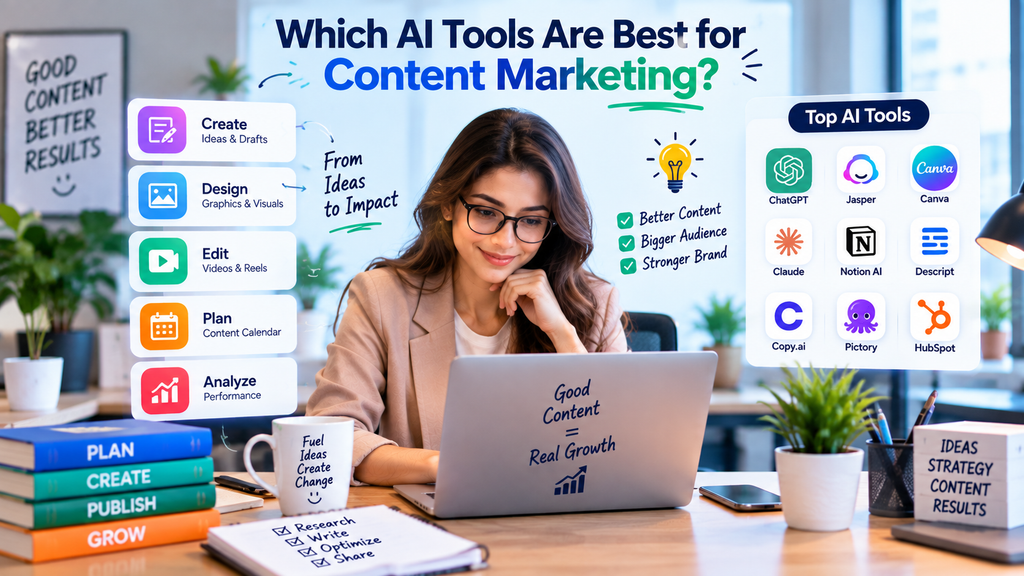
Some of the most useful AI tools for content marketing include ChatGPT, Claude, Google Gemini, Jasper, Semrush, Surfer SEO, Canva, Frase, HubSpot, and Buffer. Each tool serves a different purpose. ChatGPT, Claude, and Gemini are useful for research and writing. Jasper focuses on marketing copy. Semrush and Surfer SEO support SEO and optimization. Canva helps create visual content.
HubSpot supports marketing automation, while Buffer can simplify social media distribution. The best content marketing strategy does not depend on one AI tool. It combines research, content creation, optimization, design, distribution, and human expertise. This guide explains the best AI tools for content marketing in 2026, what each platform is best for, how to build an effective AI content workflow, and how to use AI without sacrificing quality.
AI social media marketing tools help businesses create engaging content, manage campaigns, understand audiences, and improve social media performance. These tools can generate captions, suggest content ideas, analyze trends, schedule posts, and provide useful insights for better marketing decisions. By automating repetitive tasks, AI can save time while helping brands maintain a consistent online presence. When combined with SEO, AEO, and GEO, AI social media marketing tools can improve content relevance, user engagement, search visibility, and reach across AI-powered platforms.
Which AI Tools Are Best for Content Marketing?
The best AI tools for content marketing depend on the type of work you need to complete.
| AI Tool | Best For |
|---|---|
| ChatGPT | Content ideas, research, outlines and writing |
| Claude | Long-form content and document analysis |
| Google Gemini | Research, brainstorming and topic exploration |
| Jasper | Marketing copy and brand-focused content |
| Semrush | SEO research and content strategy |
| Surfer SEO | SEO content optimization |
| Frase | Content briefs and SERP research |
| Canva | Graphics, carousels, infographics and videos |
| HubSpot | Content marketing automation and CRM workflows |
| Buffer | Social media content distribution |
For most marketers, the strongest approach is to combine several specialized tools rather than trying to make one platform do everything.
What Is AI Content Marketing?
AI content marketing is the use of artificial intelligence to support the planning, creation, optimization, distribution, and analysis of marketing content.
AI can help marketers complete repetitive or time-consuming tasks while keeping humans responsible for strategy and quality.
What Can AI Do for Content Marketing?
AI can assist with:
- Topic research
- Audience research
- Content ideation
- Keyword research
- Search-intent analysis
- Content briefs
- Article outlines
- Blog writing
- Editing
- Email copy
- Social media captions
- Video scripts
- Content repurposing
- SEO optimization
- Visual content
- Content calendars
- Performance summaries
Can AI Create an Entire Content Marketing Strategy?
AI can help build and organize a strategy, but it should not make important business decisions without human input.
A strong strategy still requires understanding:
- Business goals
- Target audience
- Customer problems
- Brand positioning
- Products and services
- Competitors
- Market conditions
- Conversion goals
Best Way to Use AI for Content Marketing
Use AI to increase speed and productivity.
Keep humans responsible for:
- Strategy
- Original insights
- Brand voice
- Fact-checking
- Quality control
- Editorial judgment
- Final publication
Why Are AI Tools Important for Content Marketing in 2026?
Content marketing has become more complex.
A single article may need to support organic search, social media, email marketing, AI search visibility, lead generation, and customer education.
AI helps marketers turn one core idea into multiple useful content formats.
How AI Improves the Content Marketing Process
A traditional workflow may look like:
Research → Writing → Editing → Design → Publishing → Promotion
AI can accelerate nearly every step.
A more modern workflow can be:
Topic Research → Keyword Validation → Content Brief → AI-Assisted Draft → Human Editing → SEO Optimization → Visual Creation → Repurposing → Distribution → Performance Analysis
Which Content Tasks Benefit Most From AI?
AI is especially useful for:
- Brainstorming
- First drafts
- Content restructuring
- Summarization
- Content expansion
- Headline variations
- Social repurposing
- FAQ creation
- Email adaptations
- Metadata
- Content calendars
Where Should Humans Add the Most Value?
Human expertise matters most when adding:
- First-hand experience
- Original research
- Expert opinion
- Customer insight
- Case studies
- Unique examples
- Brand personality
- Editorial judgment
1. ChatGPT – Best Overall AI Tool for Content Marketing
ChatGPT is one of the most flexible tools for content marketers.
It can assist with research, content planning, writing, editing, repurposing, and campaign development.
What Can ChatGPT Do for Content Marketing?
Content marketers can use ChatGPT for:
- Blog ideas
- Content briefs
- Article outlines
- Search-intent analysis
- Headline ideas
- Blog drafts
- FAQs
- Social captions
- Email copy
- Video scripts
- Content repurposing
- Landing-page copy
- Content calendars
Why Is ChatGPT Useful for Content Teams?
Its biggest advantage is flexibility.
You can provide information about:
- Your audience
- Brand voice
- Product
- Target keyword
- Search intent
- Platform
- Campaign goal
Then ask ChatGPT to adapt content accordingly.
Best ChatGPT Content Workflow
A practical workflow is:
Research → Brief → Outline → Draft → Human Editing → SEO Optimization → Repurposing → Publication
This makes ChatGPT an assistant throughout the content lifecycle rather than only a writing tool.
2. Claude – Best for Long-Form Content
Claude is particularly useful for long documents, detailed articles, research synthesis, and editing.
What Can Claude Help With?
Claude can assist with:
- Long-form blog posts
- Guides
- Reports
- Content briefs
- Document analysis
- Editing
- Rewriting
- Research synthesis
- Content restructuring
Why Is Claude Good for Content Marketing?
Long-form content often requires maintaining context across many sections.
Claude can be useful when working with larger documents or detailed information.
Best Claude Use Case
Claude can be especially helpful when updating an existing pillar article.
It can review the article, identify missing sections, improve organization, simplify explanations, and suggest additional topics.
Human review should still verify all important claims.
3. Google Gemini – Best for Research and Topic Exploration
Gemini can support research, brainstorming, topic expansion, content planning, and information organization.
What Can Gemini Do for Content Marketers?
Gemini can help with:
- Topic discovery
- Content ideas
- Audience questions
- Research summaries
- Content planning
- Article structures
- Campaign brainstorming
- Topic expansion
When Should You Use Gemini?
Gemini is useful during the early stages of content creation when you need to explore a topic from several angles.
Example Gemini Workflow
Broad Topic → Audience Questions → Supporting Topics → Content Ideas → Keyword Validation → Content Plan
4. Jasper – Best for Marketing Copy and Brand Consistency
Jasper focuses heavily on marketing-oriented content workflows.
It can help teams produce copy across multiple channels.
What Can Jasper Create?
Jasper can support:
- Blog posts
- Ad copy
- Product descriptions
- Email copy
- Social posts
- Landing pages
- Campaign messaging
Who Is Jasper Best For?
Jasper can be useful for:
- Marketing teams
- Agencies
- Ecommerce brands
- Content teams
- Businesses producing large amounts of copy
Jasper vs General AI Assistants
General AI assistants are highly flexible.
Jasper may be more attractive to teams looking for workflows centered specifically on marketing content and brand consistency.
5. Semrush – Best for SEO-Driven Content Strategy
Content marketing and SEO often work together.
Semrush helps marketers identify topics, keywords, competitors, and organic search opportunities.
What Can Semrush Help With?
Semrush can support:
- Keyword research
- Topic research
- Competitor analysis
- Content gaps
- Search intent
- SERP research
- Content planning
- Rank tracking
Why Is Semrush Important for Content Marketing?
AI writing tools can generate ideas.
Semrush helps validate whether those ideas have search demand and competitive relevance.
Best Semrush Content Workflow
Keyword Research → Competitor Analysis → Content Gap → Topic Selection → Brief → Content Creation → Tracking
6. Surfer SEO – Best for SEO Content Optimization
Surfer SEO focuses on improving on-page content.
It can help marketers understand whether an article covers topics related to current search results.
What Can Surfer SEO Help With?
It can assist with:
- Content optimization
- Topic coverage
- Content briefs
- Article structure
- On-page SEO
- Existing-content updates
When Should You Use Surfer SEO?
Use it after understanding the search intent and creating a useful draft.
Do Not Optimize Only for a Score
A higher optimization score does not guarantee rankings.
Always prioritize:
- Accuracy
- Usefulness
- Readability
- Originality
- User experience
7. Frase – Best for Content Briefs and SERP Research
Frase can be useful during content planning and optimization.
What Can Frase Do?
Frase can help with:
- SERP research
- Content briefs
- Article outlines
- Topic research
- Content optimization
- FAQ discovery
Why Are Content Briefs Important?
A strong brief gives writers clear direction.
It can include:
- Primary topic
- Search intent
- Supporting questions
- Recommended structure
- Competitor observations
- Important concepts
Frase vs Surfer SEO
Both can support SEO content workflows.
Frase may appeal to teams focused heavily on briefs and research, while Surfer SEO is commonly used for optimization.
8. Canva – Best for Visual Content Marketing
Content marketing is not only written content.
Visual assets play an important role in social media, blog promotion, email campaigns, presentations, and brand storytelling.
What Can Content Marketers Create With Canva?
Canva can be used for:
- Blog graphics
- Infographics
- Social media posts
- Carousels
- YouTube thumbnails
- Presentations
- Short videos
- Lead magnets
- Marketing banners
Why Is Canva Useful for Content Teams?
It allows non-designers to create professional-looking assets quickly.
Best Canva Content Workflow
Content Idea → Key Message → Visual Format → Design → Brand Review → Resize → Publish
9. HubSpot – Best for Content Marketing Automation
HubSpot combines CRM, marketing, content, sales, and automation tools.
What Can HubSpot Help With?
Depending on the product and plan, HubSpot can support:
- Email marketing
- Lead nurturing
- CRM workflows
- Content management
- Campaign tracking
- Marketing automation
- Customer segmentation
- Reporting
Why Is Automation Important?
Content marketing often involves repeated follow-up.
For example:
Blog Visitor → Lead Magnet → Email Sequence → Product Education → Sales Follow-Up
Who Should Consider HubSpot?
HubSpot can be useful for:
- B2B companies
- Growing businesses
- Agencies
- Lead-generation businesses
- Marketing and sales teams
10. Buffer – Best for Content Distribution on Social Media
Creating content is only half the work.
Marketers also need to distribute it.
Buffer can help plan, organize, schedule, and publish social media content.
What Can Buffer Help With?
Buffer can support:
- Social scheduling
- Content planning
- Publishing
- Caption workflows
- Multi-platform distribution
- Content organization
Why Is Distribution Important?
Even excellent content can underperform if nobody sees it.
Example Content Distribution Workflow
Blog Post → LinkedIn Post → Instagram Carousel → Short Video → Facebook Post → Email Newsletter
AI makes this repurposing process much faster.
Best AI Tools for Different Content Marketing Tasks
| Content Marketing Task | Recommended Tools |
|---|---|
| Content Ideas | ChatGPT, Gemini |
| Long-Form Writing | Claude, ChatGPT |
| Marketing Copy | Jasper, ChatGPT |
| Keyword Research | Semrush, Ahrefs |
| Content Optimization | Surfer SEO, Frase |
| Content Briefs | Frase, ChatGPT |
| Visual Content | Canva |
| Social Distribution | Buffer |
| Marketing Automation | HubSpot |
| Content Repurposing | ChatGPT, Claude |
| Research | Gemini, Claude, ChatGPT |
| SEO Strategy | Semrush |
Best AI Tools for Blog Content
Blogging remains an important part of content marketing.
Recommended AI Blogging Stack
Use:
Semrush for keyword research.
ChatGPT or Claude for content planning and drafting.
Frase or Surfer SEO for optimization.
Canva for blog graphics.
Buffer for social promotion.
What Makes an AI Blog Post Good?
A strong blog article should:
- Match search intent
- Answer the main question quickly
- Use clear headings
- Include useful examples
- Be factually accurate
- Avoid unnecessary repetition
- Add original value
- Link to relevant resources
Avoid Generic AI Content
AI-assisted articles should not simply repeat information already available everywhere.
Add unique value through:
- Experience
- Data
- Screenshots
- Examples
- Case studies
- Expert insights
- Original comparisons
Best AI Tools for Social Media Content Marketing
Social media requires frequent content production.
AI can make the process more efficient.
Recommended Social Content Stack
ChatGPT or Claude for captions and scripts.
Canva for visual content.
Buffer for scheduling and distribution.
What Can AI Create for Social Media?
AI can help create:
- Captions
- Hooks
- Carousel copy
- Video scripts
- Post ideas
- CTAs
- Poll questions
- Content calendars
Adapt Content to Each Platform
Do not post exactly the same content everywhere.
Different platforms have different user behavior and content formats.
Best AI Tools for Email Content Marketing
Email marketing remains valuable for nurturing audiences and generating conversions.
How Can AI Help With Email Marketing?
AI can assist with:
- Subject lines
- Email drafts
- Promotional copy
- Follow-up sequences
- Newsletter ideas
- Audience segmentation ideas
- Personalization concepts
Useful Tools
ChatGPT and Claude can help with writing.
HubSpot can support automation and CRM workflows.
Do Not Over-Automate Personal Communication
Important customer communication should still sound natural and relevant.
Best AI Tools for Video Content Marketing
Video has become a major part of modern content strategy.
How AI Helps With Video Marketing
AI can help with:
- Script ideas
- Hooks
- Storyboards
- Titles
- Descriptions
- Captions
- Repurposing
- Short-form concepts
Recommended Workflow
Topic → Script → Visual Plan → Production → Editing → Thumbnail → Distribution
Reuse Long-Form Content
A blog post can become several short video topics.
This reduces the amount of original research required for every format.
How to Repurpose Content With AI
Content repurposing helps marketers get more value from their work.
Example
Start with one detailed blog post.
Turn it into:
- LinkedIn posts
- Instagram carousels
- Email newsletters
- Video scripts
- Short-form clips
- X posts
- Facebook posts
- Infographics
Why Repurposing Works
The original research has already been completed.
Keep Each Version Unique
Adapt tone, length, hook, and format for the target platform.
AI Content Marketing for SEO
SEO and content marketing should work together.
How Can AI Support SEO Content?
AI can help with:
- Keyword ideas
- Search intent
- Topic clusters
- Content briefs
- Article outlines
- FAQs
- Internal-link ideas
- Content refreshes
Use Real SEO Data
Do not depend only on AI-generated keyword suggestions.
Use SEO platforms to validate important opportunities.
Recommended SEO Content Workflow
Keyword Research → Search Intent → Competitor Research → Content Brief → Draft → Optimization → Review → Publication
AI Content Marketing for AEO
Answer Engine Optimization focuses on giving clear answers to user questions.
How Should Content Be Structured for AEO?
Use:
Question → Direct Answer → Explanation → Example → Supporting Detail
Why FAQs Matter
FAQ sections can help address specific user questions clearly.
Avoid Artificial FAQ Stuffing
Only include questions that are genuinely relevant to the topic.
AI Content Marketing for GEO
Generative Engine Optimization focuses on making content useful and understandable in AI-generated search environments.
What Makes Content Useful for GEO?
Strong GEO-friendly content often includes:
- Clear definitions
- Accurate facts
- Useful comparisons
- Original information
- Expert insights
- Logical structure
- Relevant entities
- Reliable sourcing
Can AI Guarantee Citations in Generative Search?
No.
No tool can guarantee that your page will appear in an AI-generated answer.
Create Citation-Worthy Content
Focus on producing information that is worth referencing.
Original research, experiments, statistics, comparisons, and first-hand expertise can help make content more distinctive.
How to Build an AI Content Marketing Workflow
A structured workflow improves consistency.
Step 1: Research Your Audience
Understand:
- Problems
- Goals
- Questions
- Buying stage
- Preferred platforms
Step 2: Find Content Opportunities
Use keyword research, competitor analysis, customer questions, and AI brainstorming.
Step 3: Create a Content Brief
Define:
- Topic
- Audience
- Search intent
- Goal
- Structure
- CTA
Step 4: Create the First Draft
Use a human writer, AI assistant, or a combination.
Step 5: Add Original Value
Add examples, data, expertise, and brand perspective.
Step 6: Optimize
Improve:
- SEO
- Readability
- Structure
- Internal links
- Visual elements
Step 7: Repurpose
Turn the content into multiple formats.
Step 8: Distribute
Publish across relevant channels.
Step 9: Measure Results
Track:
- Traffic
- Engagement
- Leads
- Rankings
- Conversions
- Revenue
Example Full Workflow
Research → Strategy → Brief → Creation → Editing → SEO → Design → Repurposing → Distribution → Measurement
AI Should Support the Workflow
Do not allow the workflow to become AI-dependent.
Marketing goals should determine how AI is used.
Best AI Content Marketing Stack for Beginners
Beginners do not need every tool.
Simple Starter Stack
ChatGPT or Gemini for research and content assistance.
Canva for visual design.
Google Search Console for organic search performance.
A social scheduling tool when needed.
When Should You Add Paid SEO Tools?
Consider Semrush, Ahrefs, Surfer SEO, or Frase when you need deeper keyword data, competitor analysis, or content optimization.
Start Small
Master a few tools before adding more subscriptions.
Best AI Content Marketing Stack for Small Businesses
Small businesses need tools that save time without creating unnecessary complexity.
Recommended Stack
AI Assistant: ChatGPT or Claude
SEO: Semrush or Ahrefs when needed
Design: Canva
Social Media: Buffer
CRM and Automation: HubSpot
Why This Combination Works
It covers:
- Research
- Writing
- SEO
- Design
- Distribution
- Lead management
Avoid Buying Tools Without a Clear Purpose
Every subscription should solve a real marketing problem.
Free vs Paid AI Content Marketing Tools
Both free and paid platforms can be valuable.
Free Tools Are Good for Testing
Free or limited plans can help beginners test workflows.
Paid Tools Are Better for Scale
Paid plans may provide:
- Higher usage limits
- Team collaboration
- Better data
- Advanced automation
- More integrations
- Brand management
- Reporting
How to Decide
Ask whether the tool:
- Saves time
- Improves quality
- Supports revenue
- Replaces manual work
- Replaces another subscription
Measure Value, Not Features
The tool with the longest feature list is not automatically the best choice.
Common Mistakes When Using AI for Content Marketing
AI can improve productivity, but poor implementation can reduce content quality.
Publishing Raw AI Content
Always review important content.
Creating Content Without Audience Research
AI cannot compensate for a weak understanding of customers.
Chasing Quantity
Publishing more content does not guarantee better results.
Ignoring Search Intent
SEO content should answer what users are actually looking for.
Losing Brand Voice
AI-generated content should sound consistent with your brand.
Overusing Automation
Automation should improve customer experience, not make communication feel robotic.
Ignoring Performance Data
Content marketing should be measured.
Frequently Asked Questions About AI Content Marketing
Which AI Tool Is Best for Content Marketing?
There is no single best tool for every content marketing task. ChatGPT and Claude are strong for writing and analysis, Gemini is useful for research, Jasper focuses on marketing copy, Semrush supports SEO strategy, Canva handles visual content, and HubSpot supports automation.
What Is the Best AI Tool for Writing Content?
ChatGPT and Claude are both useful for long-form and short-form writing.
The better option depends on your workflow, tone, context needs, and personal preference.
What Is the Best AI Tool for Content Ideas?
ChatGPT and Gemini are useful for brainstorming topics, audience questions, content angles, and campaign ideas.
What Is the Best AI Tool for SEO Content?
A combination often works best.
Use Semrush for research, ChatGPT or Claude for writing, and Surfer SEO or Frase for optimization.
What Is the Best AI Tool for Social Media Content?
ChatGPT or Claude can generate ideas and captions, Canva can create visual assets, and Buffer can help schedule content.
Can AI Replace Content Writers?
AI can automate parts of writing, but skilled writers still provide original thinking, expertise, storytelling, judgment, and editorial quality.
Is AI Content Good for SEO?
AI-assisted content can be useful when it is accurate, helpful, original, relevant, and properly reviewed.
Low-quality content remains low quality regardless of how it was created.
Can AI Create a Content Calendar?
Yes.
AI can help create monthly, weekly, or campaign-based calendars based on your audience, products, topics, and channels.
Can AI Repurpose Content Automatically?
AI can make repurposing much faster, but each output should be reviewed and adapted to the target platform.
Will AI Replace Content Marketing?
No.
AI is changing how content marketing is performed, but strategy, creativity, customer understanding, brand positioning, and quality control remain important human responsibilities.
Final Verdict: Which AI Tools Are Best for Content Marketing?
The best AI tools for content marketing depend on what part of the workflow you want to improve.
ChatGPT is a strong choice when you need a flexible, all-purpose content assistant.
Long-form writing and document analysis are areas where Claude can be particularly useful.
Gemini can support topic exploration, research, and the discovery of new content angles.
Brand-focused marketing copy can be developed with Jasper, making it worth considering for professional marketing teams.
Semrush provides useful data and capabilities for SEO research and strategy.
Content optimization becomes easier with tools such as Surfer SEO and Frase.
Canva is one of the most practical options for creating graphics and other visual content.
Social distribution can be simplified with Buffer, particularly when planning and publishing content consistently.
HubSpot can connect content with broader customer workflows through marketing automation and lead management.
The strongest content marketing strategy in 2026 is not about replacing people with AI.
Instead, AI should reduce repetitive work so marketers can dedicate more time to strategy, creativity, customer understanding, and original ideas.
Start with AI to accelerate time-consuming tasks.
Let reliable data guide important marketing decisions.
Finally, apply human expertise to maintain quality, originality, and strategic value.
That combination creates a more sustainable content marketing strategy.
Related AI Marketing Guides
What Are the Best AI Tools for Digital Marketing in 2026?
Discover useful AI tools for SEO, content, social media, design, automation, research, and digital marketing workflows.
Which AI Tools Are Best for SEO in 2026?
Learn which AI tools can support keyword research, technical SEO, content optimization, competitor analysis, and organic visibility.
What Are the Best AI Tools for Keyword Research?
Compare AI and SEO tools for discovering keywords, understanding search intent, analyzing competitors, and building content clusters.
What Are the Best AI Tools for Writing SEO Blog Posts?
Explore AI tools for blog research, outlining, writing, editing, fact-checking, and SEO optimization.
Which AI Tools Can Help Improve Google Rankings?
Discover tools that can support keyword research, technical SEO, content quality, backlinks, and competitor analysis.
What Are the Best AI Tools for Social Media Marketing?
Compare AI platforms for social strategy, captions, scheduling, visual content, videos, and campaign management.
Which AI Tools Are Best for Creating Social Media Content?
Discover tools for creating social graphics, captions, scripts, carousels, images, and short-form content.
What Are the Best AI Tools for SEO Content Optimization?
Compare tools for improving search intent, topical coverage, content structure, readability, and on-page SEO.
Which AI Tools Are Best for Competitor Analysis?
Learn how AI and marketing platforms can help analyze competitor keywords, content, backlinks, rankings, and market opportunities.