
Improve Google Rankings by Ai
Improving Google rankings in 2026 requires more than adding keywords to a page. Search visibility depends on many factors, including search intent, content quality, technical SEO, backlinks, topical authority, internal linking, website performance, competition, and overall user experience. Artificial intelligence can help marketers and SEO professionals improve many of these areas faster. So, which AI tools can help improve Google rankings?
Some of the most useful tools include Semrush, Ahrefs, Surfer SEO, ChatGPT, Claude, Google Gemini, Screaming Frog, Frase, Google Search Console, and PageSpeed Insights. These tools cannot guarantee higher rankings. However, they can help identify SEO opportunities, improve content, discover technical issues, research competitors, optimize pages, and create better workflows. This guide explains which AI and SEO tools can support higher Google rankings, what each tool is best for, and how to combine them into a practical SEO strategy.
Finding the best AI code can help developers build, test, and improve software more efficiently. AI coding tools can generate code, explain complex programming concepts, identify errors, and suggest improvements across popular programming languages. Whether you are creating websites, mobile apps, or business software, the right AI code solution can save time and improve productivity. For SEO, AEO, and GEO, clear and helpful coding content can also answer user questions and improve visibility across search engines and AI-powered platforms.
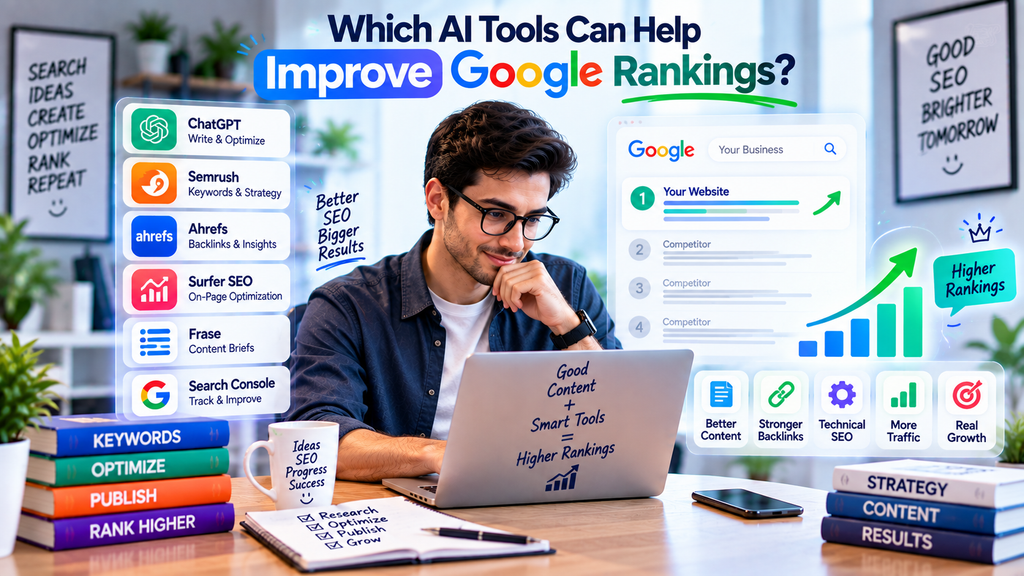
Which AI Tools Can Help Improve Google Rankings?
The best tools depend on the SEO problem you need to solve.
| Tool | Best For |
|---|---|
| Semrush | Keyword research, competitors and SEO strategy |
| Ahrefs | Backlinks, keywords and content gaps |
| Surfer SEO | Content optimization |
| ChatGPT | SEO planning, writing and analysis |
| Claude | Long-form content and content audits |
| Google Gemini | Research and topic exploration |
| Screaming Frog | Technical SEO audits |
| Frase | Content briefs and optimization |
| Google Search Console | Search performance and indexing insights |
| PageSpeed Insights | Page performance and Core Web Vitals |
The best approach is to use these tools together rather than expecting one AI platform to improve rankings on its own.
Can AI Tools Really Improve Google Rankings?
AI tools can support SEO work that may contribute to better rankings, but they do not directly control Google rankings.
How Can AI Help With SEO?
AI can help with:
- Keyword research
- Search-intent analysis
- Content planning
- Competitor research
- SEO writing
- Content optimization
- Internal linking
- Technical SEO analysis
- Backlink research
- Content refreshes
- Reporting
- SERP analysis
Can Any AI Tool Guarantee First-Page Rankings?
No.
No legitimate SEO or AI tool can guarantee a number-one position.
What Actually Matters?
Rankings depend on many factors, including:
- Relevance
- Content usefulness
- Search intent
- Website quality
- Backlinks
- Technical accessibility
- Competition
- User experience
- Freshness where relevant
- Search-system changes
Why Use AI Tools to Improve Google Rankings?
SEO requires a large amount of research and analysis.
AI can reduce the time required for many repetitive tasks.
Traditional SEO Workflow
Keyword Research → Competitor Analysis → Content Creation → Optimization → Technical Audit → Link Building → Monitoring
AI-Assisted SEO Workflow
SEO Data → AI Analysis → Content Strategy → Optimized Content → Technical Fixes → Internal Links → Performance Tracking
Why This Matters
AI can help marketers move from raw data to actionable decisions faster.
Human Review Is Still Essential
AI should assist SEO professionals, not replace judgment.
1. Semrush – Best Overall Tool for Improving SEO Visibility
Semrush is one of the most comprehensive SEO platforms for researching and improving organic search performance.
What Can Semrush Help With?
Semrush can support:
- Keyword research
- Competitor analysis
- Keyword gaps
- Rank tracking
- Site audits
- Backlink research
- On-page SEO
- Search intent
- Content research
How Can Semrush Help Improve Rankings?
Semrush helps identify opportunities and weaknesses.
For example, it can reveal:
- Keywords competitors rank for
- Pages losing visibility
- Missing keyword opportunities
- Technical SEO issues
- Potential backlink gaps
Best Semrush Workflow
Competitor Research → Keyword Gap → Content Opportunity → Optimization → Tracking
2. Ahrefs – Best for Backlinks and Content Gaps
Ahrefs is highly useful for identifying link opportunities and organic search gaps.
What Can Ahrefs Help With?
Ahrefs can support:
- Backlink analysis
- Keyword research
- Competitor research
- Content-gap analysis
- SERP analysis
- Top-page research
- Site auditing
How Do Backlinks Affect Rankings?
Links can help search engines understand relationships and authority across websites.
Quality matters more than simply increasing the number of links.
Best Ahrefs Use Case
Use Ahrefs to find:
- Competitor backlinks
- Broken-link opportunities
- High-performing pages
- Keyword gaps
- Linkable content ideas
3. Surfer SEO – Best for On-Page Content Optimization
Surfer SEO focuses on improving content based on current search results.
What Can Surfer SEO Help Improve?
It can support:
- Topic coverage
- Content structure
- Relevant terms
- Content briefs
- Existing article updates
- On-page optimization
Can Surfer SEO Improve Rankings?
It can help improve page relevance and topical coverage, but it cannot guarantee ranking changes.
Do Not Optimize Only for a Score
Always prioritize:
- Accuracy
- Readability
- Search intent
- Originality
- User value
4. ChatGPT – Best AI Assistant for SEO Strategy and Content
ChatGPT can support many parts of SEO.
What Can ChatGPT Do?
It can assist with:
- Keyword brainstorming
- Search-intent analysis
- Topic clusters
- Content outlines
- Blog drafts
- FAQs
- Meta descriptions
- Internal-link ideas
- Schema drafts
- Content audits
- Competitor-analysis frameworks
How Can ChatGPT Help Improve Rankings?
It can make planning and content production more efficient.
Important Limitation
Do not treat AI-generated search volume or rankings as reliable unless verified with SEO data.
5. Claude – Best for Content Audits and Long-Form SEO
Claude is useful for reviewing large amounts of written content.
What Can Claude Help With?
Claude can assist with:
- Long-form content
- Content audits
- Gap identification
- Content restructuring
- Editing
- Research synthesis
- Existing article updates
Best Claude Use Case
Provide a long article and ask Claude to identify:
- Repetition
- Missing sections
- Weak explanations
- Search-intent gaps
- Outdated areas
Then Add Human Review
Always verify important recommendations before updating the page.
6. Google Gemini – Best for Topic Research and Exploration
Gemini can help marketers explore topics and organize research.
What Can Gemini Help With?
It can support:
- Topic discovery
- Audience questions
- Content planning
- Research summaries
- Supporting subtopics
- Content structures
How Can This Support Rankings?
Better topic research can help create more complete pages.
Use Data to Validate Opportunities
Topic ideas should still be checked against SEO data and real search results.
7. Screaming Frog – Best for Technical SEO Audits
Technical issues can prevent otherwise strong pages from performing well.
What Can Screaming Frog Find?
It can help identify:
- Broken links
- Redirect chains
- Missing titles
- Duplicate metadata
- Canonical issues
- Indexability problems
- Internal-link issues
- Status-code errors
- Structured-data problems
Why Is Technical SEO Important?
Search engines need to access and understand your pages.
Best Workflow
Crawl → Identify Issues → Prioritize → Fix → Crawl Again
8. Frase – Best for Content Briefs and SEO Research
Frase can help create structured content based on SERP research.
What Can Frase Help With?
Frase can assist with:
- Content briefs
- SERP research
- Topic coverage
- Article outlines
- FAQs
- Optimization
Why Are Content Briefs Useful?
A strong brief helps writers stay focused on search intent.
Combine Briefs With Original Value
Do not simply recreate competitor pages.
Add something useful and unique.
9. Google Search Console – Best for Finding Real Ranking Opportunities
Google Search Console is one of the most important SEO tools because it provides data directly from your website’s search performance.
What Can Search Console Show?
It can help you analyze:
- Search queries
- Clicks
- Impressions
- Average position
- Indexing
- Coverage
- Page performance
- Search visibility
How Can It Help Improve Rankings?
One useful strategy is to find pages already ranking near the first page.
Example
If a page ranks around positions 8 to 20, improve:
- Content quality
- Search intent
- Internal links
- Title
- Supporting sections
- Freshness
These pages may already have ranking potential.
10. PageSpeed Insights – Best for Performance Optimization
Page performance can affect user experience and technical SEO.
What Can PageSpeed Insights Help With?
It can provide information about:
- Loading performance
- Core Web Vitals
- Mobile usability
- Performance opportunities
- Technical improvements
Does Faster Always Mean Higher Rankings?
Speed alone does not guarantee rankings.
Why It Still Matters
A slow or unstable website can create a poor user experience.
Best AI Tools for Different Ranking Factors
| Ranking Area | Recommended Tools |
|---|---|
| Keyword Research | Semrush, Ahrefs |
| Search Intent | Semrush, ChatGPT |
| Content Writing | ChatGPT, Claude |
| Content Optimization | Surfer SEO, Frase |
| Backlink Research | Ahrefs, Semrush |
| Technical SEO | Screaming Frog |
| Performance | PageSpeed Insights |
| Ranking Data | Google Search Console |
| Competitor Analysis | Semrush, Ahrefs |
| Content Audits | Claude, Surfer SEO |
| Internal Linking | ChatGPT, Screaming Frog |
| Topic Research | Gemini, ChatGPT |
How to Improve Google Rankings With AI Step by Step
A strong SEO process combines research, content, technical work, and measurement.
Step 1: Identify Ranking Opportunities
Use Search Console, Semrush, or Ahrefs.
Look For
- Pages ranking positions 8 to 20
- Declining pages
- Low-CTR pages
- Missing keyword opportunities
- Competitor gaps
Prioritize Realistic Opportunities
Do not start only with extremely competitive keywords.
Step 2: Understand Search Intent
Look at the current search results.
Ask
- Is the user looking for information?
- A product?
- A comparison?
- A tutorial?
- A local business?
Match the Correct Content Format
A mismatch in intent can limit rankings.
AI Can Help Classify Intent
Use ChatGPT or Claude to organize keyword groups, then verify with actual SERPs.
Step 3: Improve Content Quality
AI can help identify weaknesses.
Review
- Missing sections
- Outdated information
- Weak examples
- Poor structure
- Repetition
- Generic explanations
Add Original Value
Include:
- Experience
- Examples
- Data
- Screenshots
- Comparisons
- Case studies
- Expert insight
Better Content Is Not Always Longer Content
Add useful information, not filler.
Step 4: Improve On-Page SEO
Review:
Titles and Headings
Make them clear and relevant.
Internal Links
Connect related pages.
Metadata
Improve titles and descriptions.
Topic Coverage
Answer important related questions.
Use Optimization Tools Carefully
Surfer SEO and Frase can help identify gaps.
Do Not Keyword Stuff
Natural writing is more useful.
Step 5: Fix Technical SEO Problems
Run a crawl using Screaming Frog or another technical SEO tool.
Check
- Broken links
- Redirects
- Indexability
- Canonicals
- Duplicate content
- Metadata
- Internal links
Fix High-Impact Issues First
Not every technical issue has the same importance.
Re-Crawl After Changes
Verify that fixes worked.
Step 6: Improve Internal Linking
Internal links help users and search engines discover related pages.
AI Can Help Find Internal-Link Opportunities
Provide a list of URLs and topics to an AI assistant.
Good Internal Links Should Be
- Relevant
- Natural
- Useful
- Contextual
Example
A blog about AI tools for SEO can link to:
- AI keyword research tools
- SEO content optimization tools
- Competitor analysis tools
Step 7: Build Better Backlinks
Backlinks can contribute to authority.
Useful Link-Building Strategies
- Original research
- Data studies
- Expert guides
- Digital PR
- Broken-link building
- Resource pages
- Partnerships
Use Ahrefs or Semrush
Find relevant competitor links and opportunities.
Avoid Low-Quality Link Schemes
Focus on earning useful, relevant links.
Step 8: Improve Page Experience
Check website usability.
Review
- Mobile design
- Loading speed
- Navigation
- Layout stability
- Readability
Use PageSpeed Insights
Identify performance issues.
Think About Users First
Technical metrics should support a better experience.
Step 9: Monitor Performance
SEO improvements need time and measurement.
Track
- Rankings
- Impressions
- Clicks
- CTR
- Organic traffic
- Conversions
Use Search Console
Compare before and after changes.
Do Not Judge SEO From One Metric
Traffic without conversions may not support business goals.
How AI Can Help With Keyword Research
Keyword research is one of the first places AI can improve efficiency.
AI Can Help Generate
- Long-tail keywords
- Related questions
- Topic clusters
- Search-intent categories
- Content ideas
Validate With SEO Data
Use Semrush or Ahrefs.
Best Workflow
AI Ideas → SEO Validation → SERP Review → Content Plan
How AI Can Help With SEO Content Optimization
Existing pages often have more ranking potential than new pages.
AI Can Help
- Identify content gaps
- Improve headings
- Simplify explanations
- Add FAQs
- Remove repetition
- Refresh outdated information
Combine With Search Console
Look for pages with strong impressions but weaker rankings or CTR.
Update Strategically
Do not change a page only because it is old.
How AI Can Help With Technical SEO
Technical SEO produces a lot of data.
AI Can Help Analyze
- Crawl exports
- Error lists
- Redirect reports
- Metadata issues
- Internal-link data
Example
Export a Screaming Frog crawl.
Ask an AI assistant to categorize issues by:
- Critical
- High
- Medium
- Low
Human Validation Is Important
Technical changes can affect the whole website.
How AI Can Help With Competitor Analysis
Competitor research can reveal opportunities.
Use Semrush or Ahrefs to Find
- Competitor keywords
- Top pages
- Backlinks
- Content gaps
Use AI to Organize Results
ChatGPT or Claude can help classify data.
Do Not Copy Competitors
Use competitor insights to build a better strategy.
How AI Can Help With AEO
AEO focuses on answering user questions clearly.
Create Direct Answers
Use:
Question → Direct Answer → Explanation → Example
Add Relevant FAQs
Answer common questions.
Keep Answers Natural
Do not create unnecessary FAQs only for SEO.
How AI Can Help With GEO
GEO focuses on creating content that works well in generative search environments.
Improve GEO With
- Clear factual statements
- Reliable sourcing
- Original data
- Strong topical coverage
- Useful comparisons
- Expert insight
Why Original Information Matters
Generic information is easy to reproduce.
Create Citation-Worthy Content
Unique data and clear expert information can make a page more useful.
Best AI SEO Stack for Improving Rankings
A practical stack might include:
Keyword Research
Semrush or Ahrefs
AI Assistant
ChatGPT, Claude, or Gemini
Content Optimization
Surfer SEO or Frase
Technical SEO
Screaming Frog
Performance Tracking
Google Search Console
Speed Testing
PageSpeed Insights
Complete Workflow
Research → Prioritize → Create → Optimize → Audit → Link → Monitor → Improve
You Do Not Need Every Tool
Choose tools based on your website, budget, and SEO goals.
Best AI Tools for Small Websites
Small websites should focus on essentials.
Suggested Stack
ChatGPT or Gemini for research and writing.
Google Search Console for performance.
A keyword tool when deeper data is needed.
Add Advanced Tools Later
Use Semrush, Ahrefs, Surfer SEO, or Screaming Frog when complexity grows.
Avoid Too Many Subscriptions
Only pay for tools that create measurable value.
Best AI Tools for SEO Agencies
Agencies often need more advanced data and scale.
Useful Agency Stack
Semrush or Ahrefs
ChatGPT or Claude
Surfer SEO or Frase
Screaming Frog
Google Search Console
Why Agencies Need Multiple Tools
Agencies manage:
- Multiple websites
- Large keyword sets
- Technical audits
- Reporting
- Competitor research
Build Repeatable Workflows
Consistency improves efficiency.
Free vs Paid Tools for Improving Google Rankings
Free tools can be very powerful.
Useful Free Options
- Google Search Console
- PageSpeed Insights
- AI assistant free plans
- Google Keyword Planner
- Basic SEO extensions
Paid Platforms
Examples include:
- Semrush
- Ahrefs
- Surfer SEO
- Frase
- Premium AI assistants
When Should You Pay?
Pay when the tool:
- Saves time
- Improves decisions
- Provides data you cannot easily get elsewhere
- Supports client or business growth
ROI Matters More Than Tool Count
More tools do not automatically mean better SEO.
Common Mistakes When Using AI to Improve Google Rankings
AI can accelerate SEO, but it can also accelerate poor decisions.
Publishing Low-Quality AI Content
Quantity does not replace usefulness.
Trusting Fake Search Data
Validate keyword metrics.
Keyword Stuffing
Write naturally.
Ignoring Technical SEO
Content alone cannot fix every SEO issue.
Over-Optimizing for Scores
Optimization scores are not ranking guarantees.
Buying Low-Quality Backlinks
Poor link building can create risk.
Ignoring Search Intent
This is one of the most damaging mistakes.
Not Tracking Results
SEO should be measured.
Frequently Asked Questions About AI and Google Rankings
Which AI Tool Is Best for Improving Google Rankings?
There is no single best tool. Semrush and Ahrefs help with SEO research, Surfer SEO and Frase help optimize content, Screaming Frog supports technical SEO, and ChatGPT or Claude can improve content workflows.
Can ChatGPT Improve Google Rankings?
ChatGPT can help with SEO planning, content creation, internal linking, keyword clustering, and optimization ideas.
It cannot guarantee rankings.
Can AI Content Rank on Google?
AI-assisted content can perform well if it is useful, relevant, accurate, and properly reviewed.
What Is the Best AI Tool for On-Page SEO?
Surfer SEO and Frase are useful for content optimization.
What Is the Best AI Tool for Technical SEO?
Screaming Frog is a strong technical SEO crawler.
What Is the Best AI Tool for Backlinks?
Ahrefs and Semrush are useful for backlink research.
Can AI Fix Technical SEO?
AI can help identify and explain technical issues, but implementation should be reviewed carefully.
How Long Does It Take to Improve Google Rankings?
There is no fixed timeline.
Results depend on competition, website authority, content quality, technical issues, backlinks, and the scale of changes.
Can AI Guarantee Page-One Rankings?
No.
Any tool promising guaranteed rankings should be treated cautiously.
Is SEO Still Worth Doing in 2026?
Yes.
Users still search for products, information, services, comparisons, and answers across traditional and AI-powered search experiences.
Final Verdict: Which AI Tools Can Help Improve Google Rankings?
The best AI tools for improving Google rankings are the ones that solve specific SEO problems.
Semrush and Ahrefs are strong choices for keyword research, competitor analysis, and SEO strategy.
Content optimization becomes easier with Surfer SEO and Frase, especially when improving topical coverage and structure.
ChatGPT, Claude, and Gemini can increase productivity across SEO planning, writing, analysis, and content updates.
Technical SEO issues affecting crawling, indexing, and site structure can be identified with Screaming Frog.
Google Search Console remains essential for understanding real search-performance data.
PageSpeed Insights can reveal technical improvements that may enhance page perfor
The most important point is simple:
AI tools do not rank websites.
Useful content, strong SEO strategy, technical quality, authority, relevance, and good user experience support rankings.
AI simply helps you execute those activities faster and more efficiently.
Related AI SEO Guides
What Are the Best AI Tools for Digital Marketing in 2026?
Explore AI tools for SEO, content, social media, research, automation, advertising, and digital marketing workflows.
Which AI Tools Are Best for SEO in 2026?
Compare tools for keyword research, technical SEO, content optimization, backlinks, and competitor analysis.
What Are the Best AI Tools for Keyword Research?
Discover tools for finding keywords, search intent, content gaps, long-tail opportunities, and topic clusters.
Which AI Tools Are Best for Content Marketing?
Learn how AI can support research, writing, optimization, repurposing, design, and distribution.
What Are the Best AI Tools for Writing SEO Blog Posts?
Compare AI tools for content research, outlines, drafting, editing, and SEO optimization.
What Are the Best AI Tools for Social Media Marketing?
Discover AI tools for social strategy, content creation, scheduling, design, and campaign management.
Which AI Tools Are Best for Creating Social Media Content?
Explore tools for captions, graphics, videos, carousels, scripts, and social content production.
What Are the Best AI Tools for SEO Content Optimization?
Compare platforms that help improve search intent, topic coverage, structure, readability, and on-page SEO.
Which AI Tools Are Best for Competitor Analysis?
Learn which tools can reveal competitor keywords, backlinks, rankings, top pages, and content gaps.