
Best AI Tools, Features, Pricing & Comparisons
Finding the right AI software can be difficult. New AI tools are launched every week, while existing platforms continue to add new features, models, integrations, and pricing plans. Our AI tool reviews help you understand what different AI platforms actually offer, who they are best for, and whether they are worth using. Whether you are looking for AI tools for writing, SEO, digital marketing, productivity, design, coding, research, or content creation, this guide helps you compare your options before choosing a tool. The best AI tool depends on your specific goal, budget, workflow, and required features. Instead of choosing a tool simply because it is popular, compare its capabilities, ease of use, output quality, pricing, integrations, and limitations.
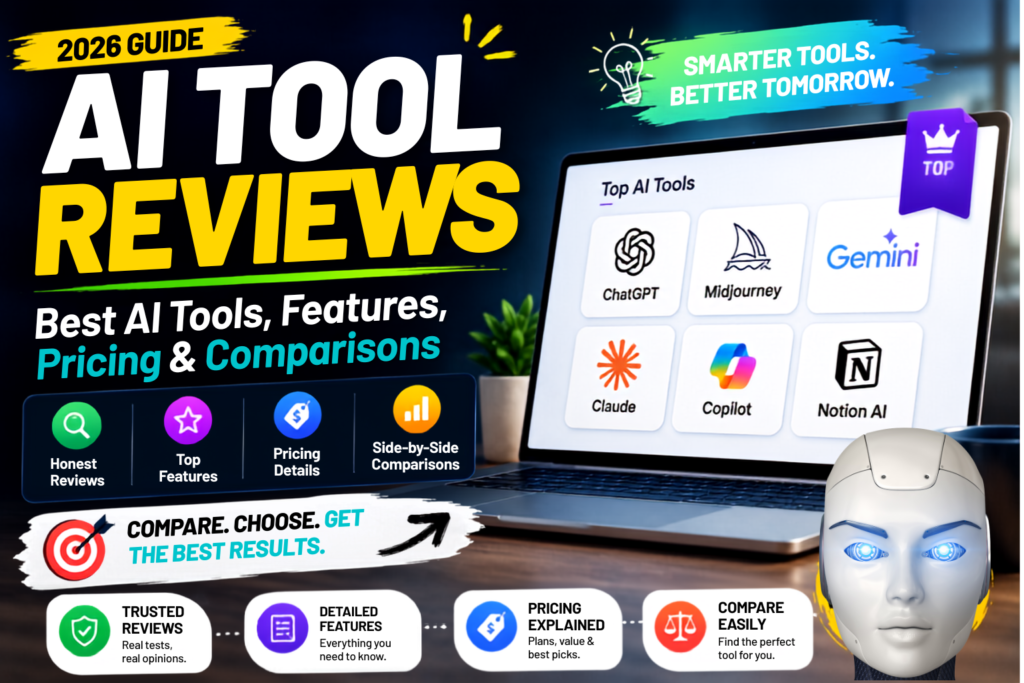
What Are AI Tool Reviews?
AI tool reviews are evaluations of artificial intelligence software, platforms, and applications.
A useful review should explain more than what a tool claims to do. It should help you understand how the software fits into real-world workflows.
A comprehensive AI software review typically covers:
- Key features
- AI capabilities
- Ease of use
- Pricing
- Free plan or trial
- Performance
- Best use cases
- Pros and cons
- Integrations
- Limitations
- Alternatives
- Overall value
This information allows individuals, creators, marketers, businesses, and professionals to make better decisions when choosing AI software.
How We Review AI Tools
Not every AI tool is designed for the same purpose. A platform that works well for content creation may not be the best option for coding or data analysis.
We evaluate AI tools using several important criteria.
1. Features
We examine the main features and determine whether they provide practical value.
Important considerations can include:
- AI models
- Automation
- Content generation
- Research capabilities
- Image or video generation
- Data analysis
- Integrations
- Collaboration features
- Customization
More features do not necessarily mean a better tool. The important question is whether those features solve a real problem.
2. Ease of Use
An AI tool should be accessible to its intended users.
We consider:
- Interface design
- Setup process
- Learning curve
- Prompting experience
- Workflow
- Documentation
- Beginner friendliness
A powerful AI platform can still be difficult to recommend if users need extensive technical knowledge to operate it.
3. Output Quality
Output quality is one of the most important factors in an AI tool review.
For example, an AI writing tool should be evaluated for:
- Accuracy
- Clarity
- Relevance
- Structure
- Originality
- Editing requirements
Similarly, an AI image generator should be assessed for image quality, prompt understanding, consistency, and editing capabilities.
4. Pricing
Pricing can determine whether an AI tool is suitable for an individual, freelancer, startup, or large business.
We look at factors such as:
- Free plans
- Free trials
- Monthly subscriptions
- Annual plans
- Usage limits
- Premium features
- Team plans
- Enterprise options
AI pricing changes frequently, so always verify the current pricing on the provider’s official website before purchasing.
5. Use Cases
A good review should answer one important question:
Who should use this AI tool?
For example, a tool may be particularly useful for:
- Students
- Content writers
- SEO professionals
- Digital marketers
- Graphic designers
- Developers
- YouTubers
- Freelancers
- Entrepreneurs
- Businesses
Understanding the intended audience makes AI software comparisons much easier.
6. Pros and Cons
No AI tool is perfect.
Our reviews should highlight both the strengths and weaknesses of a platform so readers can make an informed decision.
Typical limitations can include:
- Usage restrictions
- Expensive plans
- Limited integrations
- Inconsistent output
- Learning curve
- Limited customization
- Accuracy issues
Best AI Tools by Category
There is no universal “best AI tool.” The right choice depends on what you want to accomplish.
Best AI Productivity Tools
AI productivity tools can help users automate repetitive tasks, summarize information, brainstorm ideas, create documents, manage workflows, and save time.
If productivity is your priority, explore our guide to Best AI Productivity Tools.
When comparing productivity tools, consider integrations, automation capabilities, collaboration features, ease of use, and pricing.
Best AI Tools for SEO
AI is becoming an important part of modern SEO workflows.
SEO professionals can use AI for:
- Keyword research
- Content ideas
- Search-intent analysis
- Content briefs
- On-page optimization
- Meta descriptions
- Title generation
- Competitor research
- Content optimization
Explore our guide to Best AI Tools for SEO to find tools designed for different SEO tasks.
Best AI Tools for Digital Marketing
AI can assist digital marketers with content creation, social media, advertising, email marketing, SEO, customer research, and campaign planning.
If you’re a marketer looking to add AI to your workflow, see our guide to Best AI Tools for Digital Marketing.
AI Writing Tools
AI writing tools can help generate and improve:
- Blog posts
- Social media captions
- Emails
- Product descriptions
- Marketing copy
- Content briefs
- Headlines
- Summaries
However, AI-generated content should still be reviewed by humans for accuracy, originality, context, and usefulness.
AI Image Generators
AI image tools allow users to create visual content from text prompts.
They can be useful for:
- Social media graphics
- Blog illustrations
- Marketing campaigns
- Advertising concepts
- Product visuals
- Creative projects
When reviewing image-generation software, consider image quality, prompt accuracy, editing tools, generation limits, and commercial-use terms.
AI Video Tools
AI video platforms can simplify video production by helping with scripts, avatars, voiceovers, subtitles, editing, animation, and other production tasks.
These tools can be particularly useful for creators, marketers, educators, and businesses.
AI Coding Tools
AI coding assistants can help developers write, explain, debug, refactor, and document code.
When comparing coding tools, look at:
- Supported programming languages
- IDE integrations
- Code completion
- Debugging
- Context handling
- Repository support
- Privacy features
AI Tool Reviews vs. AI Tool Comparisons
An AI tool review normally evaluates one platform, while an AI tools comparison evaluates multiple platforms.
For example:
AI tool review:
ChatGPT Review: Features, Pricing, Pros and Cons
AI tool comparison:
ChatGPT vs Claude vs Gemini: Which AI Tool Is Best?
Comparisons are particularly useful when several platforms appear to solve the same problem.
For example, if you are deciding between major AI assistants, our ChatGPT vs Claude vs Gemini comparison can help you understand their differences.
How to Choose the Right AI Tool
Before subscribing to an AI platform, consider these five questions.
1. What problem does the tool solve?
Start with your goal rather than the tool.
Do you need help with:
- Writing?
- SEO?
- Research?
- Productivity?
- Coding?
- Images?
- Video?
- Marketing?
- Automation?
2. Does it fit your workflow?
The best AI software should work naturally with the tools you already use.
Check whether it supports integrations with your existing:
- Documents
- Browsers
- CRM
- Marketing platforms
- Design tools
- Development environment
- Communication tools
3. Is the price worth it?
A paid AI tool can be worthwhile if it saves significant time or improves productivity.
However, beginners should consider starting with a free plan or trial whenever available.
4. How accurate are the results?
AI tools can make mistakes.
Always evaluate whether the output needs human verification, particularly for technical, financial, legal, medical, or business-critical information.
5. Are there better alternatives?
Never assume that the most popular AI tool is automatically the best option.
Compare alternatives based on your specific requirements.
Are AI Tools Worth Paying For?
AI tools can be worth paying for when they provide measurable value.
For example, a freelancer who spends several hours each week researching, writing, or creating marketing material may benefit from an AI subscription that significantly reduces the time required.
However, paying for multiple overlapping AI subscriptions can quickly become expensive.
Before subscribing, ask:
Does this tool save me enough time or improve my results enough to justify the cost?
If the answer is no, a free alternative may be sufficient.
AI Tools for Beginners
If you are new to AI, you don’t need dozens of tools.
Start with a small toolkit based on your needs.
For example:
| Need | AI Tool Category |
| General assistance | AI assistant |
| Writing | AI writing tool |
| Productivity | AI productivity software |
| SEO | AI SEO tool |
| Images | AI image generator |
| Video | AI video tool |
| Coding | AI coding assistant |
Once you understand your workflow, you can add specialized tools where they provide genuine value.
ChatGPT, Claude and Gemini
General-purpose AI assistants are among the most popular AI applications.
They can assist with:
- Writing
- Research
- Brainstorming
- Coding
- Summarization
- Learning
- Data analysis
- Planning
However, each platform can have different strengths, features, models, integrations, and usage limits.
If you want to learn more about ChatGPT itself, read our ChatGPT Guide covering features, tools, prompts, and practical uses.
For a direct comparison, see ChatGPT vs Claude vs Gemini.
Frequently Asked Questions About AI Tool Reviews
What are AI tool reviews?
AI tool reviews evaluate artificial intelligence software based on features, performance, pricing, ease of use, use cases, advantages, limitations, and alternatives.
Which AI tools are the best?
The best AI tools depend on your specific needs. Different platforms are designed for writing, SEO, productivity, marketing, coding, image generation, video creation, research, and automation.
How do I compare AI software?
Compare AI software based on features, output quality, pricing, ease of use, integrations, limitations, privacy considerations, and your specific use case.
Are AI tool reviews useful?
Yes. A detailed AI tool review can help you understand whether software is suitable for your needs before you spend time or money testing it yourself.
Are free AI tools good enough?
Free AI tools can be sufficient for basic tasks. Paid plans usually provide additional features, higher usage limits, better models, or advanced capabilities.
What should I look for in an AI software review?
Look for information about features, pricing, performance, ease of use, pros and cons, use cases, limitations, alternatives, and who the tool is best suited for.
Can AI tools replace human expertise?
AI can automate many repetitive tasks, but human judgment remains important for strategy, accuracy, creativity, fact-checking, and decision-making.
Explore More AI Guides
Looking for more AI software recommendations and comparisons?
- Best AI Tools
- Best AI Productivity Tools
- Best AI Tools for SEO
- Best AI Tools for Digital Marketing
- ChatGPT vs Claude vs Gemini
- ChatGPT Guide
Final Thoughts
The AI software market is growing quickly, and choosing the right tool can be challenging. The best approach is to focus on your specific requirements instead of simply choosing the most popular platform.
Use AI tool reviews to understand individual products, AI tools comparisons to evaluate competing platforms, and category-specific guides to find software designed for particular tasks.