
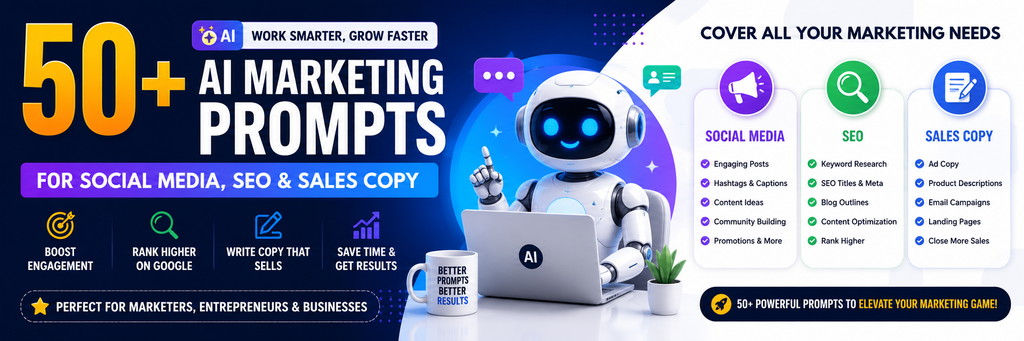
50+ AI Marketing Prompts
Customers move between Google Search, AI-powered search, social media, videos, email, product pages, reviews, and brand websites before making a decision. Marketers therefore need content that is useful, discoverable, persuasive, and easy to understand.
An AI-powered social media marketing suite helps businesses create, schedule, analyze, and optimize social media content from one platform. AI can assist with content ideas, captions, audience insights, post scheduling, performance analysis, and campaign optimization. By automating repetitive marketing tasks, businesses can save time, improve engagement, and build data-driven social media strategies for consistent online growth.
Marketing in 2026 is no longer about simply publishing more content.
Customers move between Google Search, AI-powered search, social media, videos, email, product pages, reviews, and brand websites before making a decision. Marketers therefore need content that is useful, discoverable, persuasive, and easy to understand.
This is where AI marketing prompts can help.
A well-written prompt can help you brainstorm campaign ideas, understand customer pain points, create social media posts, build SEO content, write sales copy, generate email campaigns, improve landing pages, and repurpose existing content.
But there is one important rule:
AI should accelerate your marketing strategy—not replace it.
A generic prompt often produces generic content. A detailed prompt containing your audience, product, goal, brand voice, evidence, and constraints can produce significantly more useful output.
This guide contains 60+ practical AI marketing prompts for social media, SEO, sales copy, content marketing, email, advertising, AEO, GEO, and conversion optimization.
What Are AI Marketing Prompts?
AI marketing prompts are specific instructions given to an AI tool to perform a marketing task.
For example, instead of asking:
Write a social media post about indoor plants.
Use:
Act as a social media strategist for an online nursery. Create an educational Instagram post for beginner plant owners in India. Explain three common indoor plant mistakes, use a strong but truthful hook, provide practical solutions, and finish with a natural CTA encouraging readers to explore beginner-friendly plants.
The second prompt provides:
- Business context
- Target audience
- Platform
- Topic
- Content objective
- Tone
- Structure
- CTA
That’s why it is more useful.
Why Use AI Marketing Prompts in 2026?
AI can help marketers reduce the time required for repetitive creative and research tasks.
You can use AI prompts to:
- Generate content ideas
- Research customer questions
- Create social media posts
- Write SEO outlines
- Improve headlines
- Draft sales pages
- Create email sequences
- Develop ad concepts
- Generate video scripts
- Repurpose content
- Identify customer objections
- Improve CTAs
- Analyze marketing copy
- Build content calendars
- Develop marketing campaigns
However, AI-generated content still needs human review.
Your experience, customer knowledge, original data, product information, examples, and expertise are what make the final content distinctive.
The Best AI Marketing Prompt Formula
Before using the prompts below, understand this simple framework:
Role + Context + Audience + Goal + Input + Constraints + Output + CTA
For example:
Act as a senior SEO content strategist. I run [business] and sell [product/service] to [audience]. Create an SEO-focused article about [topic] targeting [keyword]. Identify search intent, answer the main question early, include related questions, practical examples, internal-link opportunities, FAQs, and a relevant CTA. Avoid keyword stuffing, unsupported claims, and generic filler.
This framework can be adapted to almost any marketing task.
60+ Best AI Marketing Prompts
Section 1: AI Prompts for Social Media Marketing
Social media content should not simply advertise your product.
A stronger strategy combines education, entertainment, authority, community, proof, and promotion.
1. Social Media Strategy Prompt
Act as a senior social media strategist. Create a 30-day social media strategy for [business] targeting [audience]. Define content pillars, platform, content format, topic, objective, CTA, and KPI for each post. Prioritize useful and original content over repetitive promotional posts.
2. Social Media Content Ideas
Generate 50 social media content ideas for [business]. Divide them into educational, entertaining, inspirational, product-focused, customer-focused, behind-the-scenes, authority-building, and promotional categories.
3. Instagram Post Prompt
Write an Instagram post about [topic] for [audience]. Start with a compelling but truthful hook, provide useful information, use short paragraphs, and finish with a natural CTA. Avoid generic motivational language.
4. Instagram Carousel Prompt
Create a 7-slide Instagram carousel about [topic]. Give each slide a short headline and concise explanation. Slide 1 should create curiosity, slides 2–6 should teach something useful, and slide 7 should contain a relevant CTA.
5. Facebook Post Prompt
Write a helpful Facebook post for [business] about [topic]. Make it conversational and practical. Address one specific customer problem, provide a solution, and end with a question that encourages meaningful discussion.
6. LinkedIn Post Prompt
Write a LinkedIn post about [topic] for [target audience]. Start with a strong insight, explain the problem, provide three practical lessons, and end with a thoughtful conclusion. Avoid corporate clichés and excessive self-promotion.
7. Short-Form Video Prompt
Generate 20 short-form video ideas for [business]. For each idea provide a hook, problem, key lesson, visual concept, CTA, and suggested video length.
8. Social Media Hook Prompt
Generate 30 attention-grabbing hooks for [topic]. Make them specific, useful, curiosity-driven, and truthful. Avoid clickbait and exaggerated claims.
9. Social Media Caption Prompt
Write 10 social media captions for [product/service]. Create different angles including educational, emotional, problem-solution, benefit-driven, social proof, comparison, and promotional.
10. Social Media Repurposing Prompt
Convert this article into 5 Instagram posts, 3 LinkedIn posts, 5 Facebook posts, 10 short-video ideas, and 10 social media hooks. Preserve the original insights but adapt each piece to the platform instead of copying the same text.
11. Social Media Engagement Prompt
Create 20 social media questions designed to start genuine conversations with [target audience] about [topic]. Avoid engagement bait and focus on questions that reveal customer needs and opinions.
12. Social Media Content Calendar
Create a 30-day social media calendar for [business]. Include date, platform, content format, topic, hook, objective, CTA, and repurposing opportunity.
Section 2: AI Prompts for SEO
SEO content should satisfy the user’s search intent first.
Don’t build an article simply because a keyword has search volume.
Build it because people need a useful answer.
13. SEO Keyword Research Prompt
Act as an SEO strategist. Create a keyword research plan for [business/topic]. Group keywords by informational, commercial, transactional, navigational, and local intent. Include primary keywords, related topics, questions, entities, and content opportunities.
14. Search Intent Prompt
Analyze the search intent behind the keyword “[keyword].” Explain what the searcher wants, what questions they probably have, what type of content would satisfy them, and what information a high-quality result should include.
15. SEO Blog Outline Prompt
Create a comprehensive SEO-friendly outline for an article targeting “[keyword].” Include the primary search intent, direct answer, H2/H3 structure, related questions, examples, practical advice, FAQs, internal-link opportunities, and CTA.
16. SEO Title Prompt
Generate 15 SEO-friendly titles for “[keyword].” Prioritize clarity, relevance, CTR potential, and accurate expectations. Avoid clickbait and keyword stuffing.
17. Meta Description Prompt
Write 10 compelling meta descriptions for a page targeting “[keyword].” Keep them concise, relevant, natural, and focused on encouraging qualified clicks without making unsupported claims.
18. SEO Content Writing Prompt
Write a comprehensive, people-first article about “[topic]” for [audience]. Cover the main search intent first, answer important questions clearly, include practical examples, explain limitations where relevant, and add original insights. Use natural keywords rather than keyword stuffing.
19. SEO Content Gap Prompt
Analyze the following competing content: [content/URLs]. Identify important questions, examples, explanations, use cases, evidence, and perspectives that are missing. Recommend ways to create substantially more useful content rather than simply adding more words.
20. Internal Linking Prompt
Analyze these articles: [list]. Create an internal-linking strategy showing which pages should link to each other, suggested natural anchor text, and the purpose of each link.
21. Content Refresh Prompt
Audit this existing article for outdated information, missing questions, weak explanations, repetitive sections, unsupported claims, and content gaps. Recommend specific improvements that would make it more useful to readers.
22. SEO FAQ Prompt
Create 15 genuine FAQs about [topic] based on likely customer questions. Give each question a concise answer first, followed by additional context where useful. Do not invent facts.
Section 3: AI Prompts for AEO
AEO, or Answer Engine Optimization, focuses on making information clear and useful for question-based discovery.
The goal isn’t to stuff a page with questions.
The goal is to answer genuine questions better.
23. Direct Answer Prompt
Rewrite this section so the main question is answered clearly within the first 2–3 sentences. Then provide supporting details, examples, limitations, and practical advice.
24. Question Research Prompt
Generate 30 questions that beginners, buyers, and experienced users might ask about [topic]. Group them into basic, practical, comparison, buying, troubleshooting, and advanced questions.
25. AEO Content Structure Prompt
Structure an article about [topic] so that important questions are answered clearly and naturally. Provide concise answers first, followed by supporting explanations, examples, evidence opportunities, and practical recommendations.
26. Voice Search Prompt
Identify conversational questions someone might ask about [topic] using natural language. Provide concise answers followed by useful supporting information.
27. Featured Answer Prompt
Identify the five most important questions a user needs answered about [topic]. Provide a direct answer to each question followed by the context required to make an informed decision.
28. FAQ Optimization Prompt
Review these FAQs and identify questions that are repetitive, unnatural, or created primarily for keyword targeting. Replace them with genuine customer questions and provide useful answers.
Section 4: AI Prompts for GEO and AI Search
GEO, often used to describe Generative Engine Optimization, should not be treated as a collection of tricks.
A stronger approach is to create content that is:
- Clear
- Original
- Accurate
- Well structured
- Evidence-supported
- Context-rich
- Useful
- Easy to understand
29. GEO Content Audit Prompt
Analyze this article for AI-search visibility. Evaluate clarity, factual accuracy, originality, topical completeness, entities, evidence, practical usefulness, and answerability. Recommend improvements without adding unnatural keyword repetition.
30. Entity Optimization Prompt
Identify the important entities related to [topic], including products, brands, people, concepts, locations, organizations, and related subjects. Explain which entities should be included naturally and why.
31. Original Information Prompt
Analyze this article and identify information that sounds generic or commonly repeated online. Suggest opportunities to add original examples, first-hand experience, data, comparisons, expert insights, testing, or practical observations.
32. Evidence Prompt
Review these claims: [claims]. Identify which statements require evidence or verification. For each, recommend the appropriate type of authoritative source. Do not invent statistics, studies, quotes, or references.
33. AI Search Content Prompt
Improve this article for AI-powered search by making important concepts explicit, answers clear, relationships between entities understandable, and unique insights easy to identify. Preserve natural writing and prioritize human usefulness.
34. GEO Content Differentiation Prompt
Compare this article with the common information typically found about [topic]. Identify five areas where the content could provide genuinely unique value through examples, experience, original analysis, data, or expert perspective.
Section 5: AI Prompts for Sales Copy
Sales copy has a different job from informational content.
Its purpose is to help a qualified customer understand:
Why this product? Why now? Why trust you?
35. Sales Copy Prompt
Act as a conversion-focused copywriter. Write sales copy for [product/service] targeting [audience]. Focus on customer outcomes, pain points, objections, proof, differentiation, and a clear CTA. Avoid exaggerated claims and artificial urgency.
36. Value Proposition Prompt
Create 15 value propositions for [product/service]. Focus on the customer’s desired outcome rather than simply listing features. Make each specific, credible, and differentiated.
37. Product Benefits Prompt
Convert these product features into customer-focused benefits: [features]. Explain why each feature matters and what problem it solves.
38. Landing Page Prompt
Write a complete landing page for [product/service]. Include headline, subheadline, problem, solution, benefits, features, proof, objections, FAQs, CTA, and trust-building elements.
39. Sales Headline Prompt
Generate 20 sales headlines for [product/service]. Use different angles including benefit, problem-solution, outcome, curiosity, specificity, comparison, and customer transformation.
40. CTA Prompt
Generate 20 CTA options for [product/service]. Focus on the customer’s desired next step instead of generic phrases such as “Submit” or “Click Here.”
41. Objection Handling Prompt
List the 20 strongest objections a customer might have before buying [product/service]. For each objection, write a concise, honest response that reduces uncertainty without making unsupported claims.
42. Product Description Prompt
Write an ecommerce product description for [product]. Include an engaging introduction, customer benefits, key features, specifications, use cases, ideal customer, FAQs, and CTA. Keep the copy clear, persuasive, and factual.
43. Product Comparison Prompt
Compare [Product A] and [Product B] based on features, benefits, ideal customer, use cases, limitations, value, and buying considerations. Remain objective and explain which product is better suited to different customer needs.
Section 6: AI Prompts for Email Marketing
Email remains valuable because it gives brands a direct communication channel with potential and existing customers.
44. Welcome Email Prompt
Create a 5-email welcome sequence for [business]. Define the purpose of each email, subject line, hook, value proposition, CTA, and conversion goal.
45. Promotional Email Prompt
Write a promotional email for [product/service]. Explain the customer’s problem, introduce the solution, highlight the most important benefits, address one major objection, and end with a clear CTA.
46. Abandoned Cart Prompt
Create a three-email abandoned-cart sequence for [product]. Address uncertainty, answer common objections, reinforce product value, and provide a clear CTA without using manipulative urgency.
47. Newsletter Prompt
Create a weekly newsletter for [business]. Include one useful insight, one practical tip, one relevant example or story, one recommended resource, and one natural conversion opportunity.
48. Re-Engagement Email Prompt
Create a re-engagement email sequence for customers who have not interacted with [business] for [time period]. Use helpful content, a relevant reason to return, and a clear but non-aggressive CTA.
Section 7: AI Prompts for Advertising
49. Google Ads Prompt
Create 15 Google Ads headlines and 10 descriptions for [product/service]. Target customers searching for [search intent]. Focus on the strongest legitimate benefit and maintain clear, accurate messaging.
50. Meta Ads Prompt
Create 10 Facebook and Instagram ad concepts for [product/service]. For each provide primary text, headline, CTA, audience, pain point, marketing angle, and creative concept.
51. Ad Hook Prompt
Generate 30 advertising hooks for [product]. Use different angles such as problem-solution, benefit, convenience, comparison, education, proof, objection handling, and value.
52. A/B Testing Prompt
Create an A/B testing plan for [campaign]. Test headlines, hooks, offers, CTAs, creative formats, audience segments, and landing-page messaging. Explain the hypothesis behind each test.
Section 8: AI Prompts for Content Strategy
53. Content Strategy Prompt
Create a 12-month content strategy for [business]. Identify pillar topics, supporting content, search intent, target audience, content format, internal links, conversion goals, and publishing priority.
54. Topic Cluster Prompt
Build a topic cluster around [main topic]. Identify one pillar page and 15 supporting topics. Explain the search intent behind each topic and recommend internal links between the pages.
55. Content Calendar Prompt
Create a 90-day content calendar for [business]. Include article title, primary topic, search intent, target audience, format, funnel stage, CTA, and content repurposing opportunity.
56. Content Repurposing Prompt
Turn this long-form article into a complete content distribution package including social posts, short-video ideas, email content, carousel ideas, FAQs, and sales content. Preserve the original insights while adapting each format to its audience.
Section 9: AI Prompts for Conversion Optimization
57. CRO Audit Prompt
Audit this landing page: [copy]. Evaluate headline clarity, value proposition, benefits, proof, objections, CTA, trust, friction, content hierarchy, and mobile readability. Rank recommendations by potential impact.
58. Customer Psychology Prompt
Analyze why a customer might buy or reject [product/service]. Identify motivations, fears, perceived risks, objections, desired outcomes, trust factors, and decision criteria. Convert the insights into ethical marketing recommendations.
59. Offer Optimization Prompt
Analyze this offer: [offer]. Explain why a customer might accept or reject it. Recommend improvements to the value proposition, packaging, pricing presentation, proof, risk reduction, bonuses, and CTA.
60. Marketing Audit Prompt
Conduct a complete marketing audit for [business]. Evaluate positioning, audience, website, SEO, content, social media, email, advertising, conversion optimization, customer retention, and analytics. Prioritize the top 10 actions by impact and effort.
Bonus: The Ultimate AI Marketing Prompt
If you want one prompt that combines many of the strategies above, use this:
Act as a senior marketing strategist, SEO specialist, AEO strategist, GEO/AI-search content strategist, conversion copywriter, and customer-research expert.
Analyze my business:
Business: [business]
Product/service: [product/service]
Target audience: [audience]
Location: [location]
Main competitors: [competitors]
Primary goal: [goal]
Brand voice: [voice]First identify the customer’s main problems, search intent, buying triggers, objections, desired outcomes, and decision criteria.
Then create a marketing strategy covering SEO, AEO, AI-search visibility, social media, sales copy, email, advertising, content marketing, and conversion optimization.
For every recommendation, explain what to do, why it matters, who it targets, which channel to use, what CTA to use, and how success should be measured.
Prioritize original, useful, trustworthy, people-first marketing. Do not invent statistics, customer reviews, expert quotes, case studies, or product claims. Clearly distinguish facts, assumptions, and recommendations.
How to Get Better Results From AI Marketing Prompts
The prompts above are templates. Do not blindly copy and paste them.
Add your own information.
For example, instead of:
Write sales copy for my product.
Give AI:
Product: Jade Plant
Audience: Beginner indoor plant buyers
Location: India
Main concern: Easy plant care
Product benefit: Low-maintenance ornamental plant
Brand: Anuj Nursery
CTA: Buy online
Tone: Helpful, trustworthy, simple English
The second prompt gives AI far more useful context.
The 8 Things You Should Add to Important AI Prompts
For serious marketing work, provide:
- Business context
- Target audience
- Customer problem
- Desired outcome
- Product/service details
- Brand voice
- Evidence and source material
- Conversion goal
This turns an AI prompt from a simple instruction into a marketing brief.
How to Use These Prompts for SEO + AEO + GEO
Don’t create separate content for every acronym.
Instead, build one strong piece of content that satisfies multiple needs.
SEO asks:
Can the right users discover this content?
Focus on:
- Search intent
- Relevant topics
- Technical accessibility
- Internal linking
- Descriptive titles
- Useful content
AEO asks:
Can the user’s question be answered clearly?
Focus on:
- Real questions
- Direct answers
- Clear structure
- FAQs
- Concise explanations
- Practical context
GEO asks:
Does the content provide useful information that can be understood and referenced in generative search experiences?
Focus on:
- Original insights
- Strong topical context
- Clear entities
- Evidence
- First-hand experience
- Specific examples
- Trustworthiness
The strongest strategy is therefore:
Search intent → Helpful content → Clear answers → Original information → Evidence → Good UX → Conversion
Mistakes to Avoid When Using AI Marketing Prompts
1. Using Generic Prompts
“Write a blog about SEO” is not a strategy.
Give AI the audience, intent, context, goal, and source material.
2. Asking AI to Guarantee Rankings
No AI prompt can guarantee a #1 Google position.
Instead, optimize for:
- Relevance
- Usefulness
- Originality
- Accuracy
- Search intent
- Technical quality
- Customer satisfaction
3. Publishing Everything AI Generates
AI output can contain:
- Incorrect facts
- Repetition
- Generic statements
- Unsupported claims
- Outdated information
- Artificial language
Human review is essential.
4. Keyword Stuffing
Don’t repeat a keyword unnaturally to make content “more SEO-friendly.”
Use natural language and cover the subject comprehensively.
5. Creating Content Only for Search Engines
If your content is written for algorithms instead of people, it will often become repetitive and shallow.
Start with the user’s problem.
Then solve it better.AI Marketing Workflow for 2026
Here’s a simple workflow you can use for almost any campaign.
Step 1: Research
Use AI to identify:
- Audience
- Problems
- Questions
- Search intent
- Objections
- Competitors
Step 2: Strategy
Create:
- Positioning
- Value proposition
- Content strategy
- Funnel
- Campaign goals
Step 3: Creation
Produce:
- SEO content
- Social posts
- Sales copy
- Emails
- Ads
- Videos
Step 4: Optimization
Review:
- Accuracy
- Originality
- Search intent
- Clarity
- Conversion
- Brand voice
Step 5: Distribution
Repurpose the strongest content across relevant channels.
Step 6: Measure
Track:
- Traffic
- Engagement
- Leads
- Conversion rate
- Revenue
- Customer acquisition cost
- Retention
Step 7: Improve
Use performance data to create the next campaign.
Frequently Asked Questions
What are AI marketing prompts?
AI marketing prompts are detailed instructions used with AI tools to perform marketing tasks such as content creation, SEO research, social media management, sales copywriting, email marketing, advertising, and conversion optimization.
What are the best AI prompts for social media?
The most useful social media prompts help with content strategy, hooks, captions, carousel posts, video scripts, content calendars, audience research, engagement ideas, and content repurposing.
Can AI write SEO content?
Yes. AI can help with SEO research, outlines, drafts, optimization, FAQs, and content updates. However, marketers should review AI output for accuracy, originality, usefulness, and search intent before publishing.
Can AI help with AEO?
Yes. AI can help identify genuine user questions, create direct answers, structure FAQs, and improve content clarity. AEO should focus on genuinely answering users rather than manipulating content into artificial question-and-answer formats.
What is GEO in marketing?
GEO is commonly used to describe Generative Engine Optimization, which focuses on making content useful and understandable in AI-powered discovery and generative search environments. The practical foundation is high-quality, original, well-structured information rather than attempting to exploit a specific algorithmic trick.
Can AI create sales copy?
Yes. AI can create headlines, product descriptions, landing pages, CTAs, email sequences, advertisements, and objection-handling copy. The quality improves significantly when you provide customer research, product details, proof, and brand positioning.
How do I make AI-generated marketing content better?
Give AI detailed context, provide real customer information, add original examples and evidence, define the conversion goal, specify the brand voice, and review the output before publishing.
Should I use AI for all my marketing content?
No. Use AI where it provides leverage, particularly for research, ideation, drafting, repurposing, analysis, and testing. Keep strategic decisions, original expertise, factual verification, and final publishing under human control.
Final Takeaway
AI marketing prompts can help you create content faster, but speed alone does not create successful marketing.
The real advantage comes from combining AI with customer understanding, strong positioning, original ideas, accurate information, and continuous testing.
Use the prompts in this guide to build better social media content, SEO articles, sales copy, emails, advertisements, landing pages, and conversion campaigns.
For SEO, focus on satisfying search intent and creating genuinely useful content.
For AEO, answer real questions clearly and directly.
For GEO and AI-powered search, make your content original, specific, trustworthy, and rich in useful context.
And for sales, remember the most important principle:
Don’t try to convince everyone to buy. Help the right customer understand why your solution is worth choosing.
The best AI marketing prompt isn’t the one that generates the longest response.
It’s the one that produces a useful result for a real customer and moves the business closer to its goal.
Ready to Use These AI Marketing Prompts?
Start with one specific marketing goal.
Choose the prompt that matches it, add your business context + audience + product details + desired outcome, generate the first draft, and then improve it using real customer feedback and performance data.
Better prompts → better content → better customer experiences → better marketing results.

