
Digital marketing is changing quickly.
Customers now discover businesses through Google Search, AI-powered search, social media, videos, email, reviews, and online communities. That means marketers need more than just more content.
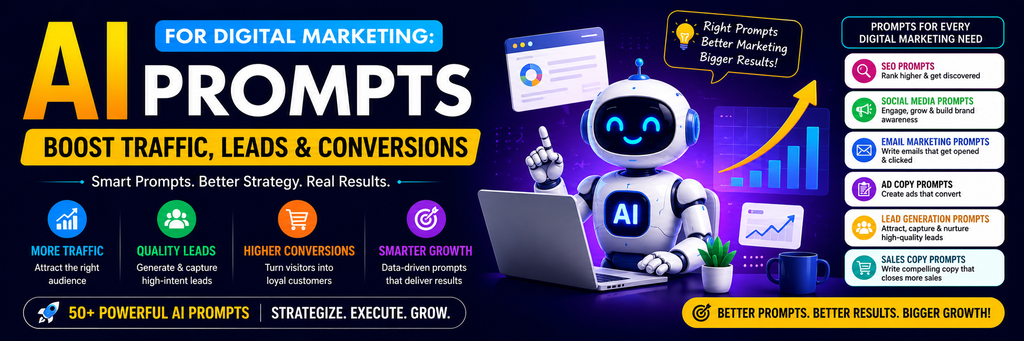
They need better content, better targeting, better offers, and better customer experiences. With the right AI prompts, you can research your audience, create content, improve SEO, write social media posts, build email campaigns, generate sales copy, develop ad ideas, and find ways to increase conversions.
AI prompts for digital marketing help marketers create better content, plan campaigns, analyze audiences, and complete repetitive marketing tasks more efficiently. These prompts can be used for SEO content ideas, keyword research, social media posts, email marketing, ad copy, competitor analysis, customer personas, content calendars, and campaign strategies. For SEO, well-structured AI prompts can help align content with search intent, target relevant keywords, and improve topical coverage. GEO can be supported by creating detailed, trustworthy, and context-rich content that AI-powered search systems can understand, while AEO focuses on generating direct answers, FAQs, and conversational content that addresses common user questions. By including the target audience, marketing goal, brand voice, context, keywords, and desired output format, AI prompts for digital marketing can produce more relevant and actionable results while keeping human expertise at the center of the strategy.
What Are AI Prompts for Digital Marketing?
AI prompts are instructions that tell an AI tool what marketing task you want it to perform.
For example, instead of saying:
Write a Facebook post about plants.
Try:
Act as a social media strategist for an online nursery. Write a Facebook post for beginner plant owners in India. Explain three common plant-care mistakes, give simple solutions, use a friendly tone, and end with a natural CTA to explore suitable plants.
The second prompt gives AI much more information.
It tells AI:
- Who you are
- What you sell
- Who the audience is
- What problem to address
- What platform to use
- What tone to follow
- What action to encourage
That is the difference between a generic AI output and useful marketing content.
Why Use AI Prompts for Digital Marketing?
AI can help marketers complete repetitive tasks faster and explore more ideas.
You can use AI prompts to:
- Research customer pain points
- Generate content ideas
- Build SEO content plans
- Create social media posts
- Write sales copy
- Create email campaigns
- Develop advertising concepts
- Improve landing pages
- Generate video scripts
- Create lead magnets
- Analyze customer objections
- Build marketing funnels
- Repurpose existing content
- Improve calls to action
- Create testing ideas
However, AI should support your strategy rather than replace it.
Your customer knowledge, experience, original data, product information, and expertise are still extremely valuable.
Google’s current guidance for generative search emphasizes that SEO remains relevant and recommends creating unique, useful, trustworthy content for people rather than relying on artificial “AEO/GEO hacks.”
The Best AI Prompt Formula for Digital Marketing
For important marketing tasks, use this simple formula:
Role + Context + Audience + Goal + Information + Constraints + Format + CTA
Example
Act as a senior digital marketing strategist.
Business: [business name]
Product: [product/service]
Audience: [target audience]
Location: [location]
Goal: Increase qualified leads.
Context: [business information].
Create a content strategy covering SEO, social media, email, and landing pages. Use clear English, avoid generic claims, and recommend measurable KPIs.
This structure gives AI a clear marketing brief.
50+ AI Prompts for Digital Marketing
AI Prompts for Marketing Strategy
1. Complete Digital Marketing Strategy
Act as a senior digital marketing strategist. Create a complete marketing strategy for [business/product]. Analyze the target audience, customer problems, competitors, positioning, acquisition channels, content strategy, conversion strategy, retention opportunities, KPIs, and 90-day action plan. Prioritize recommendations by impact and effort.
2. Marketing Funnel
Build a complete marketing funnel for [product/service]. Cover awareness, consideration, conversion, onboarding, retention, and referral stages. For each stage provide customer intent, content, channel, message, CTA, objection, and KPI.
3. Marketing Opportunities
Analyze this business: [business information]. Identify 20 realistic digital marketing opportunities. Rank them by potential impact, difficulty, cost, and expected speed of implementation.
4. 90-Day Marketing Plan
Create a 90-day digital marketing plan for [business]. Divide the plan into weekly actions covering SEO, content, social media, email, advertising, lead generation, conversion optimization, and analytics.
5. Customer Persona
Create a detailed customer persona for [product/service]. Include goals, frustrations, buying triggers, objections, desired outcomes, decision criteria, preferred channels, and questions they may ask before purchasing.
AI Prompts for Traffic Growth
Traffic is useful only when it comes from people who are relevant to your business.
More visitors do not automatically mean more sales.
The goal should be qualified traffic.
6. Traffic Growth Strategy
Create a traffic-growth strategy for [website/business]. Identify opportunities across organic search, social media, video, email, communities, referral traffic, and paid advertising. Prioritize channels based on audience fit and business potential.
7. Organic Traffic Ideas
Generate 30 content opportunities that could attract qualified organic traffic for [business]. Group them by informational, commercial, transactional, comparison, problem-solving, and local intent.
8. Search Intent Analysis
Analyze the search intent behind “[keyword].” Explain what the user wants, what questions they may have next, what content format would best satisfy them, and what information would make the page more useful than a generic competitor page.
9. Content Gap Analysis
Analyze these competitor topics/pages: [information]. Identify important questions, examples, use cases, evidence, and perspectives that are missing. Recommend content opportunities that provide genuinely additional value.
10. Content Cluster
Create a topic cluster around [main topic]. Identify one comprehensive pillar page and 15 supporting topics. Explain the search intent of each topic and recommend logical internal links.
AI Prompts for SEO
SEO is still an important part of digital marketing.
Google’s current guidance says generative AI features in Search rely on core Search ranking and quality systems, so established SEO fundamentals remain relevant.
11. Keyword Research
Act as an SEO strategist. Create a keyword research framework for [business/topic]. Group keywords by informational, commercial, transactional, navigational, and local intent. Include related questions, topics, entities, and content opportunities.
12. SEO Content Brief
Create a detailed content brief for “[keyword].” Include search intent, target audience, primary question, secondary questions, H2/H3 structure, examples, unique information opportunities, internal links, FAQs, and CTA.
13. SEO Title Ideas
Generate 15 SEO-friendly titles for “[keyword].” Prioritize clarity, relevance, strong CTR potential, and accurate expectations. Avoid clickbait and keyword stuffing.
14. Meta Description
Write 10 concise meta descriptions for a page targeting “[keyword].” Make each relevant, natural, benefit-focused, and compelling without making unsupported promises.
15. SEO Article
Write a comprehensive, people-first article about “[topic]” for [audience]. Answer the primary question early, explain the topic clearly, include useful examples, cover important related questions, add original insights where possible, and finish with a relevant CTA.
16. Internal Linking
Analyze these website pages: [list]. Create an internal-linking strategy showing which pages should link to each other, suggested natural anchor text, and the reason for each link.
17. SEO Content Refresh
Audit this article: [content]. Identify outdated information, missing sections, weak explanations, repetitive content, unsupported claims, and opportunities to make the article substantially more useful.
AI Prompts for AEO
AEO, or Answer Engine Optimization, is commonly used to describe making content easier to use for question-based search and answer experiences.
The practical goal is simple:
Answer the user’s question clearly.
18. Direct Answer
Rewrite this section so the main question is answered clearly within the first 2–3 sentences. Then provide supporting details, examples, limitations, and practical advice.
19. Question Research
Generate 30 genuine questions that beginners, buyers, and experienced users may ask about [topic]. Group them into beginner, practical, comparison, buying, troubleshooting, and advanced questions.
20. FAQ Content
Create 15 useful FAQs about [topic]. Use genuine customer questions rather than keyword variations. Give a concise answer first, followed by additional context when necessary.
21. Voice Search
Generate conversational questions that people might ask using voice search about [topic]. Provide clear, natural answers that address the user’s actual intent.
22. Answer Optimization
Review this content and identify questions that are not answered clearly. Rewrite the relevant sections so users can quickly understand the answer without sacrificing useful context.
AI Prompts for GEO and AI-Powered Search
Google’s 2026 guidance specifically recommends focusing on unique, useful content and strong SEO fundamentals rather than attempting to manipulate AI search with supposed “GEO hacks.”
That means your content should provide something valuable beyond generic information.
23. GEO Content Audit
Analyze this article for AI-search visibility. Evaluate originality, factual accuracy, clarity, topical completeness, entities, evidence, practical usefulness, and answerability. Recommend improvements without adding unnatural keyword repetition.
24. Original Value
Review this article and identify information that is generic or commonly repeated online. Suggest opportunities to add original examples, first-hand experience, data, comparisons, expert insights, or practical observations.
25. Entity Analysis
Identify important entities related to [topic], including brands, products, people, organizations, locations, concepts, and related subjects. Explain how they should be included naturally.
26. Evidence Review
Review these claims: [claims]. Identify which statements need verification or authoritative sources. Recommend the appropriate source type for each claim. Do not invent statistics, studies, quotes, or references.
27. AI Search Optimization
Improve this article for AI-powered search by making important concepts clear, relationships between entities understandable, answers easy to identify, and unique insights prominent. Keep the writing natural and useful for humans.
AI Prompts for Lead Generation
Traffic is only the first step.
A successful digital marketing strategy needs to turn relevant visitors into leads and potential customers.
28. Lead Magnet Ideas
Generate 20 lead magnet ideas for [business] targeting [audience]. Prioritize resources that solve an immediate customer problem and naturally connect to the company’s product or service.
29. Lead Magnet Creation
Create a practical lead magnet titled “[title]” for [audience]. Make it actionable, easy to understand, and valuable enough to solve a meaningful part of the reader’s problem.
30. Lead Generation Funnel
Create a lead-generation funnel for [business]. Include traffic source, landing page, lead magnet, form strategy, thank-you page, email sequence, sales offer, CTA, and KPIs.
31. Lead Qualification
Create a lead qualification framework for [business]. Identify high-intent, medium-intent, and low-intent leads. Provide the signals that should determine how each segment is followed up.
32. Lead Nurturing
Create a 7-email lead-nurturing sequence for people who downloaded [lead magnet]. Move them from problem awareness to solution awareness and finally toward evaluating [product/service].
AI Prompts for Sales Copy
Good sales copy does not simply say:
“Buy now.”
It explains why the product matters to the right customer.
33. Sales Copy
Act as a conversion copywriter. Write sales copy for [product/service] targeting [audience]. Focus on customer outcomes, pain points, objections, proof, differentiation, and a clear CTA. Avoid exaggerated claims.
34. Value Proposition
Create 15 value propositions for [product/service]. Focus on customer outcomes rather than simply listing features. Make each specific, credible, and differentiated.
35. Product Benefits
Convert these product features into customer-focused benefits: [features]. Explain why each feature matters and what customer problem it solves.
36. Landing Page
Create a complete landing page for [product/service]. Include headline, subheadline, problem, solution, benefits, features, proof, objections, FAQs, CTA, and trust elements.
37. CTA Ideas
Generate 20 CTA options for [product/service]. Make them specific to the customer’s desired outcome rather than generic phrases such as “Submit” or “Click Here.”
38. Objection Handling
Identify the 20 strongest objections a customer may have before purchasing [product/service]. For each objection, write an honest response that reduces uncertainty without making unsupported claims.
AI Prompts for Social Media
Social media should support the larger marketing strategy.
Don’t post randomly.
Each piece of content should have a purpose.
39. Social Media Strategy
Create a 30-day social media strategy for [business]. Define content pillars, platform, format, topic, objective, CTA, and KPI for each post.
40. Social Media Content Ideas
Generate 50 social media ideas for [business]. Divide them into educational, entertaining, authority-building, community, product, customer-story, and promotional content.
41. Instagram Carousel
Create a 7-slide Instagram carousel about [topic]. Start with a strong hook, provide practical information in slides 2–6, and finish with a useful CTA.
42. LinkedIn Post
Write a LinkedIn post about [topic] for [audience]. Start with a useful insight, explain the problem, provide three practical lessons, and finish with a clear takeaway. Avoid generic corporate language.
43. Short Video
Generate 20 short-form video ideas for [business]. For each provide a hook, problem, key insight, visual concept, CTA, and suggested duration.
AI Prompts for Email Marketing
44. Welcome Sequence
Create a five-email welcome sequence for [business]. For each email provide the purpose, subject line, opening hook, key message, CTA, and conversion goal.
45. Promotional Email
Write a promotional email for [product]. Explain the customer problem, introduce the solution, highlight the strongest benefits, address a major objection, and end with a clear CTA.
46. Abandoned Cart
Create a three-email abandoned-cart sequence for [product]. Address hesitation, explain value, answer common objections, and encourage the customer to return without using manipulative urgency.
47. Newsletter
Create a weekly newsletter for [business]. Include one useful insight, one practical tip, one example, one relevant resource, and one natural conversion opportunity.
AI Prompts for Paid Advertising
48. Google Ads
Create 15 Google Ads headlines and 10 descriptions for [product/service]. Target users searching for [search intent]. Focus on the strongest legitimate benefit and use clear, accurate messaging.
49. Meta Ads
Create 10 Facebook and Instagram ad concepts for [product/service]. For each provide primary text, headline, CTA, target audience, pain point, marketing angle, and creative concept.
50. Ad Testing
Create an A/B testing plan for [campaign]. Test headlines, hooks, offers, CTAs, creative formats, audience segments, and landing-page messages. Explain the hypothesis behind each test.
AI Prompts for Conversion Optimization
Getting traffic is not enough.
If visitors do not understand your offer or trust your business, traffic can become expensive.
51. CRO Audit
Audit this landing page: [copy/URL]. Evaluate headline clarity, value proposition, benefits, trust, proof, objections, CTA, friction, information hierarchy, and mobile readability. Rank recommendations by potential impact.
52. Conversion Barriers
Act as a skeptical customer evaluating [product/service]. List every reasonable concern that could stop you from buying. For each concern, recommend information, proof, or website improvements that could reduce uncertainty.
53. Offer Optimization
Analyze this offer: [offer]. Explain why a customer might accept or reject it. Recommend improvements to the value proposition, packaging, pricing presentation, proof, risk reduction, and CTA.
54. Customer Psychology
Analyze why [target audience] might buy or reject [product]. Identify motivations, fears, perceived risks, objections, desired outcomes, trust factors, and decision criteria. Convert the insights into ethical marketing recommendations.
The Ultimate AI Prompt for Digital Marketing
If you want one comprehensive prompt, use this:
Act as a senior digital marketing strategist, SEO specialist, AEO strategist, AI-search content strategist, conversion copywriter, and customer-research expert.
Business: [business]
Product/service: [product]
Target audience: [audience]
Location: [location]
Main competitors: [competitors]
Marketing goal: [goal]
Brand voice: [voice]First identify the target customer’s problems, search intent, buying triggers, objections, desired outcomes, and decision criteria.
Then create a digital marketing strategy covering SEO, AEO, AI-search visibility, content marketing, social media, email, paid advertising, lead generation, sales copy, landing pages, and conversion optimization.
For every recommendation, explain what to do, why it matters, who it targets, which channel to use, the CTA, and the KPI.
Use clear, simple language. Prioritize original, useful, accurate, trustworthy, people-first marketing. Do not invent statistics, reviews, testimonials, case studies, expert quotes, or product claims. Clearly separate facts, assumptions, and recommendations.
How to Make AI Marketing Prompts More Effective
The biggest mistake is giving AI too little information.
Compare these two prompts.
Weak Prompt
Write a marketing article about SEO.
Better Prompt
Act as an SEO strategist for a small ecommerce business. The audience is beginner business owners who want more organic traffic but have limited technical knowledge. Explain SEO in simple English. Include search intent, keyword research, on-page SEO, internal linking, technical basics, common mistakes, practical examples, FAQs, and a CTA for a free SEO consultation.
The second prompt is far more useful because it gives AI context.
Add These Details to Your Prompts
For important marketing tasks, provide:
- Business: What do you sell?
- Audience: Who is the customer?
- Problem: What problem are they trying to solve?
- Goal: What result do you want?
- Location: Which market do you serve?
- Offer: What are you selling?
- Competitors: Who are you competing with?
- Brand voice: How should you sound?
- Evidence: What facts or data can AI use?
- CTA: What should the customer do next?
This turns a simple AI instruction into a useful marketing brief.
AI Marketing Workflow: Traffic → Leads → Conversions
A strong digital marketing system should connect every stage.
Step 1: Attract Traffic
Use:
- SEO
- Helpful blog content
- Social media
- Video
- Paid advertising
- Referral traffic
Step 2: Capture Attention
Use:
- Strong headlines
- Clear answers
- Useful visuals
- Relevant landing pages
- Valuable content
Step 3: Generate Leads
Use:
- Lead magnets
- Forms
- Email subscriptions
- Free consultations
- Product demonstrations
- Useful resources
Step 4: Build Trust
Use:
- Customer reviews
- Case studies
- Product information
- Demonstrations
- FAQs
- Expert insights
- Transparent policies
Step 5: Convert
Use:
- Strong offers
- Clear CTAs
- Simple checkout
- Objection handling
- Product comparisons
- Relevant follow-up
Step 6: Retain
Use:
- Education
- Customer support
- Loyalty programs
- Cross-selling
- Re-engagement campaigns
This is where AI becomes much more powerful.
Instead of using AI to create one blog post, use it to help build the entire customer journey.
SEO + AEO + GEO: One Strategy, Not Three Separate Tricks
You don’t need three completely different versions of your content.
Build one strong resource.
SEO
Help people discover it.
Focus on:
- Search intent
- Relevant topics
- Technical accessibility
- Internal linking
- Descriptive titles
- Helpful content
AEO
Help people get answers.
Focus on:
- Real questions
- Direct answers
- Clear structure
- Useful FAQs
- Practical explanations
GEO
Help your content provide useful information in AI-powered discovery.
Focus on:
- Original insights
- Strong topical context
- Clear entities
- Evidence
- First-hand experience
- Specific examples
- Trust
Google’s current guidance says there are no special technical requirements needed specifically for AI Overviews or AI Mode beyond being eligible for Search, and it recommends continuing to follow SEO fundamentals while creating unique, valuable content.
So don’t chase every new “GEO trick.”
Build a better website instead.
Common AI Marketing Mistakes
Mistake 1: Using Generic Prompts
Generic prompts create generic output.
Give AI business-specific information.
Mistake 2: Publishing Everything AI Writes
AI can make mistakes.
Always review important content for:
- Accuracy
- Claims
- Sources
- Brand voice
- Originality
- Customer relevance
Mistake 3: Keyword Stuffing
Repeating the same keyword again and again does not make content better.
Write naturally.
Cover the topic properly.
Mistake 4: Chasing AI Search Hacks
Don’t create strange content simply because someone claims it will help AI systems quote your website.
Google’s current guidance explicitly encourages site owners to focus on established SEO practices and unique, useful content rather than artificial AEO/GEO tactics.
Mistake 5: Focusing Only on Traffic
Traffic is not the final goal.
Ask:
Is this traffic relevant?
Then:
Does it generate leads?
And finally:
Does it generate profitable customers?
A website with 10,000 irrelevant visitors can be less valuable than one with 1,000 highly qualified visitors.
How to Measure AI-Assisted Digital Marketing
Don’t measure success by how much content AI produces.
Measure business outcomes.
Traffic Metrics
- Organic clicks
- Qualified sessions
- Search impressions
- Referral traffic
- Social traffic
Engagement Metrics
- Engagement rate
- Time spent
- Content interactions
- Returning visitors
- Video engagement
Lead Metrics
- Leads generated
- Lead conversion rate
- Qualified leads
- Cost per lead
- Email subscribers
Sales Metrics
- Conversion rate
- Revenue
- Average order value
- Customer acquisition cost
- Return on ad spend
- Repeat purchases
The most important metric depends on your business model.
Frequently Asked Questions
What are AI prompts for digital marketing?
AI prompts for digital marketing are instructions that help AI perform marketing tasks such as SEO research, content creation, social media management, email marketing, advertising, lead generation, sales copywriting, and conversion optimization.
Can AI help increase website traffic?
Yes. AI can help identify content opportunities, analyze search intent, create content briefs, improve existing content, develop social media ideas, and support other traffic-generation activities. However, AI itself does not guarantee increased traffic.
Can AI generate leads?
AI can help create lead magnets, landing pages, email sequences, ad copy, CTAs, and lead-nurturing campaigns. Lead generation still depends on the quality of the offer, audience targeting, traffic, trust, and conversion experience.
Can AI improve conversions?
Yes. AI can help analyze customer objections, improve sales copy, generate CTA variations, audit landing pages, and suggest A/B tests. Actual conversion improvement should be validated using real customer and performance data.
Are AI-generated articles good for SEO?
They can be useful when they provide accurate, original, relevant, people-first information. Simply generating large amounts of generic content is not a sound SEO strategy. Google’s current guidance emphasizes unique and useful content and warns against using AI or scaled content primarily to manipulate Search.
Is AEO different from SEO?
AEO is commonly used for optimizing content to answer questions clearly in answer-oriented search experiences. In practice, it overlaps heavily with good SEO because both benefit from useful, well-structured, relevant content.
What is GEO in digital marketing?
GEO commonly means Generative Engine Optimization. It refers to efforts aimed at improving the usefulness and visibility of content in generative AI search experiences. The practical foundation is still strong SEO, original information, clear structure, and trustworthy content.
Can AI guarantee Google rankings?
No.
No prompt can guarantee a specific Google ranking.
Search visibility depends on many factors, including relevance, competition, quality, technical accessibility, authority, user experience, and Google’s ranking systems.
Final Takeaway
AI can make digital marketing faster.
But faster does not automatically mean better.
The real opportunity is to use AI to improve the entire marketing process:
Research → Strategy → Content → Traffic → Leads → Trust → Conversions → Retention
Use AI prompts to understand your customers, create useful content, improve SEO, answer questions, develop social media campaigns, write sales copy, build email sequences, and test conversion ideas.
SEO, focus on search intent and useful content.
AEO, answer genuine questions clearly.
GEO and AI-powered search, provide original, specific, trustworthy information.
lead generation, solve a real problem before asking for contact information.
sales, make the value clear and reduce customer uncertainty.
And don’t measure success by the number of AI-generated articles you publish.
Measure what matters:
qualified traffic, leads, conversions, revenue, and customer value.
The smartest digital marketers in 2026 won’t be the people who use AI to produce the most content.
They will be the people who use AI to think better, move faster, test more intelligently, and create more value for their customers.
Better prompts → better content → better customer experiences → more qualified traffic → more leads → more conversions.

