
ChatGPT for Competitor Analysis
Competitor analysis is essential for understanding what other businesses are doing well, where they are falling behind, and where your brand can gain an advantage. However, manually researching competitors across websites, social media, content, pricing, and SEO can take hours. ChatGPT for competitor analysis can make this process faster and more organized. You can use ChatGPT to create competitor profiles, analyze positioning, identify content gaps, generate SWOT analyses, compare marketing strategies, and turn research into actionable ideas. For marketers, business owners, SEO professionals, and content creators, ChatGPT can act as a research assistant that helps organize competitive intelligence into useful insights. ChatGPT can help with competitor analysis by comparing competitors, analyzing their positioning and content, identifying gaps, generating SWOT analyses, and creating strategic recommendations. For accurate results, provide reliable competitor data and verify important claims before making business decisions.
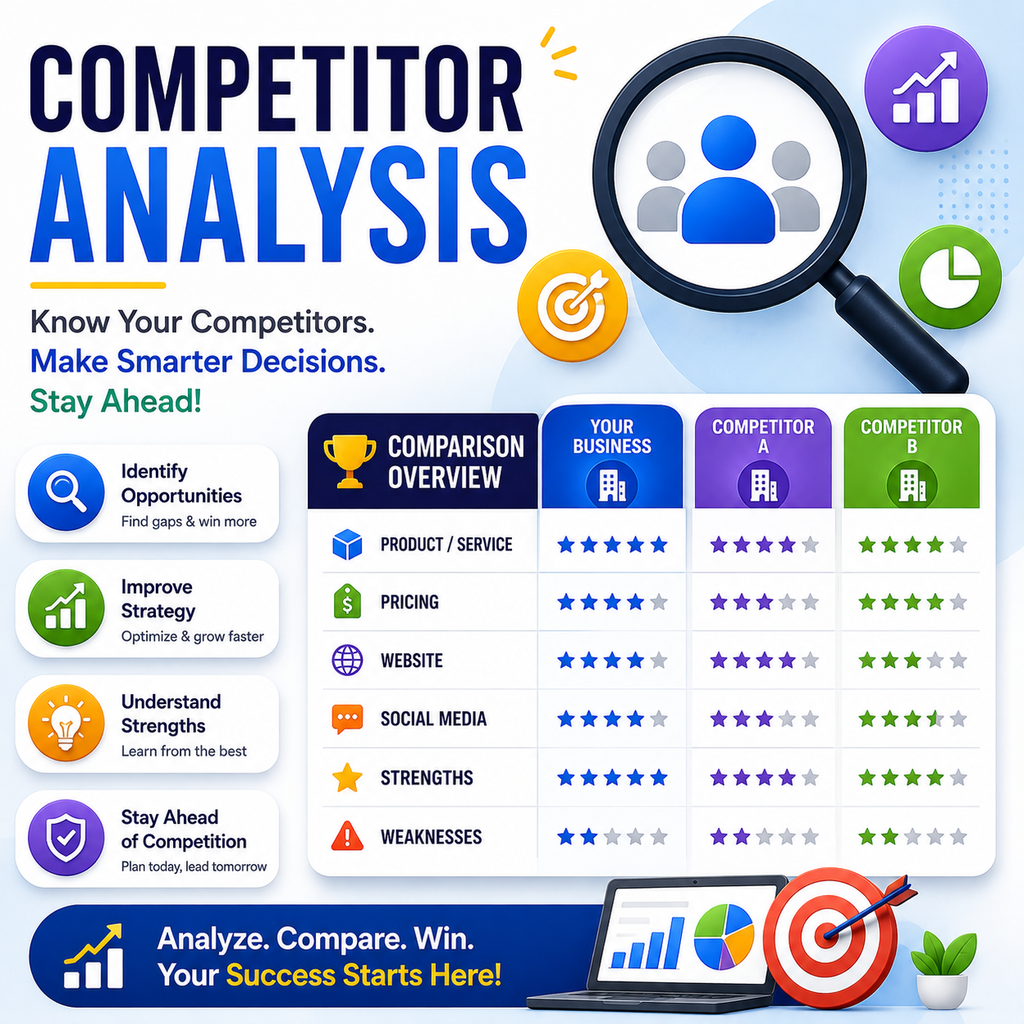
What Is Competitor Analysis?
Competitor analysis is the process of researching businesses that compete with your brand to understand their:
- Products and services
- Target audience
- Pricing
- Marketing strategy
- Content strategy
- SEO performance
- Strengths and weaknesses
- Unique selling propositions
- Customer experience
- Social media presence
Traditional competitor research can involve spreadsheets, SEO platforms, social media research, website audits, and manual analysis.
AI can simplify the process by helping you organize and interpret this information.
How Can ChatGPT Help With Competitor Analysis?
ChatGPT can support several parts of the competitive research process.
1. Create Competitor Profiles
Give ChatGPT information about your business and competitors, then ask it to create standardized profiles.
For example, you can analyze:
- Company positioning
- Target customers
- Products
- Pricing
- Marketing channels
- Content themes
- Brand messaging
- Strengths
- Weaknesses
A standardized format makes it easier to compare several competitors side by side.
2. Analyze Competitor Positioning
Your competitors may sell similar products but communicate their value differently.
ChatGPT can help identify:
- Main positioning
- Unique selling propositions
- Brand promises
- Target customer segments
- Tone of voice
- Differentiators
This can reveal opportunities to position your own business more clearly.
3. Find Content Gaps
Content gap analysis is particularly useful for SEO.
Provide competitor content topics, keywords, or URLs and ask ChatGPT to identify topics that:
- Competitors cover well
- Competitors cover poorly
- Your website does not cover
- Could be developed into detailed guides
- Could answer customer questions
The result can become a content roadmap for your website.
4. Perform SWOT Analysis
ChatGPT can turn competitor research into a simple SWOT framework.
SWOT stands for:
- Strengths
- Weaknesses
- Opportunities
- Threats
For example, a competitor may have strong brand recognition but weak educational content. That could create an opportunity for your business to build authority through useful guides and comparison content.
5. Compare Marketing Strategies
You can ask ChatGPT to compare how competitors attract and engage customers.
Analyze channels such as:
- SEO
- Blogs
- Email marketing
- Social media
- YouTube
- Paid advertising
- Influencer marketing
- Lead magnets
- Landing pages
This helps you identify which channels competitors appear to prioritize.
How to Use ChatGPT for Competitor Analysis
A good competitor analysis workflow should follow a clear process rather than asking one broad question.
Step 1: Identify Your Competitors
Start by creating a list of direct and indirect competitors.
Direct competitors offer similar products or services to the same audience.
Indirect competitors solve the same customer problem through a different product or approach.
You can ask ChatGPT:
“Act as a competitive research strategist. Based on my business description, identify the types of direct and indirect competitors I should research. Explain why each competitor category matters.”
Step 2: Collect Competitor Information
Gather publicly available information from competitor websites, product pages, blogs, social profiles, reviews, and other relevant sources.
Useful information includes:
- Homepage messaging
- Product descriptions
- Pricing
- Blog topics
- Main keywords
- Calls to action
- Customer reviews
- Social media content
- Lead-generation offers
ChatGPT works best when you provide the information you want it to analyze rather than relying on unsupported assumptions.
Step 3: Create a Competitor Comparison
Ask ChatGPT to organize your findings into a comparison table.
Useful comparison categories include:
| Factor | Competitor A | Competitor B | Competitor C |
|---|---|---|---|
| Target audience | |||
| Main product | |||
| Pricing | |||
| USP | |||
| Content strategy | |||
| SEO strategy | |||
| Social presence | |||
| Strengths | |||
| Weaknesses |
This gives you a quick overview of the competitive landscape.
Step 4: Identify Competitive Gaps
Once your data is organized, ask ChatGPT to identify gaps.
Look for opportunities involving:
- Missing content
- Weak messaging
- Poor customer education
- Underserved audiences
- Missing product features
- Weak calls to action
- Poor comparison pages
- Unanswered customer questions
Step 5: Turn Insights Into Action
The goal of competitor analysis isn’t simply to collect information.
Use your findings to create:
- SEO content ideas
- New landing pages
- Product improvements
- Better positioning
- Social media campaigns
- Lead magnets
- Email campaigns
- Comparison pages
Best ChatGPT Prompts for Competitor Analysis
Here are practical prompts you can copy and customize.
Competitor Research Prompt
Act as a competitive intelligence analyst. Analyze the following competitor: [Competitor Name]. Evaluate its target audience, products, positioning, pricing, unique selling proposition, marketing channels, content strategy, strengths, weaknesses, and potential opportunities for my business. Present the findings in a structured table. Clearly separate verified information from assumptions.
SWOT Analysis Prompt
Create a detailed SWOT analysis for [Competitor]. Identify its major strengths, weaknesses, opportunities, and threats. Then explain how my business could use these insights to differentiate itself.
Content Gap Prompt
Compare my website/content topics with the following competitor topics: [Insert Data]. Identify important topics my competitors cover that I do not. Group the opportunities by search intent and prioritize them by potential business value.
SEO Analysis Prompt
Analyze the SEO strategy of this competitor based on the information I provide. Identify its primary keyword themes, content clusters, search intent coverage, internal linking opportunities, and potential content gaps. Then recommend an SEO strategy that can compete without simply copying the competitor.
Marketing Strategy Prompt
Analyze the marketing strategy of [Competitor]. Identify its likely target audience, messaging, content formats, promotional channels, lead-generation methods, calls to action, and customer journey. Then suggest five ways my business can create a stronger strategy.
Competitor Pricing Prompt
Compare the following competitor pricing information: [Insert Pricing]. Identify pricing patterns, entry-level offers, premium plans, feature differences, and positioning. Recommend three possible pricing strategies for my business and explain the advantages and disadvantages of each.
Competitor Social Media Prompt
Analyze the social media content strategy of [Competitor] using the data below. Identify recurring topics, formats, hooks, CTAs, audience pain points, and engagement opportunities. Then create 20 original content ideas inspired by market gaps rather than copying the competitor.
ChatGPT Prompt for a Complete Competitor Analysis
If you want one comprehensive prompt, use this:
Act as a senior competitive intelligence and digital marketing strategist. I want to analyze [Competitor Name] against my business, [Business Name].
My business: [Describe business]
Target audience: [Audience]
Main products/services: [Products]
Website: [URL]Competitor: [Competitor Name]
Competitor website: [URL]Analyze:
- Target audience
- Brand positioning
- Unique selling proposition
- Products/services
- Pricing
- Content strategy
- SEO opportunities
- Social media strategy
- Customer pain points
- Strengths
- Weaknesses
- Content gaps
- Marketing opportunities
- Potential threats
- Three ways my business can differentiate itself
Present the findings in a concise table followed by actionable recommendations. Do not invent facts. Clearly identify information that requires verification.
ChatGPT for SEO Competitor Analysis
ChatGPT can also help organize an SEO competitor analysis.
You can use it to evaluate:
- Keyword themes
- Search intent
- Content clusters
- Topic coverage
- Title ideas
- Meta descriptions
- FAQ opportunities
- Internal linking ideas
- Content gaps
- SERP-focused content structures
However, ChatGPT should complement dedicated SEO tools rather than completely replace them.
Modern competitor research is also expanding beyond traditional Google rankings. AI search visibility matters because platforms such as ChatGPT, Gemini, Perplexity, and Google’s AI features can surface different sources and competitors. Recent AEO research recommends tracking competitor mentions, citations, prompts, and visibility across answer engines.
ChatGPT for Competitor Analysis in GEO and AEO
Competitor research is no longer limited to traditional SEO.
GEO (Generative Engine Optimization) focuses on improving visibility in AI-generated answers, while AEO (Answer Engine Optimization) focuses on making content more likely to be surfaced as an answer by answer engines.
This creates a new competitive question:
“Which competitors are AI platforms mentioning or citing when customers ask questions in my industry?”
You can manually test this by asking different AI platforms questions such as:
- “What are the best [product] for beginners?”
- “Which [service] companies should I consider?”
- “[Competitor A] vs [Competitor B] — which is better?”
- “What are alternatives to [Competitor]?”
- “What should I look for when choosing [product/service]?”
Then record:
- Brands mentioned
- Sources cited
- Reasons given
- Missing brands
- Common recommendations
- Frequently mentioned features
This information can help you identify gaps in your own content and authority strategy.
Important: Don’t Ask ChatGPT to Guess Competitor Data
One of the biggest mistakes in AI-powered competitor research is treating every AI-generated statement as a verified fact.
ChatGPT can help analyze information, but competitor pricing, traffic, revenue, rankings, product features, and other changing information should be verified against reliable sources.
A better workflow is:
Research → Collect data → Verify → Analyze with ChatGPT → Validate insights → Take action
This produces much more reliable competitive intelligence.
Benefits of Using ChatGPT for Competitor Analysis
Faster Research
ChatGPT can summarize and organize large amounts of information into a consistent format.
Better Organization
Instead of keeping scattered notes, you can create structured competitor profiles and comparison tables.
More Strategic Insights
ChatGPT can help connect individual observations and turn them into broader strategic recommendations.
Easier Content Planning
Competitor content analysis can quickly become a list of new topics, FAQs, comparison pages, and content clusters.
Useful for Small Businesses
Businesses without large research teams can use AI to speed up early-stage competitive research.
Limitations of ChatGPT for Competitor Research
ChatGPT is powerful, but it should not be treated as a complete competitive intelligence platform.
Data Accuracy
Always verify important claims using reliable sources.
Real-Time Information
Competitor pricing, products, rankings, campaigns, and strategies can change quickly.
Missing Context
An AI model may not understand every industry-specific factor without sufficient information.
SEO Data
For detailed keyword volumes, backlink profiles, rankings, traffic estimates, and SERP data, dedicated SEO platforms can provide more specialized datasets.
Best Practices for ChatGPT Competitor Analysis
Follow these practices to get better results:
- Give ChatGPT specific data.
- Use the same evaluation criteria for every competitor.
- Ask for evidence or source references when appropriate.
- Separate facts from assumptions.
- Verify important business information.
- Analyze multiple competitors instead of just one.
- Focus on customer needs rather than copying competitors.
- Turn insights into measurable actions.
- Repeat competitor analysis periodically.
- Combine traditional SEO research with AI-search visibility analysis.
Frequently Asked Questions
Can ChatGPT do competitor analysis?
Yes. ChatGPT can help analyze competitor information, compare businesses, identify strengths and weaknesses, generate SWOT analyses, find content gaps, and develop competitive strategies.
What is the best prompt for competitor analysis?
A strong competitor-analysis prompt should provide your business details, competitor information, target audience, and specific areas you want analyzed. Asking for a structured output also makes the results easier to compare.
Can ChatGPT analyze competitor websites?
Yes, when relevant website information or accessible web data is provided. You can use it to analyze messaging, content structure, product positioning, FAQs, calls to action, and other publicly available information. Important claims should still be verified.
Can ChatGPT analyze competitor SEO?
ChatGPT can help interpret SEO data and identify keyword, content, search-intent, and topic opportunities. For detailed rankings, backlinks, keyword volumes, and technical SEO metrics, use specialized SEO tools alongside ChatGPT.
Can ChatGPT find competitor content gaps?
Yes. Give ChatGPT your content topics and competitor topics, and ask it to identify missing subjects, unanswered questions, search-intent gaps, and potential content opportunities.
How often should I perform competitor analysis?
For most businesses, a detailed competitor review every few months can be useful, with lighter monitoring in between. Fast-moving industries may benefit from more frequent checks.
Final Thoughts
ChatGPT for competitor analysis can turn a time-consuming research process into a faster and more structured workflow.
Use it to build competitor profiles, compare positioning, analyze content, identify SEO opportunities, create SWOT analyses, and develop new marketing ideas. The key is not to ask ChatGPT to simply “analyze my competitors.” Give it structured information, define exactly what you want to measure, verify important facts, and turn the findings into specific actions.
For modern marketers, the strongest approach combines traditional SEO competitor research with GEO and AEO analysis. As AI-powered search increasingly influences how people discover products, services, and brands, understanding which competitors appear in AI-generated answers can become an important part of competitive strategy.
Research your competitors. Find the gaps. Build where they are weak.