
Prompts for Digital Marketing
Digital marketing involves a lot more than publishing a few social media posts. Marketers need to research audiences, find keywords, develop content ideas, write ads, create emails, analyze competitors, plan campaigns, and measure results. Doing all of this manually can take a lot of time. That’s where ChatGPT can help.
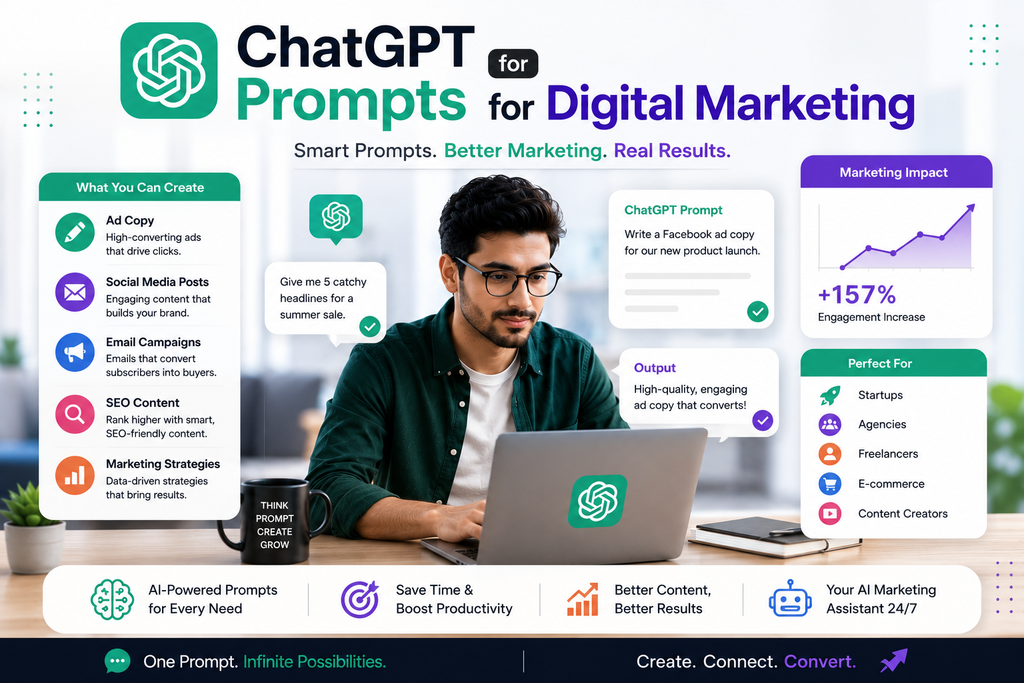
With the right ChatGPT prompts for digital marketing, you can brainstorm campaigns, create content drafts, research customer pain points, develop SEO ideas, improve emails, write advertising copy, and organize your marketing strategy.
ChatGPT prompts for marketing help digital marketers, business owners, and content creators develop effective marketing strategies, create engaging content, and improve campaign performance. These prompts can support keyword research, SEO content planning, social media posts, email marketing, ad copy, customer research, product descriptions, and marketing campaign ideas. By providing clear instructions, target audience details, marketing goals, brand voice, and desired output formats, marketers can get more relevant and actionable results from ChatGPT. For SEO, these prompts help create content that matches search intent and covers important topics, while GEO and AEO support clear, useful, and answer-focused information for AI-powered search and answer engines. Whether you need fresh content ideas, persuasive promotional copy, or a complete marketing plan, ChatGPT prompts for marketing can make everyday digital marketing tasks faster, more organized, and more effective when combined with human creativity and review.
Hi, I’m Gurudeep Singh, and in this guide, I’ll share practical ChatGPT prompts you can customize for different digital marketing tasks.
You’ll find prompts for SEO, content marketing, social media, email marketing, advertising, competitor research, lead generation, and more.
How Can You Use ChatGPT for Digital Marketing?
ChatGPT can help digital marketers with content planning, SEO brainstorming, social media posts, email campaigns, ad copy, audience research, competitor analysis, lead-generation ideas, and campaign planning.
For example:
Prompt:
“Act as a digital marketing strategist for a [business type]. My target audience is [audience], my main product is [product], and my goal is [goal]. Create a 30-day digital marketing plan covering SEO, content, social media, email, and paid advertising. Include priorities, content ideas, KPIs, and recommended actions.”
The more relevant context you provide, the more useful the response can be.
What Are ChatGPT Prompts for Digital Marketing?
ChatGPT prompts for digital marketing are instructions designed to help AI understand a specific marketing task.
A weak prompt might be:
“Create a marketing strategy.”
A stronger prompt would be:
“Act as a digital marketing strategist. Create a 90-day marketing strategy for a small online fitness business targeting busy professionals aged 25–40. Include SEO, social media, email marketing, lead generation, content ideas, KPIs, and a weekly action plan.”
The second prompt provides important context.
A useful marketing prompt usually includes:
- Your business or industry
- Product or service
- Target audience
- Marketing objective
- Customer problem
- Marketing channel
- Brand voice
- Budget or other limitations
- Desired output format
Think of ChatGPT as a marketing assistant that needs a clear brief.
30+ Best ChatGPT Prompts for Digital Marketing
Replace the information inside [brackets] with details about your business, audience, product, or campaign.
1. Create a Complete Digital Marketing Strategy
Prompt:
“Act as an experienced digital marketing strategist. Create a digital marketing strategy for [business]. We sell [product/service] to [target audience]. Our main objective is [goal]. Include SEO, content marketing, social media, email, paid advertising, lead generation, KPIs, and a 90-day action plan.”
Best for: Creating an initial marketing roadmap.
2. Create a 30-Day Marketing Plan
Prompt:
“Create a 30-day digital marketing plan for [business]. Our target customers are [audience], and our primary goal is [goal]. Organize the plan by week and include SEO, social media, content, email, and conversion activities.”
Best for: Small businesses and marketers who need an actionable monthly plan.
3. Identify Your Target Audience
Prompt:
“Help me identify potential target audiences for [product/service]. Create 3 customer segments and explain their needs, pain points, motivations, buying triggers, objections, preferred content, and potential marketing channels.”
Do not assume an AI-generated customer profile represents your actual customers. Validate important assumptions using analytics, surveys, interviews, and real customer data.
4. Create a Buyer Persona
Prompt:
“Create a detailed buyer persona for [product/service] targeting [general audience]. Include goals, challenges, pain points, motivations, buying concerns, questions, preferred channels, and factors that may influence purchasing decisions. Clearly label any assumptions.”
5. Find Customer Pain Points
Prompt:
“List 20 potential pain points experienced by [target audience] when dealing with [problem/category]. Group them by urgency and explain what evidence I should collect to verify each pain point.”
This prompt is particularly useful before developing advertising or landing-page messaging.
6. Generate SEO Keyword Ideas
Prompt:
“Generate keyword ideas related to [topic/product] for [target audience]. Group them by informational, commercial, transactional, and navigational search intent. Suggest relevant topic clusters and long-tail variations. Do not invent search-volume or keyword-difficulty data.”
ChatGPT can brainstorm keywords, but use current keyword-research data before making important SEO decisions.
7. Build an SEO Topic Cluster
Prompt:
“Create an SEO topic cluster around [main topic]. Suggest one pillar page and 20 supporting articles. Group the supporting content into subtopics and explain the search intent behind each article.”
8. Generate SEO Blog Topics
Prompt:
“Suggest 30 useful blog topics about [topic] for [target audience]. Group them by search intent and customer journey stage. Avoid duplicate ideas and overly broad topics.”
9. Create an SEO Content Brief
Prompt:
“Create an SEO content brief for an article targeting the keyphrase [keyphrase]. Include likely search intent, reader questions, recommended H2/H3 structure, entities and concepts worth covering, FAQ questions, internal-link opportunities, and information that should be verified using current authoritative sources.”
10. Optimize Existing Content
Prompt:
“Review the following article for clarity, usefulness, search intent, structure, repetition, missing subtopics, and opportunities to answer reader questions more directly. Do not add keywords unnaturally. Provide recommended changes before rewriting anything: [paste article].”
11. Generate Meta Titles and Descriptions
Prompt:
“Create 10 SEO title options and 10 compelling meta descriptions for a page targeting [keyphrase]. Keep them accurate to the content, natural, specific, and useful to searchers. Avoid clickbait.”
12. Create a Content Marketing Strategy
Prompt:
“Develop a 3-month content marketing strategy for [business] targeting [audience]. Our objective is [goal]. Include content pillars, article ideas, distribution channels, funnel stages, repurposing opportunities, and KPIs.”
13. Create a Content Calendar
Prompt:
“Create a 30-day content calendar for [brand] targeting [audience]. Include publication date, channel, topic, format, customer journey stage, CTA, and primary objective.”
14. Repurpose One Piece of Content
Prompt:
“Turn the following blog article into a content-repurposing plan. Suggest a LinkedIn post, Instagram carousel concept, short-form video script, email newsletter, FAQ section, and three social posts. Adapt each format to its platform rather than simply shortening the original: [paste content].”
15. Generate Social Media Content Ideas
Prompt:
“Generate 30 social media content ideas for [business] targeting [audience]. Divide them into educational, entertaining, trust-building, promotional, customer-focused, and engagement content.”
16. Create Instagram Post Ideas
Prompt:
“Create 20 Instagram post ideas for [brand/product]. For each idea, provide a hook, format, key message, CTA, and the customer problem or interest it addresses.”
17. Write Social Media Captions
Prompt:
“Write 5 social media caption variations about [topic/product] for [platform]. Our target audience is [audience], and our brand voice is [voice]. Keep the claims accurate and give each caption a natural CTA.”
18. Generate Short-Form Video Ideas
Prompt:
“Generate 20 short-form video ideas for [business/topic]. For each video, provide a hook, core message, suggested structure, CTA, and approximate audience intent.”
19. Create a Short-Form Video Script
Prompt:
“Write a short-form video script about [topic] for [audience]. Start with a strong but accurate hook, explain one useful idea clearly, include a practical example, and finish with a relevant CTA. Avoid exaggerated claims.”
20. Create an Email Marketing Campaign
Prompt:
“Create a 5-email marketing sequence for [product/service]. The audience is [audience], and the campaign goal is [goal]. For each email, provide the purpose, subject-line ideas, body outline, CTA, and recommended timing.”
21. Generate Email Subject Lines
Prompt:
“Generate 20 email subject lines for an email about [topic/offer]. The target audience is [audience]. Create a mix of curiosity, benefit-focused, direct, question-based, and urgency-based approaches without using misleading claims.”
22. Create a Welcome Email Sequence
Prompt:
“Create a 5-email welcome sequence for new subscribers to [business/newsletter]. The audience is [audience]. Build trust, introduce the brand, provide useful information, address common problems, and naturally introduce [product/service].”
23. Generate Google Ads Copy
Prompt:
“Create Google Search ad copy ideas for [product/service] targeting people searching for [intent/keyword]. Focus on specific benefits, differentiation, and a clear CTA. Do not invent discounts, guarantees, certifications, or product features.”
Always check the final copy against current platform requirements before launching an advertising campaign.
24. Generate Facebook and Instagram Ad Ideas
Prompt:
“Create 10 Meta ad concepts for [product/service] targeting [audience]. For each concept, provide the customer problem, hook, primary message, creative concept, CTA, and funnel stage. Avoid unsupported claims.”
25. Create Ad Copy Variations
Prompt:
“Write 10 ad-copy variations for [product/service]. Our target audience is [audience], primary benefit is [benefit], and campaign objective is [objective]. Create distinct angles for pain point, benefit, social proof, curiosity, comparison, and objection handling.”
26. Analyze Competitors
Prompt:
“Create a competitor-analysis framework for [industry/business]. I want to compare competitors based on target audience, positioning, offer, pricing, content strategy, SEO, social media, advertising messages, strengths, weaknesses, and customer complaints. Tell me which information requires current external research.”
For actual competitor research, combine ChatGPT with current websites, search results, customer reviews, and reliable market information.
27. Find Content Gaps
Prompt:
“Here is a list of topics covered by my website and competitors: [paste data]. Identify potential content gaps based only on the information provided. Group opportunities by search intent, funnel stage, and audience problem.”
28. Generate Lead Magnet Ideas
Prompt:
“Suggest 15 lead-magnet ideas for [business] targeting [audience]. Each lead magnet should solve a specific small problem related to our paid offer [offer]. Include format, title concept, value proposition, and natural next step.”
29. Create a Lead Generation Strategy
Prompt:
“Create a lead-generation strategy for [business] targeting [audience]. Include organic channels, paid channels, lead magnets, landing pages, email nurturing, conversion points, measurement, and a 60-day testing plan.”
30. Improve a Landing Page
Prompt:
“Review this landing-page copy from the perspective of [target audience]. Identify unclear messaging, weak benefits, unanswered objections, unnecessary sections, trust gaps, and CTA problems. Recommend improvements without inventing customer testimonials or product claims: [paste copy].”
31. Create a Marketing Funnel
Prompt:
“Create a digital marketing funnel for [product/service]. Map the awareness, consideration, conversion, onboarding, and retention stages. For each stage, suggest customer questions, suitable content, marketing channels, CTA, and KPIs.”
32. Create a Product Launch Strategy
Prompt:
“Create a digital marketing launch plan for [product] targeting [audience]. Divide it into pre-launch, launch, and post-launch stages. Include content, email, social media, advertising, landing pages, measurement, and optimization activities.”
33. Generate Marketing Campaign Ideas
Prompt:
“Generate 10 creative digital marketing campaign ideas for [brand/product] targeting [audience]. For each campaign, explain the concept, audience insight, primary channel, content formats, CTA, success metric, and potential risk.”
34. Analyze Marketing Performance
Prompt:
“Analyze the following marketing performance data: [paste data]. Identify meaningful patterns, potential problems, areas that need further investigation, and experiments worth testing. Clearly distinguish observations from hypotheses.”
35. Create A/B Testing Ideas
Prompt:
“Generate 15 A/B testing ideas for this [landing page/email/ad]: [details]. Prioritize tests involving headlines, offers, CTAs, creative, messaging, and page structure. For each test, state the hypothesis and metric that should determine success.”
Best ChatGPT Prompt for a Digital Marketing Strategy
If you only want to save one prompt from this guide, try this:
Prompt:
“Act as a senior digital marketing strategist. I run [business] and sell [product/service]. My target audience is [audience], primary market is [location], approximate monthly marketing budget is [budget], and main objective is [goal].
Create a practical 90-day digital marketing strategy.
Include:
- Target-audience hypotheses
- Customer journey
- SEO strategy
- Content strategy
- Social media strategy
- Email marketing
- Paid advertising
- Lead generation
- Conversion optimization
- Weekly priorities
- KPIs
- Experiments to run
Clearly distinguish recommendations from assumptions and identify any information that requires current external research.”
This prompt works well because it gives ChatGPT both context and a clear output structure.
How to Write Better ChatGPT Prompts for Marketing
A useful formula is:
Role + Business Context + Audience + Goal + Constraints + Task + Output
For example:
Role: Act as an SEO strategist.
Business: I operate an online language-learning platform.
Audience: Working professionals who want to improve their English.
Goal: Increase organic traffic.
Constraint: We can publish four high-quality articles per month.
Task: Build a content strategy.
Output: Give me a three-month calendar with topic, search intent, funnel stage, and CTA.
Combining these details produces a much clearer prompt:
Prompt:
“Act as an SEO strategist for an online language-learning platform targeting working professionals who want to improve their English. Our objective is to increase relevant organic traffic, and we can publish four high-quality articles each month. Create a three-month content plan containing the primary topic, target search intent, customer journey stage, article purpose, and CTA for every article.”
How to Use ChatGPT for Digital Marketing Step by Step
Step 1: Define Your Goal
Don’t start with the tool. Start with the marketing problem.
For example:
- Increase qualified website traffic
- Generate leads
- Improve email engagement
- Create more consistent content
- Increase conversions
- Research customer needs
Step 2: Give ChatGPT Context
Explain your:
- Business
- Product
- Audience
- Market
- Goal
- Budget
- Limitations
Step 3: Ask for a Specific Deliverable
Instead of asking:
“Help with marketing.”
Ask:
“Create a 30-day Instagram content calendar.”
Specific tasks usually produce more usable responses.
Step 4: Review the Response
Check whether the output:
- Fits your audience
- Matches your brand
- Contains factual errors
- Makes unsupported claims
- Uses outdated information
- Needs additional research
Step 5: Refine the Prompt
Your first response doesn’t have to be the final one.
Try follow-up instructions such as:
“Make this more specific to beginners.”
“Give me three alternative approaches.”
“Remove generic recommendations.”
“Explain the reasoning behind each recommendation.”
“Which assumptions should I validate?”
Step 6: Verify Important Information
This is especially important for:
- Statistics
- Market trends
- Competitor information
- Search volumes
- Keyword difficulty
- Advertising requirements
- Platform features
- Prices
- Laws and regulations
AI-generated information should not automatically be treated as current or verified.
Step 7: Measure Real Results
Marketing decisions should ultimately be based on real performance.
Track metrics such as traffic, qualified leads, conversions, customer acquisition cost, revenue, engagement, and retention where relevant.
Where ChatGPT Can Help Digital Marketers Most
ChatGPT is particularly useful for tasks involving brainstorming, drafting, organizing, summarizing, and generating variations.
SEO
Use it to brainstorm keywords, build topic clusters, create content briefs, generate FAQ ideas, and improve content structure.
Content Marketing
Use ChatGPT for content calendars, article outlines, topic ideas, repurposing plans, and first drafts.
Social Media
It can help generate hooks, post ideas, captions, scripts, content calendars, and campaign concepts.
Email Marketing
Use it for subject-line variations, email sequences, segmentation ideas, CTAs, and copy drafts.
Paid Advertising
ChatGPT can brainstorm ad angles, headlines, creative concepts, audience pain points, and A/B tests.
Market Research
It can help you develop research questions, organize provided data, build customer hypotheses, and create competitor-analysis frameworks.
What ChatGPT Should Not Replace in Digital Marketing
ChatGPT can make marketing work faster, but it shouldn’t replace everything.
You still need reliable sources and human judgment for:
Real-time data: ChatGPT shouldn’t be your only source for current search volumes, competitor activity, advertising costs, or trends.
Customer research: AI-generated personas are hypotheses until supported by real customer evidence.
Analytics: Use your actual website, advertising, CRM, and sales data when evaluating performance.
Brand judgment: Review AI-generated copy to ensure it sounds like your business.
Factual accuracy: Verify important claims before publishing them.
The best approach is often AI assistance + human expertise + real data.
Common Mistakes When Using ChatGPT for Digital Marketing
1. Using Generic Prompts
“Write a Facebook post” gives ChatGPT very little direction.
Specify the audience, goal, product, tone, and CTA.
2. Publishing AI Content Without Editing
A first draft can contain generic wording, repetition, factual errors, or claims that don’t match your business.
Always review it.
3. Asking ChatGPT to Invent SEO Metrics
Don’t ask ChatGPT to guess keyword search volumes or difficulty scores and then treat those numbers as factual data.
Use appropriate current SEO data sources.
4. Creating Content Only for Search Engines
A page can contain keywords and still be unhelpful.
Start with what the reader is actually trying to accomplish.
5. Using the Same Content Everywhere
An email, Instagram Reel, blog article, Google ad, and landing page serve different purposes.
Adapt the message to the channel.
6. Trusting AI-Generated Competitor Information Without Checking
Competitor products, pricing, features, and positioning can change.
Verify them using current sources.
Frequently Asked Questions
What are the best ChatGPT prompts for digital marketing?
The best prompts clearly specify the business, target audience, marketing objective, channel, constraints, and desired output. Useful applications include SEO planning, content creation, social media, email marketing, advertising, lead generation, and campaign analysis.
Can ChatGPT be used for digital marketing?
Yes. ChatGPT can assist with many digital marketing tasks, including brainstorming, content planning, copywriting, SEO research frameworks, email drafts, social media ideas, advertising concepts, and marketing analysis.
How do digital marketers use ChatGPT?
Digital marketers can use ChatGPT to accelerate repetitive creative and planning tasks. For example, a marketer can provide information about a campaign and ask ChatGPT to generate headline variations, audience hypotheses, content ideas, or A/B tests.
Can ChatGPT help with SEO?
Yes. ChatGPT can help brainstorm keywords, organize topic clusters, create content briefs, generate FAQs, analyze supplied content, and improve structure. Current keyword metrics, rankings, search results, and competitor data should be verified using reliable external sources.
Can ChatGPT create a digital marketing strategy?
Yes. ChatGPT can draft a digital marketing strategy when you provide information about your business, audience, goals, budget, and resources. The strategy should then be reviewed against actual customer, market, and performance data.
Can ChatGPT write marketing content?
Yes. ChatGPT can help draft blog posts, emails, advertisements, social media posts, landing pages, product descriptions, scripts, and other marketing materials. Human review remains important for accuracy, originality, brand voice, and quality.
Is ChatGPT good for social media marketing?
ChatGPT can be useful for generating content ideas, captions, hooks, short-form video scripts, calendars, campaign concepts, and content variations. Actual platform performance should determine which ideas you continue using.
Can ChatGPT replace a digital marketer?
ChatGPT can automate or accelerate parts of a marketer’s workflow, but digital marketing also requires strategic judgment, customer understanding, current data, experimentation, creativity, measurement, and business knowledge.
Final Thoughts
ChatGPT can be a powerful assistant for digital marketers when you know how to prompt it properly.
Instead of relying on one-line instructions, provide information about your business, audience, objective, channel, constraints, and expected output.
The ChatGPT prompts for digital marketing in this guide can help you brainstorm and organize SEO, content marketing, social media, email, advertising, lead generation, and campaign strategies.
But remember that AI output is a starting point, not automatically a final answer.
Combine ChatGPT with your experience, real customer insights, current research, and performance data to make better marketing decisions.