
Transportation is an essential part of modern life. People travel by cars, buses, trains, airplanes, and ships every day, while businesses depend on transportation networks to move products around the world.
As transportation systems become more connected and complex, artificial intelligence is playing an increasingly important role.
Automate business processes with AI to save time, reduce repetitive work, and improve overall efficiency. AI can automate tasks such as customer support, data entry, email management, lead generation, reporting, and marketing workflows. Businesses can use AI tools to streamline daily operations, improve productivity, and make faster data-driven decisions. Whether you run a small business or a growing company, automate business processes with AI to reduce manual effort, improve accuracy, and create scalable workflows that support long-term business growth.
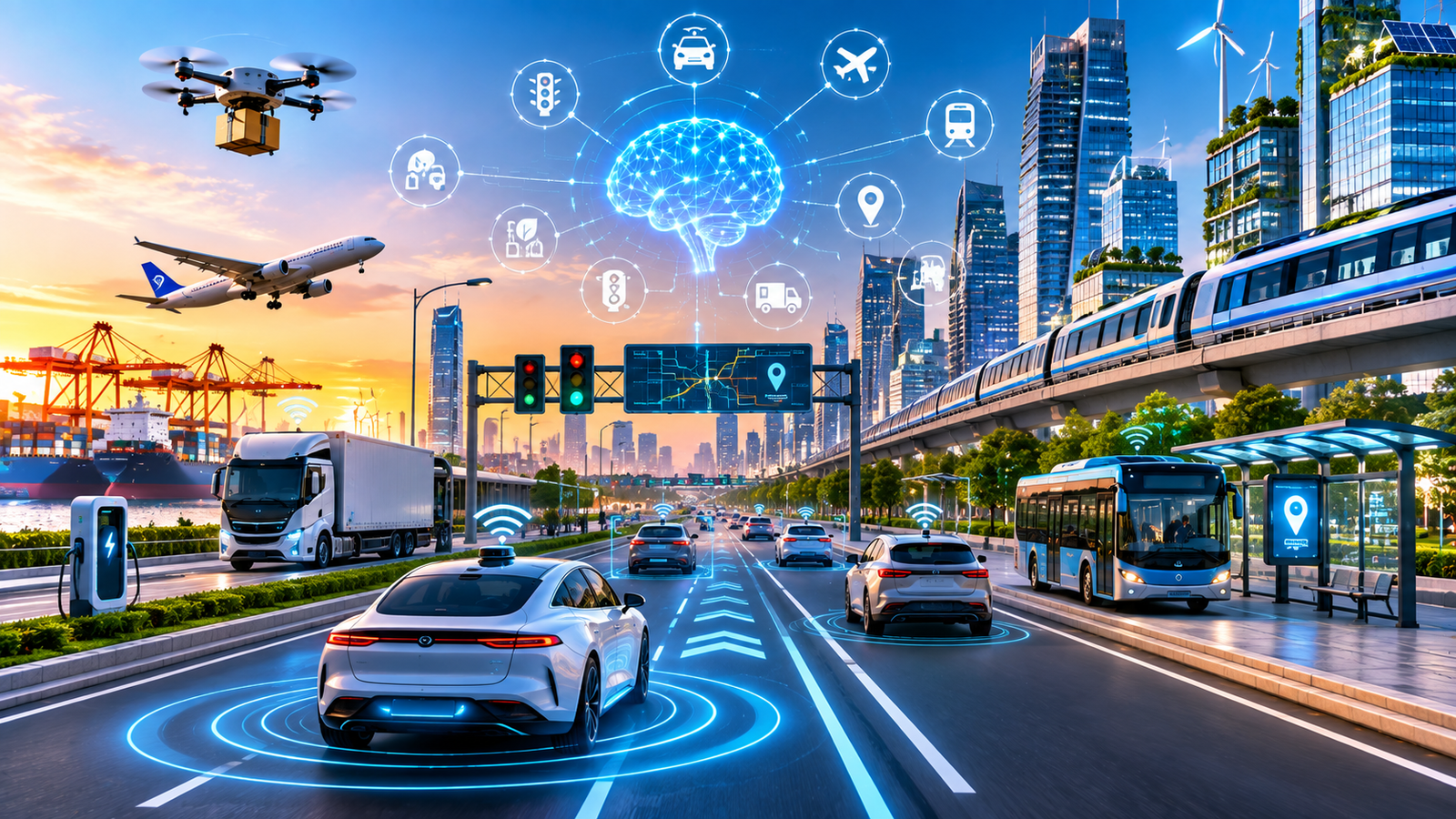
AI in transportation is being used for traffic management, route optimization, vehicle safety, predictive maintenance, autonomous vehicles, logistics, public transportation, and many other applications.
By analyzing large amounts of information in real time, AI can help transportation systems become more efficient, safer, and responsive.
What Is AI in Transportation?
AI in transportation refers to the use of artificial intelligence, machine learning, computer vision, sensors, and data analytics to improve transportation systems.
AI can analyze information from:
- Cameras
- GPS systems
- Traffic sensors
- Vehicles
- Road infrastructure
- Weather systems
- Maps
- Public transportation networks
- Historical travel data
This information can be used to identify patterns, predict conditions, and support automated or human decisions.
Why Is AI Important in Transportation?
Transportation systems generate huge amounts of data every day.
For example, millions of vehicles generate information about:
- Location
- Speed
- Traffic conditions
- Travel routes
- Fuel consumption
- Vehicle performance
AI can process this information much faster than traditional manual methods.
This allows transportation companies and authorities to make more informed decisions.
AI for Traffic Management
Traffic congestion is a major problem in many cities.
Traditional traffic signals often operate according to fixed schedules.
AI-powered traffic management systems can analyze traffic conditions and adjust signals according to real-time demand.
For example, if one road becomes heavily congested, an intelligent traffic system may adjust signal timings to improve traffic flow.
AI can consider:
- Vehicle volume
- Traffic speed
- Road congestion
- Time of day
- Accidents
- Weather conditions
- Special events
This can potentially reduce unnecessary waiting and improve road efficiency.
AI for Route Optimization
Choosing the best route is important for both individuals and businesses.
Navigation applications already use algorithms to recommend routes.
AI can take this further by analyzing multiple factors simultaneously.
These may include:
- Traffic
- Road closures
- Weather
- Accidents
- Construction
- Travel time
- Historical traffic patterns
The system can then recommend a route that may reduce travel time or avoid congestion.
AI and Autonomous Vehicles
Autonomous vehicles are one of the most well-known applications of AI in transportation.
These vehicles use cameras, radar, sensors, maps, and computing systems to understand their surroundings.
AI can help a vehicle identify:
- Cars
- Pedestrians
- Traffic lights
- Road signs
- Lane markings
- Bicycles
- Obstacles
The system processes this information and makes decisions within the capabilities and rules of the autonomous driving system.
Fully autonomous transportation remains a complex technological challenge.
How AI Helps Self-Driving Cars
A self-driving vehicle needs to understand what is happening around it.
A simplified process looks like:
Sensors → Data Processing → Object Detection → Prediction → Decision → Vehicle Action
For example, a vehicle may detect a pedestrian near a crossing.
The AI system can analyze the pedestrian’s position and movement, estimate potential movement, and determine an appropriate response.
This requires extremely fast processing.
AI for Driver Assistance
AI is already used in many driver-assistance technologies.
Examples include:
- Lane departure warnings
- Automatic emergency braking
- Blind-spot detection
- Adaptive cruise control
- Parking assistance
- Traffic-sign recognition
These technologies can provide additional assistance to drivers.
However, drivers must understand the limitations of these systems and remain responsible for operating their vehicles where required.
AI for Accident Prevention
AI can potentially help reduce certain transportation risks.
Vehicle systems can analyze sensor information and identify potential hazards.
For example, a vehicle may detect an obstacle and warn the driver.
Advanced systems may also automatically apply braking in certain situations.
AI cannot prevent every accident, but intelligent safety technologies can provide additional layers of protection.
AI for Predictive Maintenance
Vehicle and transportation equipment maintenance can be expensive.
Unexpected breakdowns can also cause delays.
AI can analyze information from sensors installed in vehicles, trains, aircraft, or other equipment.
The system can identify patterns that may indicate developing problems.
This approach is known as predictive maintenance.
Instead of waiting for equipment to fail, operators can investigate potential problems earlier.
AI in Public Transportation
Public transportation systems can also benefit from AI.
Buses, trains, metros, and other transportation services can use AI for:
- Route planning
- Scheduling
- Passenger demand prediction
- Maintenance
- Traffic management
- Service optimization
AI can analyze passenger patterns and help transportation authorities understand when and where demand is highest.
AI for Bus Route Optimization
Bus routes need to balance passenger demand, travel time, operating costs, and road conditions.
AI can analyze historical passenger data and traffic patterns.
This can help transportation providers evaluate whether routes and schedules are meeting demand efficiently.
During periods of high demand, additional services may be considered where appropriate.
AI for Railway Systems
Railways generate significant amounts of operational data.
AI can assist with:
- Train scheduling
- Track monitoring
- Predictive maintenance
- Passenger demand forecasting
- Energy management
- Safety monitoring
AI-based monitoring systems can analyze information from railway infrastructure and identify unusual patterns that may require inspection.
AI for Railway Predictive Maintenance
Railway infrastructure requires regular maintenance.
Tracks, signals, bridges, trains, and other components need to remain in good condition.
Sensors and monitoring equipment can collect information about infrastructure.
AI can analyze this data and identify patterns associated with potential maintenance requirements.
This can help operators plan maintenance before equipment develops a serious problem.
AI in Air Transportation
Air transportation is another major area where AI can support operations.
Airlines and airports can use AI for:
- Flight scheduling
- Passenger processing
- Baggage management
- Aircraft maintenance
- Route planning
- Airport operations
- Customer service
AI can help process large amounts of operational information.
AI for Aircraft Maintenance
Aircraft maintenance requires careful inspection and planning.
AI can analyze information from aircraft systems and maintenance records.
Predictive systems can identify unusual patterns that may indicate potential equipment issues.
Maintenance professionals can then inspect the relevant systems.
AI supports the process but does not eliminate the need for qualified aviation professionals.
AI for Airport Security
Airports use advanced technologies to support security and passenger processing.
AI-powered computer vision can help analyze images and identify objects or patterns that require further inspection.
Automated systems can also support identity verification and passenger flow management.
Security applications require careful handling because they involve privacy, safety, and regulatory considerations.
AI for Baggage Management
Managing baggage at large airports can be complicated.
AI can help optimize baggage routing and identify potential problems.
Systems can analyze information about:
- Flight schedules
- Baggage destinations
- Transfer times
- Conveyor systems
- Airport operations
Better coordination can potentially reduce baggage delays and improve airport efficiency.
AI in Shipping and Maritime Transportation
AI is also being used in maritime transportation.
Ships and shipping companies can use AI to analyze:
- Weather
- Sea conditions
- Fuel consumption
- Shipping routes
- Port congestion
- Vessel performance
This can help companies optimize routes and reduce unnecessary fuel consumption.
AI for Logistics
Logistics involves moving products from one location to another.
Companies need to manage:
- Warehouses
- Trucks
- Drivers
- Delivery routes
- Inventory
- Customer demand
AI can analyze these factors and help optimize logistics operations.
AI for Delivery Route Optimization
Delivery companies often have hundreds or thousands of deliveries.
AI can help determine efficient routes based on:
- Delivery locations
- Traffic
- Vehicle capacity
- Delivery priorities
- Time windows
- Road conditions
A well-optimized route can potentially reduce travel time and fuel consumption.
AI and Last-Mile Delivery
The last mile refers to the final stage of delivering a product to the customer.
It is often one of the most expensive parts of logistics.
AI can help optimize last-mile delivery by analyzing delivery locations and traffic conditions.
Companies can use AI to group deliveries and create more efficient routes.
AI-Powered Delivery Robots
Delivery robots are being explored for certain short-distance delivery applications.
These robots can use cameras and sensors to navigate their surroundings.
AI can help them identify:
- Pedestrians
- Roads
- Obstacles
- Sidewalks
- Other objects
The technology is still developing and may be more suitable for specific environments than general transportation.
AI and Drones
Drones can be used for certain delivery and transportation-related applications.
AI can help drones navigate and process information from their sensors.
Potential applications include:
- Package delivery
- Infrastructure inspection
- Emergency response
- Mapping
- Monitoring
Drone operations must comply with applicable aviation and safety requirements.
AI for Fleet Management
Businesses operating large vehicle fleets need to monitor their vehicles continuously.
AI can analyze fleet information such as:
- Fuel consumption
- Vehicle location
- Driver behavior
- Maintenance status
- Route efficiency
- Vehicle utilization
This can help fleet managers identify inefficiencies.
AI for Fuel Efficiency
Fuel is a major operating cost for many transportation businesses.
AI can analyze driving patterns, vehicle performance, traffic, and routes to identify opportunities for improved efficiency.
For example, optimized routes may reduce unnecessary distance traveled.
AI can also help identify inefficient driving patterns.
AI and Electric Vehicles
Electric vehicles are creating new opportunities for intelligent transportation systems.
AI can support:
- Battery monitoring
- Charging optimization
- Energy management
- Route planning
- Range prediction
- Predictive maintenance
An intelligent navigation system could consider charging station availability when planning a long-distance route.
AI for Battery Management
Battery performance is important for electric vehicles.
AI can analyze battery information to estimate:
- Energy consumption
- Battery condition
- Remaining range
- Charging requirements
Better predictions can help drivers plan trips more effectively.
AI for Smart Parking
Finding parking can waste time and increase unnecessary traffic.
AI-powered parking systems can analyze parking availability and guide drivers toward available spaces.
Smart parking systems can use:
- Cameras
- Sensors
- Mobile applications
- Parking databases
This can potentially reduce the amount of time drivers spend searching for parking.
AI for Emergency Transportation
AI can also support emergency response.
Emergency vehicles need to reach destinations quickly.
AI systems can analyze traffic and identify potentially efficient routes.
Traffic management systems may also support emergency vehicle movement by coordinating signals where appropriate.
AI for Accident Detection
AI-powered cameras and sensors can help identify potential accidents.
For example, computer vision systems can detect:
- Sudden vehicle stops
- Collisions
- Abnormal traffic patterns
- Vehicles stopped in unusual locations
The system can then alert relevant authorities or transportation operators.
Fast detection can help emergency services respond more quickly.
AI and Smart Cities
AI in transportation is closely connected to the development of smart cities.
A smart city can combine information from:
- Traffic systems
- Public transportation
- Roads
- Parking systems
- Weather sensors
- Emergency services
AI can analyze this information and help coordinate transportation infrastructure.
AI for Transportation Demand Prediction
Transportation demand changes throughout the day.
Demand may increase during:
- Morning commutes
- Evening commutes
- Weekends
- Holidays
- Major events
AI can analyze historical data and current conditions to predict demand.
Transportation providers can use these insights to adjust services.
AI for Travel Planning
AI assistants can also help individual travelers.
Users may ask an AI system to help plan a journey involving:
- Cars
- Buses
- Trains
- Flights
- Walking
- Ride-sharing
The AI can help organize available options and explain travel considerations.
Users should still verify schedules, prices, and availability before traveling.
AI and Ride-Sharing
Ride-sharing companies can use AI for matching passengers and drivers.
AI can analyze:
- Driver locations
- Passenger requests
- Traffic
- Travel distance
- Demand patterns
This can help improve matching and reduce unnecessary driving.
AI and Transportation Safety
Safety is one of the most important reasons for developing intelligent transportation technologies.
AI can support safety through:
- Hazard detection
- Driver assistance
- Traffic monitoring
- Predictive maintenance
- Accident detection
- Infrastructure monitoring
However, AI systems must be carefully tested because transportation is a high-stakes environment.
Challenges of AI in Transportation
Despite its potential benefits, AI in transportation has several challenges.
These include:
- High development costs
- Data privacy
- Cybersecurity
- System reliability
- Infrastructure requirements
- Regulatory challenges
- Weather-related limitations
- Algorithmic errors
- Public acceptance
Transportation systems need to be reliable because failures can affect large numbers of people.
AI and Transportation Cybersecurity
Connected vehicles and transportation systems can create new cybersecurity risks.
Modern transportation infrastructure may connect vehicles, mobile applications, cloud platforms, traffic systems, and communication networks.
If these systems are compromised, attackers could potentially disrupt operations.
Strong cybersecurity measures are therefore essential.
Data Privacy in Smart Transportation
AI transportation systems can collect significant amounts of information.
This may include:
- Vehicle locations
- Travel patterns
- Passenger information
- Device data
- License plate information
Organizations need appropriate policies and safeguards to protect sensitive information.
AI Can Make Mistakes
AI systems are not perfect.
A computer vision system may incorrectly identify an object.
A traffic prediction model may fail to anticipate an unusual event.
A route optimization system may make a poor recommendation because of incomplete data.
Human oversight and system safeguards remain important.
AI and Human Drivers
Even as AI-powered driver assistance becomes more advanced, human drivers remain important in many transportation environments.
Drivers need to understand:
- What the system can do
- What it cannot do
- When intervention is required
- How alerts work
Users should not assume that an AI-enabled vehicle can handle every possible situation.
Benefits of AI in Transportation
AI can provide several potential advantages.
Improved Traffic Management
AI can analyze traffic conditions and support smarter signal management.
Better Route Planning
AI can identify routes based on traffic and other conditions.
Improved Safety
AI can help detect hazards and unusual situations.
Predictive Maintenance
AI can identify patterns that may indicate equipment problems.
Better Public Transportation
AI can help optimize schedules and routes.
Lower Operational Costs
Better planning can reduce unnecessary fuel use and vehicle downtime.
Improved Customer Experience
AI can support travel planning, customer service, and real-time information.
The Future of AI in Transportation
Transportation is moving toward a more connected environment.
Future transportation systems may combine:
AI + Sensors + Connectivity + Robotics + Autonomous Systems + Real-Time Data
Vehicles may communicate with infrastructure.
Traffic systems may respond dynamically to changing conditions.
Public transportation may use AI to optimize schedules based on demand.
Logistics companies may increasingly automate route planning and fleet management.
AI and Connected Vehicles
Connected vehicles can communicate with digital systems and potentially with other vehicles and infrastructure.
AI can analyze this information to support:
- Traffic awareness
- Route planning
- Safety alerts
- Vehicle management
- Fleet coordination
Connected transportation could eventually create more coordinated road networks.
AI and Autonomous Public Transportation
Autonomous buses, shuttles, and other transportation systems are being explored for controlled environments and specific routes.
AI can help these vehicles navigate and respond to their surroundings.
Potential applications include:
- Airport transportation
- Campus transportation
- Industrial areas
- Dedicated transit routes
The technology needs extensive testing before being deployed widely.
AI and Sustainable Transportation
AI can potentially contribute to more sustainable transportation.
Optimized routes can reduce unnecessary travel.
Smart traffic systems can reduce idle time.
Predictive maintenance can help vehicles operate efficiently.
Public transportation optimization can potentially encourage better use of shared transportation.
AI alone cannot solve transportation-related environmental challenges, but it can support more efficient systems.
AI Skills in the Transportation Industry
As AI becomes more common, transportation professionals may need new skills.
Important areas may include:
- Data analysis
- AI systems
- Robotics
- Cybersecurity
- Autonomous technology
- Fleet management
- Digital infrastructure
The transportation workforce may increasingly combine traditional industry knowledge with technology expertise.
How Businesses Can Adopt AI in Transportation
Businesses should begin with specific operational problems.
A practical process can include:
- Identify a transportation challenge.
- Collect reliable data.
- Select an appropriate AI solution.
- Test the system.
- Measure results.
- Add human oversight.
- Monitor performance.
- Improve the system over time.
AI should solve a real business problem rather than being adopted simply because it is a popular technology.
What Travelers Should Know About AI
Travelers are increasingly interacting with AI without realizing it.
AI may already be involved in:
- Navigation
- Traffic predictions
- Ride matching
- Airport operations
- Customer support
- Travel recommendations
Users should understand that AI recommendations are based on available data and may not always be accurate.
Important travel information such as schedules, cancellations, and safety instructions should be verified through appropriate official channels.
Final Thoughts
AI in transportation is changing how people and products move from one place to another.
From traffic management and route optimization to autonomous vehicles, predictive maintenance, logistics, smart parking, public transportation, and electric vehicle technology, AI has a wide range of applications.
The biggest opportunity lies in combining AI with reliable infrastructure, high-quality data, strong cybersecurity, and human expertise.
At the same time, transportation AI must be developed responsibly because mistakes can affect safety and public trust.
The future of transportation will likely not depend on artificial intelligence alone.
Instead, it will involve a combination of AI, connected infrastructure, intelligent vehicles, human expertise, and real-time data.
As these technologies continue to develop, transportation systems could become more efficient, safer, better connected, and more responsive to the needs of travelers and businesses.
FAQs
What is AI in transportation?
AI in transportation refers to using artificial intelligence, machine learning, computer vision, sensors, and data analytics to improve vehicles, traffic systems, logistics, public transportation, and other transportation operations.
How is AI used in transportation?
AI is used for traffic management, route optimization, autonomous vehicles, predictive maintenance, fleet management, logistics, accident detection, public transportation, and travel planning.
Can AI reduce traffic congestion?
AI can analyze real-time traffic information and help optimize traffic signals, routes, and transportation operations. It cannot eliminate congestion completely.
How does AI help self-driving cars?
AI helps autonomous vehicles analyze information from cameras, sensors, radar, maps, and other systems to identify objects and make driving decisions within the capabilities of the vehicle.
Can AI improve road safety?
AI can assist with hazard detection, driver-assistance systems, accident detection, and predictive maintenance, potentially adding additional layers of safety.
How does AI help public transportation?
AI can help optimize routes, schedules, passenger demand, maintenance, and transportation operations.
What is predictive maintenance in transportation?
Predictive maintenance uses data and AI models to identify patterns that may indicate equipment problems before a major failure occurs.
How does AI help logistics companies?
AI can optimize delivery routes, analyze demand, manage fleets, predict maintenance needs, and improve supply-chain operations.
Can AI help electric vehicles?
Yes. AI can support battery monitoring, range prediction, charging optimization, route planning, energy management, and predictive maintenance.
What are the risks of AI in transportation?
Major risks include system errors, cybersecurity threats, privacy concerns, infrastructure limitations, unreliable predictions, and overreliance on automated systems.
Will AI replace transportation workers?
AI may automate some repetitive tasks, but transportation still requires human expertise, supervision, maintenance, decision-making, and customer interaction.
What is the future of AI in transportation?
The future may involve increasingly connected vehicles, intelligent traffic systems, autonomous transportation, smart infrastructure, AI-powered logistics, and more efficient public transportation.

Akshay Saini is an AI and technology writer at KeyArtificial, covering ChatGPT, Google Gemini, AI prompts, AI tools, AI image generation, photo editing trends, and emerging AI developments.
Pingback: AI in E-Commerce: How Artificial Intelligence Is Transforming Online Shopping - keyartificial.com