
ChatGPT Prompts for SEO
In 2026, successful SEO requires a much broader approach: search intent, useful content, topical relevance, technical SEO, internal linking, original information, user experience, trust, and conversion optimization. ChatGPT can make many of these tasks faster. You can use it to research keyword ideas, analyze search intent, create content briefs, improve titles, generate FAQs, build topic clusters, find internal-link opportunities, refresh old content, analyze SEO data, and develop content strategies.
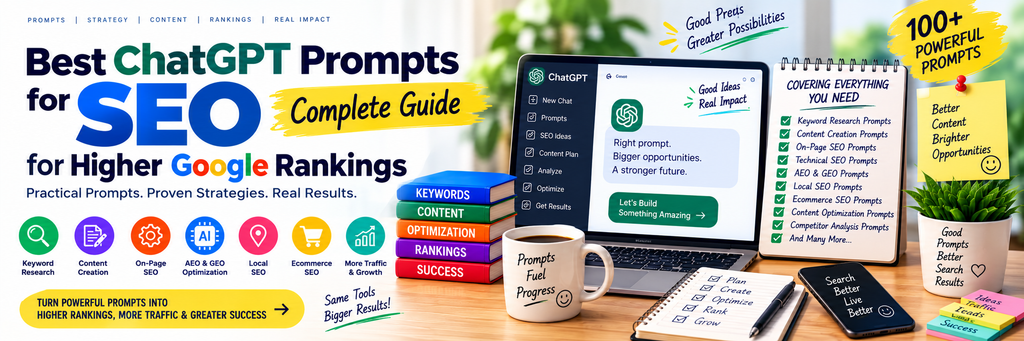
ChatGPT SEO prompts help SEO professionals, content writers, and marketers use ChatGPT more effectively for keyword research, content planning, search intent analysis, on-page optimization, content briefs, internal linking, competitor research, and SEO content creation. Instead of using generic instructions, well-written ChatGPT SEO prompts provide specific goals, target keywords, audience information, tone, search intent, and desired output formats to generate more relevant results. For GEO, these prompts can help create clear, useful, and context-rich content that AI-powered search systems can understand and potentially reference. AEO can also be supported by using ChatGPT SEO prompts to create direct answers, FAQs, conversational content, and question-based sections that address what users are searching for. When combined with reliable SEO data and human review, ChatGPT SEO prompts can make SEO workflows faster while helping create content that is useful for both readers and modern search platforms.
But there is a major mistake you should avoid:
Don’t use ChatGPT simply to produce more content. Use it to produce better SEO decisions and more useful content.
Google’s current guidance confirms that established SEO best practices remain important for AI-powered Search experiences. Google also recommends unique, useful, people-first content rather than trying to exploit special “AEO/GEO hacks.” This guide contains practical ChatGPT prompts for SEO that you can copy, customize, and use for your website.
What Are 100+ ChatGPT Prompts for SEO?
ChatGPT SEO prompts are instructions designed to help ChatGPT perform specific SEO tasks.
Compare these two prompts.
Weak prompt
Write an SEO article about indoor plants.
The instruction is too broad.
Better prompt
Act as an experienced SEO content strategist. Create a beginner-friendly guide to indoor plant care for Indian homeowners. Identify the primary search intent, important questions, related topics, common mistakes, practical examples, and conversion opportunities. Use simple English, short paragraphs, clear headings, and natural keyword usage. Avoid keyword stuffing and unsupported claims.
The second prompt gives ChatGPT:
- A role
- A topic
- An audience
- A location
- A goal
- Content requirements
- Quality standards
That difference matters.
Can ChatGPT Help With Google SEO?
Yes, but ChatGPT should be treated as an SEO assistant, not an automatic ranking machine.
It can help you with:
- Keyword research
- Search-intent analysis
- Content planning
- Topic clusters
- SEO outlines
- Article drafts
- Title optimization
- Meta descriptions
- Internal linking
- Content audits
- Content refreshing
- FAQ research
- Local SEO
- Ecommerce SEO
- Technical SEO planning
- AEO
- AI-search optimization
- SEO reporting
However, no ChatGPT prompt can guarantee a #1 Google ranking.
Google’s generative AI Search features are built on its existing ranking and quality systems, so core SEO remains important.
How to Write a Powerful ChatGPT SEO Prompt
A useful formula is:
Role + Context + Audience + Keyword + Search Intent + Goal + Requirements + Output Format
Example
Act as a senior SEO strategist.
Website: [website]
Business: [business]
Audience: [target audience]
Primary keyword: [keyword]
Search intent: [intent]
Goal: [traffic/leads/sales]
Create: [task]
Requirements: clear English, short paragraphs, practical examples, natural keyword usage, strong readability, and people-first content.
Do not invent facts, statistics, testimonials, or sources.
This is much stronger than:
Make this article SEO-friendly.
100+ Best ChatGPT Prompts for SEO
1. ChatGPT Prompts for Keyword Research
1. Complete Keyword Research
Act as a senior SEO strategist. Research keyword opportunities for [business/topic]. Create primary keywords, secondary keywords, long-tail keywords, informational keywords, commercial keywords, transactional keywords, and local keywords. Group them by search intent.
2. Long-Tail Keyword Research
Generate 50 long-tail keyword ideas related to [topic]. Prioritize specific searches that indicate a clear question, problem, comparison, or buying need.
3. Question Keywords
Generate 50 questions users may genuinely search about [topic]. Group them into beginner, practical, comparison, troubleshooting, buying, and advanced questions.
4. Commercial Keywords
Generate commercial-intent keywords related to [product/service]. Explain the likely intent behind each keyword.
5. Transactional Keywords
Generate 30 transactional keywords for [product/service]. Focus on searches that indicate strong purchase intent.
6. Informational Keywords
Generate 50 informational keywords around [topic]. Organize them according to beginner, intermediate, and advanced search intent.
7. Local SEO Keywords
Generate local keywords for [business] serving [location]. Include service + location, local customer problems, buying intent, and conversational searches.
8. Keyword Clustering
Group these keywords into logical topic clusters according to search intent and semantic relevance: [keywords].
9. Keyword Mapping
Map these keywords to appropriate website pages. Recommend whether each keyword belongs on the homepage, category page, product page, service page, landing page, or blog post.
10. Keyword Cannibalization
Analyze these keywords and URLs for potential keyword cannibalization. Identify overlapping intent and recommend whether pages should be merged, differentiated, redirected, or retained.
2. ChatGPT Prompts for Search Intent
11. Search Intent Analysis
Analyze the search intent behind “[keyword].” Explain what the user wants, what information they expect, their likely buying stage, and the best content format for satisfying the search.
12. Search Intent Classification
Classify these keywords as informational, commercial, transactional, navigational, local, or mixed intent: [keywords].
13. SERP Intent
For “[keyword],” determine what type of page would best satisfy the searcher: article, guide, product page, category page, service page, comparison, or another format. Explain your reasoning.
14. Search Journey
Map the customer search journey for [product/service]. Identify the questions a user may have from initial research through purchase.
15. Searcher Expectations
What information would users reasonably expect after searching for “[keyword]”? Create a prioritized list.
3. ChatGPT Prompts for SEO Content Strategy
16. SEO Strategy
Create a 90-day SEO strategy for [business]. Include keyword opportunities, content priorities, technical SEO, internal linking, content refreshes, local SEO, and conversion opportunities.
17. Topic Cluster Strategy
Build a complete topic cluster around [main topic]. Create one pillar page and 20 supporting articles. Include search intent and recommended internal links.
18. SEO Content Calendar
Create a three-month SEO content calendar for [website]. Prioritize topics based on search intent, customer value, business relevance, and content opportunities.
19. Pillar Page Ideas
Generate 20 pillar-page ideas for [business/niche]. Identify topics that can support multiple related articles.
20. Supporting Content
Generate 25 supporting article ideas for the pillar topic “[topic].” Include beginner questions, practical problems, comparisons, buying questions, and advanced topics.
4. ChatGPT Prompts for SEO Content Briefs
21. Complete SEO Brief
Create a detailed content brief for “[keyword].” Include search intent, target audience, primary question, secondary questions, title ideas, H2/H3 structure, important entities, examples, internal links, FAQs, CTA, and opportunities for original information.
22. SEO Content Outline
Create a comprehensive but easy-to-read outline for an article targeting “[keyword].” Answer the primary question early and remove unnecessary sections.
23. H2 and H3 Structure
Create a logical H2/H3 structure for “[topic].” Make every section distinct and useful.
24. Content Depth Analysis
Analyze “[topic]” and identify the essential information a genuinely useful resource should contain. Separate essential information from optional details.
25. Content Differentiation
Suggest 15 ways to make an article about “[topic]” more useful and distinctive than generic competing content.
5. ChatGPT Prompts for SEO Article Writing
26. Complete SEO Article
Write a comprehensive, people-first article about “[topic]” for [audience]. Answer the main question early, use clear headings, short paragraphs, practical examples, useful FAQs, and a concise conclusion.
27. Beginner-Friendly Article
Explain “[topic]” to a complete beginner using simple English, short paragraphs, examples, bullet points, and practical advice.
28. Expert-Level Article
Write an advanced guide to “[topic]” for experienced [audience]. Focus on practical insights, edge cases, examples, decision-making, and common mistakes.
29. How-To Guide
Create a step-by-step guide explaining how to [task]. Make each step actionable and include common mistakes to avoid.
30. Ultimate Guide
Create a comprehensive guide to “[topic]” covering definition, benefits, process, examples, mistakes, best practices, comparisons, FAQs, and practical recommendations.
6. ChatGPT Prompts for SEO Titles
31. SEO Title Ideas
Generate 20 SEO-friendly titles for “[keyword].” Prioritize relevance, clarity, search intent, and CTR potential.
32. High-CTR Titles
Generate 20 high-CTR titles for “[keyword]” without clickbait. Use different angles such as numbers, benefits, questions, comparisons, and problem-solving.
33. Title Comparison
Rank these SEO titles according to search intent, clarity, CTR potential, and accuracy: [titles].
34. Blog Title Ideas
Generate 30 blog titles around “[topic]” for [audience]. Ensure every title targets a distinct search intent.
35. Title Rewrite
Rewrite this title to make it clearer and more compelling while naturally retaining the primary keyword: [title].
7. ChatGPT Prompts for Meta Titles & Descriptions
36. Meta Description
Write 10 concise meta descriptions for “[keyword].” Make them relevant, natural, useful, and aligned with the actual page.
37. CTR Meta Description
Create five compelling meta descriptions for “[keyword]” that attract qualified clicks without clickbait.
38. Product Meta Description
Write a concise meta description for this product: [product details]. Highlight the strongest legitimate customer benefit.
39. Meta Description Audit
Review this meta description and improve its clarity, relevance, and click appeal without changing its actual promise: [description].
40. Meta Title + Description
Create five SEO title and meta-description combinations for “[keyword].” Make each combination accurately represent the page.
8. ChatGPT Prompts for On-Page SEO
41. On-Page SEO Audit
Audit this page for on-page SEO: [content]. Evaluate title, headings, search intent, keyword usage, readability, internal links, images, FAQs, and CTA.
42. Keyword Placement
Review this article and identify natural opportunities to use the primary and related keywords. Avoid keyword stuffing.
43. Heading Optimization
Analyze these headings and improve their clarity, hierarchy, search intent, and readability: [headings].
44. Introduction Optimization
Rewrite this introduction so it answers the user’s primary question quickly, establishes relevance, and encourages further reading.
45. Conclusion Optimization
Write a useful conclusion for “[topic]” that summarizes the main insights and gives readers a practical next step.
9. ChatGPT Prompts for Internal Linking
46. Internal Linking Strategy
Create an internal-linking strategy for these website pages: [pages]. Identify relevant connections and explain why each link is useful.
47. Internal-Link Anchor Text
Suggest 10 natural anchor-text variations for linking from “[page A]” to “[page B].” Avoid keyword stuffing.
48. Orphan Page Analysis
Analyze these website pages and identify pages that may need additional internal links. Recommend suitable linking pages.
49. Pillar-to-Cluster Linking
Create an internal-link structure connecting this pillar page with its supporting articles: [pages].
50. Contextual Internal Links
Identify natural locations in this article where internal links could be added. Recommend the target page and suitable anchor text.
10. ChatGPT Prompts for Content Optimization
51. Content Audit
Audit this article for usefulness, accuracy, originality, clarity, search intent, structure, repetition, and missing information: [content].
52. Content Refresh
Review this article and identify information that may need updating for 2026. Recommend improvements based on current user needs and search intent.
53. Thin Content Analysis
Identify sections of this page that are superficial. Explain what useful information should be added.
54. Repetition Audit
Find repetitive ideas in this article and recommend which sections should be combined, removed, or rewritten.
55. Content Gap Analysis
Identify important information missing from this article that would help readers make a better decision: [content].
56. Experience & Expertise
Review this content and identify opportunities to demonstrate first-hand experience, expertise, evidence, accuracy, and trust.
57. Originality Audit
Identify generic sections in this article and suggest ways to add original examples, observations, testing, data, experience, or expert insights.
58. Fact-Checking Plan
Review factual claims in this article. Identify claims that need verification and explain what type of authoritative source should be used. Do not invent sources.
59. Readability Audit
Analyze this article for readability. Identify long sentences, complex wording, jargon, repetition, and weak transitions. Suggest simpler alternatives.
60. Human Editing
Rewrite this AI-generated content so it sounds natural, specific, useful, and human. Remove generic filler, repetitive wording, exaggerated claims, and unnatural transitions.
11. ChatGPT Prompts for AEO
AEO means Answer Engine Optimization.
The practical goal is to make important answers clear, direct, and easy to understand.
61. AEO Audit
Analyze this article for answer-focused content. Identify important questions that are not answered clearly and recommend improvements.
62. Direct Answer Optimization
Rewrite each important section so the primary question is answered within the first 2–3 sentences, followed by useful supporting information.
63. Question Research
Generate 30 genuine questions users may ask about “[topic].” Prioritize useful questions rather than keyword variations.
64. FAQ Ideas
Create 20 useful FAQs about “[topic]” based on real customer concerns. Avoid repetitive questions created only for SEO.
65. Voice Search
Generate conversational voice-search questions related to “[topic]” and provide concise, natural answers.
66. Answer-First Structure
Restructure this article so important answers appear before detailed explanations while maintaining useful context: [content].
67. Comparison Questions
Generate questions users may ask before choosing between [A] and [B]. Explain what each answer should cover.
68. Troubleshooting Questions
Generate useful troubleshooting questions related to [product/topic] and identify the key information needed for each answer.
69. Beginner Questions
Identify 20 important beginner questions about “[topic]” and provide concise answers.
70. Advanced Questions
Identify advanced questions experienced users may ask about “[topic].” Explain what a strong answer should include.
12. ChatGPT Prompts for GEO & AI Search
Google’s 2026 guidance is important here: Google says there are no special technical requirements or special “AI-only” writing techniques needed for its generative AI Search experiences. Established SEO practices still matter, while unique and useful content is especially valuable.
71. GEO Content Audit
Analyze this article for AI-search usefulness. Evaluate originality, clarity, factual accuracy, topical completeness, entities, evidence, and practical value.
72. AI Search Optimization
Improve this article so important concepts, answers, relationships, examples, and original insights are easy to understand. Do not add unnatural keyword repetition.
73. Entity Optimization
Identify important entities related to “[topic]” and explain how they can be incorporated naturally into the content.
74. Originality Audit
Identify statements that sound generic or commonly repeated online. Suggest ways to add original value.
75. Evidence Opportunities
Identify claims that would benefit from authoritative evidence, first-hand experience, testing, or original data.
76. Unique Value
Suggest 15 ways to make this article more useful than generic competing content without simply making it longer.
77. AI Answer Usefulness
Identify sections of this content that contain clear and useful information for answering user questions. Recommend ways to make those sections more precise and trustworthy.
78. Local AI Search
Improve this local business content by making location, services, products, customer needs, and local relevance clear and factual.
79. Product AI Search
Improve this product content by clearly explaining specifications, use cases, benefits, limitations, compatibility, and buying considerations.
80. GEO Myth Check
Review this SEO strategy and identify recommendations based on established SEO principles versus speculative AEO/GEO tactics.
13. ChatGPT Prompts for Technical SEO
ChatGPT can help you understand technical SEO problems, but actual website issues should be verified using crawling tools, Search Console, browser testing, and your site’s data.
81. Technical SEO Checklist
Create a technical SEO checklist for [website]. Cover crawling, indexing, canonicals, redirects, sitemap, robots.txt, HTTPS, mobile experience, structured data, JavaScript, performance, and internal links.
82. Indexing Troubleshooting
Create a troubleshooting checklist for determining why this page may not be indexed by Google: [page details].
83. Robots.txt Analysis
Explain what this robots.txt file does and identify potential SEO problems: [robots.txt].
84. Sitemap Audit
Review this sitemap and identify possible problems with URLs, status codes, canonicals, or unnecessary pages: [sitemap].
85. Canonical Strategy
Explain the correct canonical strategy for this website structure: [structure].
86. Redirect Strategy
Recommend an SEO-safe redirect strategy for these old and new URLs: [URLs].
87. Structured Data Opportunities
Identify structured-data opportunities based only on information actually present on this page. Do not recommend irrelevant schema types.
88. Site Architecture
Design an SEO-friendly site architecture for [business]. Organize categories, products/services, blog content, and internal links logically.
89. URL Structure
Recommend a clean, readable, scalable URL structure for this website.
90. Technical SEO Troubleshooting
Create a troubleshooting checklist for [technical SEO problem]. Separate possible causes from recommended fixes.
14. ChatGPT Prompts for Local SEO
91. Local SEO Strategy
Create a local SEO strategy for [business] serving [location]. Cover Google Business Profile, local pages, reviews, local content, citations, internal linking, and performance measurement.
92. Local Landing Page
Create a useful local landing-page outline for [service] in [city]. Avoid doorway-page patterns and focus on genuinely useful local information.
93. Local Content Ideas
Generate 30 useful local content ideas for [business] in [location]. Focus on real questions and problems local customers face.
94. Review Response
Write a professional response to this customer review: [review]. Be natural, helpful, and specific without revealing private information.
95. Local FAQs
Generate genuine FAQs local customers may ask before purchasing [service/product] in [location].
15. ChatGPT Prompts for Ecommerce SEO
96. Product Page SEO
Optimize this product page for search intent, clarity, customer value, and conversions: [product information].
97. Category Page SEO
Create an SEO content strategy for this ecommerce category: [category]. Include search intent, category introduction, product organization, FAQs, internal links, and buying guidance.
98. Product Description
Write a useful product description for [product]. Include benefits, features, specifications, use cases, ideal customer, limitations, FAQs, and CTA. Do not invent specifications.
99. Product Title
Generate 10 clear ecommerce product titles for [product]. Include important identifying information naturally without keyword stuffing.
100. Ecommerce FAQs
Generate useful customer FAQs for [product/category]. Cover specifications, usage, compatibility, care, delivery, returns, and buying concerns where relevant.
10 Bonus ChatGPT Prompts for SEO
101. Competitor Content Analysis
Analyze these competitor pages: [content]. Identify their strongest topics, weaknesses, missing information, structure, and opportunities to create a genuinely better resource.
102. SERP Content Strategy
Create a content strategy for “[keyword]” based on satisfying search intent rather than copying competing pages.
103. Featured Snippet Opportunities
Identify questions in this content that could be answered more clearly and concisely. Recommend paragraph, list, table, or step-by-step formats where appropriate.
104. Content Consolidation
Analyze these articles for overlapping topics. Recommend which pages should be merged, differentiated, redirected, or retained.
105. SEO Prioritization
Rank these SEO recommendations according to potential impact, implementation difficulty, risk, and expected time to benefit: [recommendations].
106. 30-Day SEO Plan
Create a 30-day SEO action plan for [website]. Prioritize high-impact tasks and organize them by week.
107. SEO Reporting
Create a monthly SEO reporting template covering organic clicks, impressions, CTR, rankings, conversions, top pages, technical issues, content performance, and next actions.
108. Search Console Analysis
Analyze this Google Search Console data: [data]. Identify growth opportunities, declining pages, query trends, CTR opportunities, and pages requiring investigation.
109. Content Performance Analysis
Compare these pages based on traffic, engagement, conversions, search queries, and business value. Recommend which pages should be updated, expanded, consolidated, or promoted.
110. SEO Strategy Stress Test
Act as a skeptical SEO consultant. Review this SEO strategy and challenge its assumptions. Identify weak reasoning, unrealistic expectations, risky tactics, missing data, and the three highest-priority improvements.
The Ultimate ChatGPT SEO Prompt
If you only want one master prompt, use this:
Act as a senior SEO strategist, content strategist, technical SEO consultant, AEO strategist, GEO/AI-search strategist, and conversion-focused editor.
Website: [website]
Business: [business]
Industry: [industry]
Target audience: [audience]
Location: [location]
Goal: [traffic/leads/sales]
Primary topic: [topic]
Primary keyword: [keyword]
Competitors: [competitors]First analyze the search intent and customer journey.
Then identify:
- Primary and secondary keywords
- Search intent
- Related questions
- Important entities
- Content gaps
- Recommended page type
- Content structure
- Internal-link opportunities
- Original information opportunities
- Conversion opportunities
Create recommendations based on people-first SEO principles.
Use clear English, short paragraphs, descriptive headings, practical examples, natural keyword usage, and direct answers.
Do not invent statistics, reviews, testimonials, studies, expert quotes, customer experiences, product specifications, or sources.
Clearly distinguish verified information from assumptions.
Prioritize accuracy, originality, usefulness, trust, search intent, readability, and business relevance over word count or keyword density.
How to Use ChatGPT for SEO the Right Way
Don’t use ChatGPT only for article writing.
Use it at every stage.
Step 1: Research
Use ChatGPT for:
- Keyword ideas
- Search intent
- Customer questions
- Content gaps
- Competitor analysis
Step 2: Strategy
Build:
- Topic clusters
- Content calendars
- SEO briefs
- Site architecture
- Internal-link strategies
Step 3: Create
Use it for:
- Articles
- Product descriptions
- FAQs
- Landing pages
- Titles
- Meta descriptions
Step 4: Add Original Value
This is where your website can beat generic AI content.
Add:
- First-hand experience
- Original photographs
- Product testing
- Customer questions
- Case studies
- Business data
- Expert opinions
- Real comparisons
- Actual specifications
Google specifically recommends creating unique content that provides more value than generic information and encourages site owners to consider what they can add from their own experience.
Step 5: Optimize
Check:
- Search intent
- Accuracy
- Readability
- Internal links
- Page structure
- Images
- CTA
- Conversion opportunities
Step 6: Measure
Track:
- Impressions
- Clicks
- CTR
- Organic traffic
- Rankings
- Leads
- Sales
- Conversions
Step 7: Improve
Use performance data to decide whether each page should be:
Updated → Expanded → Consolidated → Rewritten → Promoted
SEO + AEO + GEO: The Correct Approach
You don’t need three completely different articles.
Build one excellent resource that works for people first.
SEO
Make the content discoverable through:
- Search intent
- Relevant topics
- Technical accessibility
- Internal linking
- Clear titles
- Useful content
AEO
Make answers easy to understand through:
- Real questions
- Direct answers
- Clear headings
- Concise explanations
- Useful FAQs
GEO
Make information valuable for AI-powered Search through:
- Original insights
- Specific examples
- Clear entities
- Evidence
- First-hand experience
- Useful images and video
Google’s current documentation is unusually clear on this point: SEO still matters for generative AI Search, and there is no need to rewrite content using some special AI-only formula. Google also says there is no fixed page-length requirement.
So don’t waste your time chasing every new “GEO hack.”
Create better content instead.
Readability Checklist for SEO Content
A ranking-focused article is useless if people don’t want to read it.
Before publishing, check whether your content has:
- Short paragraphs
- Simple English
- Clear H2/H3 headings
- Bullet points
- Numbered steps
- Practical examples
- Direct answers
- Natural keyword usage
- Good transitions
- Minimal repetition
- Helpful visuals
- Clear CTA
Simple rule:
One paragraph = one main idea.
This makes long-form SEO content easier to scan and understand.
Common ChatGPT SEO Mistakes
1. Publishing Raw AI Content
Don’t publish the first AI draft without reviewing it.
Check:
- Accuracy
- Originality
- Relevance
- Brand voice
- Unsupported claims
2. Writing for Keywords Instead of People
A keyword isn’t your customer.
Understand the person behind the search.
3. Making Every Article Longer
More words do not automatically mean more value.
Google explicitly says there is no fixed page-length requirement for its generative AI Search experiences.
Write enough to solve the problem.
Then stop.
4. Inventing Expertise
Never use AI to create fake:
- Testimonials
- Case studies
- Statistics
- Research
- Expert quotes
- Product testing
If you don’t have the evidence, don’t manufacture it.
5. Copying Competitors With AI
This is one of the biggest weaknesses of AI SEO.
If your workflow is:
Search Google → copy competitor structure → ask ChatGPT to rewrite → publish
you haven’t created a competitive advantage.
You’ve created another version of the same content.
Google’s current guidance emphasizes content that offers unique value rather than information that could easily be generated by anyone.
6. Keyword Stuffing
Don’t repeatedly insert the same phrase just because ChatGPT can do it.
Use natural language.
Cover the topic properly.
7. Chasing AEO/GEO Tricks
Don’t build your entire strategy around speculative techniques.
Google’s 2026 guidance explicitly recommends focusing on effective SEO strategies instead of supposed AEO/GEO hacks.
Frequently Asked Questions
What are the best ChatGPT prompts for SEO?
The best prompts are specific to your task. The most useful categories include keyword research, search-intent analysis, content briefs, SEO writing, on-page optimization, internal linking, content audits, technical SEO, AEO, GEO, local SEO, and ecommerce SEO.
Can ChatGPT improve Google rankings?
ChatGPT can help improve your SEO workflow, content quality, research, and strategy, but it cannot guarantee higher rankings. Rankings depend on many factors, including relevance, competition, content quality, technical accessibility, authority, and Google’s ranking systems.
Can ChatGPT do keyword research?
It can generate keyword ideas, organize them by intent, identify long-tail opportunities, and create topic clusters. Actual search volume, competition, current SERPs, and performance should be validated with SEO tools and real search data.
Can ChatGPT write SEO-friendly content?
Yes. It can create outlines, drafts, FAQs, titles, meta descriptions, and content improvements. However, human review and original expertise are essential.
Is AI-generated content bad for SEO?
AI-generated content isn’t automatically bad for SEO. The important issue is whether the final content is useful, accurate, original, trustworthy, and created for people rather than primarily to manipulate Search.
How does ChatGPT help with AEO?
ChatGPT can identify genuine questions, create direct answers, organize FAQ ideas, and improve answer clarity.
How does ChatGPT help with GEO?
It can help identify opportunities for stronger entities, clearer explanations, original information, evidence, examples, and useful context. However, there is no guaranteed GEO formula.
How many words should an SEO article have?
There is no universal ideal word count.
Write enough to satisfy the user’s search intent completely. Don’t add unnecessary paragraphs simply to hit a word target. Google confirms there is no fixed page-length requirement for generative AI Search.
Can ChatGPT guarantee a #1 ranking?
No.
Any prompt claiming to guarantee a #1 Google position is selling you a fantasy.
Can ChatGPT build backlinks?
It can help create link-building strategies, outreach drafts, digital PR ideas, resource content, and link-worthy assets. It cannot guarantee that another website will link to you.
Final Takeaway
ChatGPT can become a powerful SEO assistant, but the objective isn’t to publish more AI content.
The objective is to create better information for the people searching for it.
Use this workflow:
Research → Analyze → Plan → Create → Optimize → Measure → Improve
SEO, focus on search intent, useful content, technical accessibility, topical relevance, and internal linking.
AEO, answer real questions clearly and directly.
GEO and AI-powered Search, focus on original, specific, trustworthy information rather than artificial optimization tricks.
And add what AI cannot genuinely manufacture.
That is your real SEO advantage.
The wrong question is:
“How can I use ChatGPT to create more content?”
The better question is:
“How can I use ChatGPT to create the most useful resource for my target customer?”
That shift turns ChatGPT from a simple content generator into a serious SEO research, strategy, optimization, and productivity assistant.
Better prompts → better research → better content → better user experience → stronger SEO potential.

