
SEO Content Optimization from AI
SEO content optimization in 2026 is not just about adding keywords to an article. A strong page needs to match search intent, cover the topic thoroughly, answer important questions, use a clear structure, provide useful information, and remain easy to read. Artificial intelligence can make this process faster by helping marketers analyze content gaps, improve topic coverage, rewrite weak sections, organize headings, create FAQs, and optimize existing pages. So, what are the best AI tools for SEO content optimization? Some of the most useful tools include Surfer SEO, Frase, Semrush, ChatGPT, Claude, Ahrefs, Google Gemini, Clearscope, MarketMuse, and Google Search Console.
AI content optimization helps marketers improve existing and new content for better search visibility, user experience, and topical relevance. Instead of simply adding keywords, AI can analyze search intent, identify content gaps, improve headings, suggest related topics, strengthen internal linking opportunities, and make complex sections easier to understand. Effective AI content optimization also supports GEO (Generative Engine Optimization) and AEO (Answer Engine Optimization) by helping content provide clear answers, useful explanations, relevant FAQs, and well-structured information that search engines and AI-powered answer systems can understand. When combined with reliable SEO data and human review, AI content optimization can make webpages more comprehensive, relevant, readable, and useful for both users and modern search platforms.
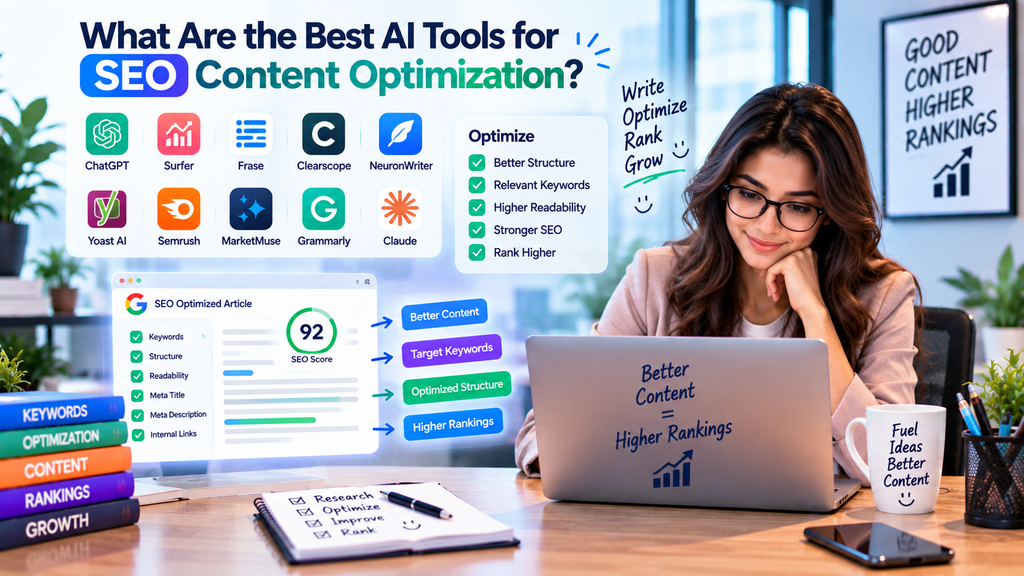
What Are the Best AI Tools for SEO Content Optimization?
The best tools depend on the type of optimization you need.
| Tool | Best For |
|---|---|
| Surfer SEO | On-page content optimization |
| Frase | Content briefs, SERP research and optimization |
| Semrush | Keyword research and content strategy |
| ChatGPT | Content rewriting, structure and topic expansion |
| Claude | Long-form content audits and editing |
| Ahrefs | Competitor analysis and content gaps |
| Google Gemini | Topic exploration and research |
| Clearscope | Topic relevance and content coverage |
| MarketMuse | Content planning and topical authority |
| Google Search Console | Identifying real SEO improvement opportunities |
For most websites, the best content optimization process combines a research tool, an AI writing assistant, an optimization platform, and Google Search Console.
What Is SEO Content Optimization?
SEO content optimization is the process of improving a webpage so that it better satisfies users and search engines.
It involves more than keywords.
What Does SEO Content Optimization Include?
It may include:
- Search-intent matching
- Keyword usage
- Topic coverage
- Heading structure
- Internal linking
- Readability
- Content depth
- FAQs
- Metadata
- Content freshness
- Entity coverage
- User experience
- Supporting examples
Is SEO Optimization the Same as Keyword Stuffing?
No.
Keyword stuffing means unnaturally repeating terms.
Good Optimization Focuses on Relevance
A well-optimized page should be useful first.
Keywords should appear naturally where they help explain the topic.
Why Use AI for SEO Content Optimization?
Optimizing content manually can take a lot of time.
AI can analyze large amounts of text quickly.
What Can AI Help With?
AI can assist with:
- Identifying missing topics
- Finding content gaps
- Rewriting weak sections
- Improving clarity
- Adding FAQs
- Improving heading structures
- Creating internal-link ideas
- Simplifying language
- Expanding thin sections
- Removing repetition
Why Is This Useful?
AI helps turn optimization from a slow manual process into a faster workflow.
Human Review Is Still Required
AI can misunderstand context or introduce errors.
Always review important changes.
1. Surfer SEO – Best Overall Tool for SEO Content Optimization
Surfer SEO is one of the most widely used tools for on-page content optimization.
What Can Surfer SEO Help With?
It can assist with:
- Topic coverage
- Related terms
- Content structure
- Content briefs
- Existing article optimization
- On-page recommendations
How Does Surfer SEO Work?
It analyzes pages that rank for a target query and compares content patterns.
What Should You Avoid?
Do not blindly follow every recommendation.
A higher score does not guarantee higher rankings.
Use the recommendations to improve useful coverage, not to force keywords.
2. Frase – Best for Content Briefs and SERP Research
Frase is useful for researching search results and building SEO-focused content.
What Can Frase Help With?
It can support:
- SERP analysis
- Content briefs
- Outline creation
- Related questions
- Topic research
- Content optimization
Why Are Content Briefs Important?
A good brief gives writers direction before writing starts.
What Should a Strong Brief Include?
It may include:
- Primary keyword
- Search intent
- Main topics
- Important questions
- Recommended headings
- Competitor observations
- Internal-link opportunities
3. Semrush – Best for SEO Content Strategy
Semrush provides broader SEO data that helps guide optimization decisions.
What Can Semrush Help With?
Semrush can support:
- Keyword research
- Search intent
- Competitor analysis
- Keyword gaps
- Rank tracking
- Content planning
- Site audits
How Does Semrush Help With Content Optimization?
It can reveal which keywords and topics a page should target more effectively.
Best Semrush Workflow
Keyword Research → Competitor Analysis → Content Gap → Optimization → Tracking
4. ChatGPT – Best AI Assistant for Rewriting and Content Improvement
ChatGPT is highly useful for editing and improving SEO content.
What Can ChatGPT Do?
It can help with:
- Rewriting weak sections
- Simplifying complex language
- Improving headings
- Creating FAQs
- Expanding examples
- Removing repetition
- Improving flow
- Generating internal-link ideas
- Organizing topic clusters
How Should You Use ChatGPT for SEO?
Give it the actual content plus clear instructions.
Better Prompting Produces Better Results
Instead of saying:
“Optimize this article for SEO.”
Provide:
- Target keyword
- Search intent
- Audience
- Important subtopics
- Current issues
- Desired tone
5. Claude – Best for Long-Form Content Audits
Claude is useful for reviewing long pages and large amounts of written content.
What Can Claude Help With?
Claude can support:
- Long-form article audits
- Repetition removal
- Content-gap analysis
- Restructuring
- Editing
- Summarization
- Content refreshes
Why Is Claude Useful for Pillar Pages?
Pillar pages often contain thousands of words.
Best Use Case
Provide the whole article and ask for:
- Missing sections
- Weak explanations
- Repeated points
- Search-intent gaps
- Outdated information
Then review the recommendations manually.
6. Ahrefs – Best for Competitor Content Gaps
Ahrefs is useful when you want to compare your content with competing pages.
What Can Ahrefs Help With?
It can support:
- Keyword research
- Competitor keywords
- Content gaps
- SERP analysis
- Top-page research
- Backlink research
Why Are Content Gaps Important?
A competitor may rank because it answers questions your page misses.
Do Not Copy Competitors
Use their coverage as research.
Your goal should be to create something better.
7. Google Gemini – Best for Topic Expansion and Research
Gemini can help explore a topic from multiple angles.
What Can Gemini Help With?
It can assist with:
- Topic expansion
- Supporting questions
- Research summaries
- Content structures
- Audience questions
- Related concepts
How Does This Help Optimization?
It can reveal subtopics that may be missing.
Validate Important Information
AI-generated research should still be checked.
8. Clearscope – Best for Topic Relevance
Clearscope is designed to help content teams improve topical relevance.
What Can Clearscope Help With?
It can support:
- Related terms
- Topic coverage
- Content grading
- Editing
- Content briefs
Who Should Use Clearscope?
It can be useful for:
- SEO teams
- Content agencies
- Publishers
- Professional content teams
Use It as a Guide
Do not sacrifice readability simply to include every recommended term.
9. MarketMuse – Best for Content Planning and Topical Authority
MarketMuse focuses on content strategy and topic coverage.
What Can MarketMuse Help With?
It can assist with:
- Topic research
- Content planning
- Content gaps
- Content briefs
- Topical authority strategy
- Existing content evaluation
Why Is Topical Authority Important?
Websites often perform better when they cover a subject consistently and comprehensively.
Build Connected Content
Use pillar pages and supporting articles.
10. Google Search Console – Best for Finding Real Optimization Opportunities
Google Search Console is especially valuable because it shows real search-performance data from your website.
What Can Search Console Show?
It can help identify:
- Queries
- Impressions
- Clicks
- Average positions
- Pages losing visibility
- Low-CTR opportunities
- Indexing issues
How Can This Help Content Optimization?
Look for pages that already have impressions but underperform.
Example
A page ranking around positions 8 to 20 may be a strong optimization opportunity.
Improve:
- Search intent
- Content depth
- internal links
- titles
- supporting sections
Best AI Tools for Different SEO Content Optimization Tasks
| Optimization Task | Recommended Tools |
|---|---|
| On-Page Optimization | Surfer SEO, Frase |
| Topic Coverage | Clearscope, MarketMuse |
| Keyword Research | Semrush, Ahrefs |
| Content Gaps | Ahrefs, Semrush |
| Rewriting | ChatGPT, Claude |
| Long-Form Audits | Claude |
| Topic Expansion | Gemini, ChatGPT |
| Content Briefs | Frase, Surfer SEO |
| Performance Opportunities | Google Search Console |
| Internal Linking | ChatGPT, Semrush |
| Existing Content Refresh | Claude, Surfer SEO |
| Competitor Research | Ahrefs, Semrush |
How to Optimize SEO Content With AI Step by Step
A structured workflow helps you avoid random changes.
Step 1: Identify the Page to Optimize
Start with a page that has potential.
Good Candidates Include
- Pages ranking on page two
- Pages losing traffic
- Pages with many impressions
- Old articles
- Thin content
- Pages with weak CTR
Use Google Search Console
Search Console can help identify these pages.
Step 2: Review Search Intent
Before changing the content, understand what the user wants.
Ask
- Is the query informational?
- Commercial?
- Transactional?
- Navigational?
Compare Current Search Results
Look at the type of pages ranking.
Match the Correct Format
A comparison query should usually have a comparison-focused page.
Step 3: Analyze Competitors
Use Semrush, Ahrefs, Frase, or manual SERP research.
Look For
- Common topics
- Questions
- Page formats
- Unique sections
- Content gaps
Identify Missing Value
Ask:
What do top pages explain that mine does not?
Do Not Reproduce Their Content
Use the findings to improve your own page.
Step 4: Analyze Topic Coverage
Use Surfer SEO, Clearscope, Frase, or MarketMuse.
Check Whether the Page Covers
- Core topic
- Related concepts
- Important entities
- Supporting questions
- Common subtopics
Avoid Adding Topics Without Relevance
More content is not always better.
Only Add Useful Coverage
Every section should support the main intent.
Step 5: Improve the Heading Structure
A clear hierarchy improves readability.
Recommended Structure
H1: Main page topic
H2: Main sections
H3: Supporting sections
H4: Detailed subtopics
H5: Minor supporting points when needed
Keep Headings Descriptive
Users should understand the section from the heading.
Avoid Keyword Repetition
Do not place the exact keyword in every heading.
Step 6: Rewrite Weak Sections
Use ChatGPT or Claude.
Common Problems to Fix
- Repetition
- Generic language
- Long paragraphs
- Poor explanations
- Weak examples
- Unclear transitions
Keep the Original Meaning
Optimization should improve clarity without changing important facts.
Add Human Expertise
Include real examples or experience where possible.
Step 7: Add Missing Questions
Question-based content can improve usefulness.
Find Questions Through
- SERP research
- Frase
- Search Console
- AI brainstorming
- Customer questions
Add Answers Naturally
Do not create an excessive FAQ section.
Prioritize Relevant Questions
Only answer questions related to the page’s intent.
Step 8: Improve Internal Linking
Internal links connect related content.
Good Internal Links Should
- Be relevant
- Help users
- Use descriptive anchor text
- Connect related topics
Example
A page about SEO content optimization can link to:
- AI keyword research tools
- AI SEO tools
- AI blog writing tools
- Competitor analysis tools
Avoid Random Linking
Internal links should have a clear purpose.
Step 9: Optimize Metadata
Review the SEO title and meta description.
Good SEO Titles Should
- Clearly describe the page
- Include the main topic naturally
- Encourage clicks
- Avoid unnecessary repetition
Good Meta Descriptions Should
- Summarize the page
- Explain the benefit
- Include relevant terms naturally
Remember
Meta descriptions do not directly guarantee rankings.
They Can Improve Search Presentation
A clearer snippet may encourage more clicks.
Step 10: Monitor Performance
Do not stop after publishing updates.
Track
- Impressions
- Clicks
- CTR
- Rankings
- Organic traffic
- Conversions
Compare Before and After
Use Search Console and analytics data.
Give Changes Enough Time
SEO results do not always appear immediately.
How to Optimize Existing Blog Posts With AI
Updating existing content can be more efficient than publishing new content.
Start With the Current Article
Provide the article to an AI assistant.
Ask It to Identify
- Outdated sections
- Missing questions
- Repeated ideas
- Weak headings
- Thin explanations
- Internal-link opportunities
Then Use SEO Data
Validate the recommendations using Search Console, Semrush, or Ahrefs.
Update Strategically
Do not rewrite content that is already working well without a reason.
How to Improve Search Intent With AI
Search intent is one of the most important optimization factors.
AI Can Help Classify Intent
Use ChatGPT or Claude to group keywords by intent.
Common Intent Types
Informational
Commercial
Transactional
Navigational
Verify With the SERP
Search results reveal what Google currently considers relevant.
How to Improve Topical Coverage With AI
Topical coverage means answering the important parts of a subject.
AI Can Help Find
- Missing subtopics
- Related entities
- Questions
- Comparisons
- Definitions
Use Optimization Platforms
Surfer SEO, Clearscope, Frase, and MarketMuse can also help identify relevant coverage.
Avoid Topic Stuffing
Do not add unrelated sections merely to increase word count.
How to Improve Readability With AI
Readable content is easier to understand.
AI Can Help
- Shorten sentences
- Remove jargon
- Break long paragraphs
- Simplify explanations
- Improve transitions
Keep the Audience in Mind
Beginner content should not sound like an academic paper.
Clarity Is More Important Than Complexity
Simple writing often communicates expertise better.
How to Optimize Content for AEO
AEO focuses on answering questions clearly.
Use Direct Answers
Structure sections as:
Question → Direct Answer → Explanation → Example
Add FAQ Content
Answer important user questions.
Keep Answers Concise First
Then provide more detail.
How to Optimize Content for GEO
GEO focuses on creating content that performs well in generative search environments.
Improve GEO With
- Clear factual statements
- Structured information
- Reliable sources
- Original insights
- Useful comparisons
- Strong entity coverage
- Topic depth
Why Original Information Matters
Generic information is easy for AI systems to summarize from many sources.
Create Distinctive Value
Useful examples, original data, experiments, and expert insights can make content more valuable.
How to Build Topic Clusters for Better SEO
Topic clusters connect related content around a central subject.
Example Pillar
Best AI Tools for Digital Marketing in 2026
Supporting Pages
- Best AI Tools for SEO
- Best AI Tools for Keyword Research
- Best AI Tools for Content Marketing
- Best AI Tools for Writing SEO Blog Posts
- AI Tools to Improve Google Rankings
- Best AI Tools for SEO Content Optimization
- Best AI Tools for Competitor Analysis
Why Topic Clusters Help
They improve site organization and internal linking.
Keep Each Page Focused
Each article should target a distinct intent.
Best AI Content Optimization Workflow
A practical workflow is:
Research
Semrush or Ahrefs
Content Analysis
Surfer SEO, Frase, Clearscope, or MarketMuse
Rewriting
ChatGPT or Claude
Topic Research
Gemini or ChatGPT
Performance Tracking
Google Search Console
Complete Workflow
Identify Opportunity → Analyze Intent → Review Competitors → Find Gaps → Rewrite → Optimize → Add Internal Links → Publish → Track
Why This Workflow Works
It combines data, AI, and human judgment.
Best AI SEO Optimization Stack for Beginners
Beginners do not need every tool.
Simple Stack
ChatGPT for rewriting and content ideas.
Google Search Console for performance.
A keyword tool when needed.
Add Advanced Tools Later
Consider Surfer SEO, Frase, Semrush, or Ahrefs as your needs grow.
Learn SEO Fundamentals First
Tools work better when you understand the strategy behind them.
Best AI SEO Optimization Stack for Small Businesses
Small businesses should focus on cost-effective workflows.
Recommended Setup
Research: Semrush or another keyword tool
Writing: ChatGPT or Claude
Optimization: Surfer SEO or Frase
Performance: Google Search Console
Why This Works
It covers:
- Keywords
- Content
- Optimization
- Tracking
Avoid Paying for Duplicate Features
Choose tools with a clear purpose.
Best AI SEO Optimization Stack for Agencies
Agencies usually need more advanced workflows.
Suggested Stack
Semrush or Ahrefs
Surfer SEO or Clearscope
ChatGPT or Claude
Google Search Console
Screaming Frog for technical audits
Agencies Need
- Client reporting
- Competitor research
- Scale
- Multiple projects
- Repeatable workflows
Standardize the Process
Create consistent optimization checklists.
Free vs Paid AI SEO Content Optimization Tools
Both can be useful.
Free Options
Possible options include:
- Google Search Console
- AI assistant free plans
- Search-result analysis
- Google Keyword Planner
Paid Options
Examples include:
- Surfer SEO
- Frase
- Semrush
- Ahrefs
- Clearscope
- MarketMuse
When Should You Upgrade?
Upgrade when you need:
- Deeper SEO data
- Better content analysis
- Large-scale optimization
- Team collaboration
- Competitor research
Focus on ROI
Use tools that save time or improve decisions.
Common SEO Content Optimization Mistakes
AI can make optimization faster, but poor decisions can still hurt content quality.
Over-Optimizing for Keywords
Do not force keywords into every paragraph.
Chasing Content Scores
Scores are guidelines, not ranking guarantees.
Ignoring Search Intent
This is one of the biggest mistakes.
Adding Unnecessary Word Count
Longer does not always mean better.
Publishing AI Edits Without Review
AI can introduce factual errors.
Copying Competitor Structure
Use competitor analysis as research, not duplication.
Ignoring Existing Performance
Do not unnecessarily change pages that already perform well.
Forgetting Internal Links
Internal linking is often overlooked.
Optimizing Without Tracking Results
Measure what changed.
Frequently Asked Questions About AI SEO Content Optimization
What Is the Best AI Tool for SEO Content Optimization?
Surfer SEO and Frase are strong options for on-page optimization. ChatGPT and Claude are useful for rewriting and content analysis, while Semrush and Ahrefs help with research.
Can ChatGPT Optimize SEO Content?
Yes.
ChatGPT can help improve headings, rewrite weak sections, add FAQs, identify missing topics, and create internal-link ideas.
Is Surfer SEO Good for Content Optimization?
Yes.
Surfer SEO is designed specifically for on-page content optimization and topic coverage.
Is Frase Good for SEO Content?
Yes.
Frase is useful for content briefs, SERP research, outlines, questions, and optimization.
Can AI Improve Existing Blog Posts?
Yes.
AI can help refresh old articles, improve clarity, remove repetition, add missing sections, and strengthen structure.
What Is the Best Tool for Finding Content Gaps?
Ahrefs and Semrush are strong for competitor content gaps, while Surfer SEO, Frase, Clearscope, and MarketMuse can help identify topical gaps.
Can AI Improve Google Rankings?
AI can support SEO work, but no tool can guarantee rankings.
Should I Optimize Every Article?
Not necessarily.
Prioritize pages with real potential, declining performance, outdated information, or weak search intent.
Is Content Optimization Important for AEO?
Yes.
Clear questions and direct answers can make content easier for answer systems to understand.
Is Content Optimization Important for GEO?
Yes.
Clear, authoritative, well-structured, and original content is more useful in generative search environments.
Final Verdict: What Are the Best AI Tools for SEO Content Optimization?
The best AI tools for SEO content optimization depend on the task you want to improve.
on-page optimization, Surfer SEO and Frase are strong choices.
keyword research, competitor analysis, and content gaps, Semrush and Ahrefs are highly useful.
Rewriting, content audits, and structural improvements, ChatGPT and Claude can save significant time.
Topic research and expansion, Gemini can help uncover additional angles.
For deeper topical coverage, Clearscope and MarketMuse may be useful for professional content teams.
For finding real pages that need optimization, Google Search Console remains one of the most valuable tools available.
The strongest content optimization strategy in 2026 is not about maximizing a content score.
It is about making the page more useful.
SEO data to identify opportunities.
AI to analyze and improve content.
Optimization tools to discover gaps.
Use human expertise to verify accuracy and add original value.
Then track performance and improve the page over time.
Related AI SEO Guides
What Are the Best AI Tools for Digital Marketing in 2026?
Explore AI tools for SEO, content marketing, social media, design, research, automation, and digital marketing workflows.
Which AI Tools Are Best for SEO in 2026?
Compare tools for keyword research, technical SEO, content optimization, backlinks, and competitor analysis.
What Are the Best AI Tools for Keyword Research?
Discover tools for keyword ideas, long-tail searches, search intent, content gaps, and topic clusters.
Which AI Tools Are Best for Content Marketing?
Explore tools for research, writing, optimization, repurposing, design, and content distribution.
What Are the Best AI Tools for Writing SEO Blog Posts?
Learn which AI tools can help with SEO research, outlines, drafting, editing, and content optimization.
Which AI Tools Can Help Improve Google Rankings?
Discover tools that can support keyword strategy, content quality, technical SEO, backlinks, and search visibility.
What Are the Best AI Tools for Social Media Marketing?
Compare AI tools for social strategy, content creation, video, scheduling, and campaign management.
Which AI Tools Are Best for Creating Social Media Content?
Explore tools for captions, graphics, videos, carousels, scripts, and social media content production.
Which AI Tools Are Best for Competitor Analysis?
Learn which tools can reveal competitor keywords, backlinks, top pages, content gaps, and market opportunities.