
ChatGPT Prompts for SEO
Search engine optimization can take hours of research, planning, writing, analysis, and optimization. ChatGPT prompts for SEO can help simplify many of these tasks by giving you structured instructions for keyword research, content creation, on-page optimization, competitor analysis, technical SEO, and more. The key is knowing how to write effective prompts. Instead of asking ChatGPT something broad like “Help me with SEO,” you can provide a specific role, goal, audience, keyword, search intent, and output format. This gives you more useful and actionable results. In this guide, you’ll find 25+ ChatGPT prompts for SEO that you can copy, customize, and use in your workflow.
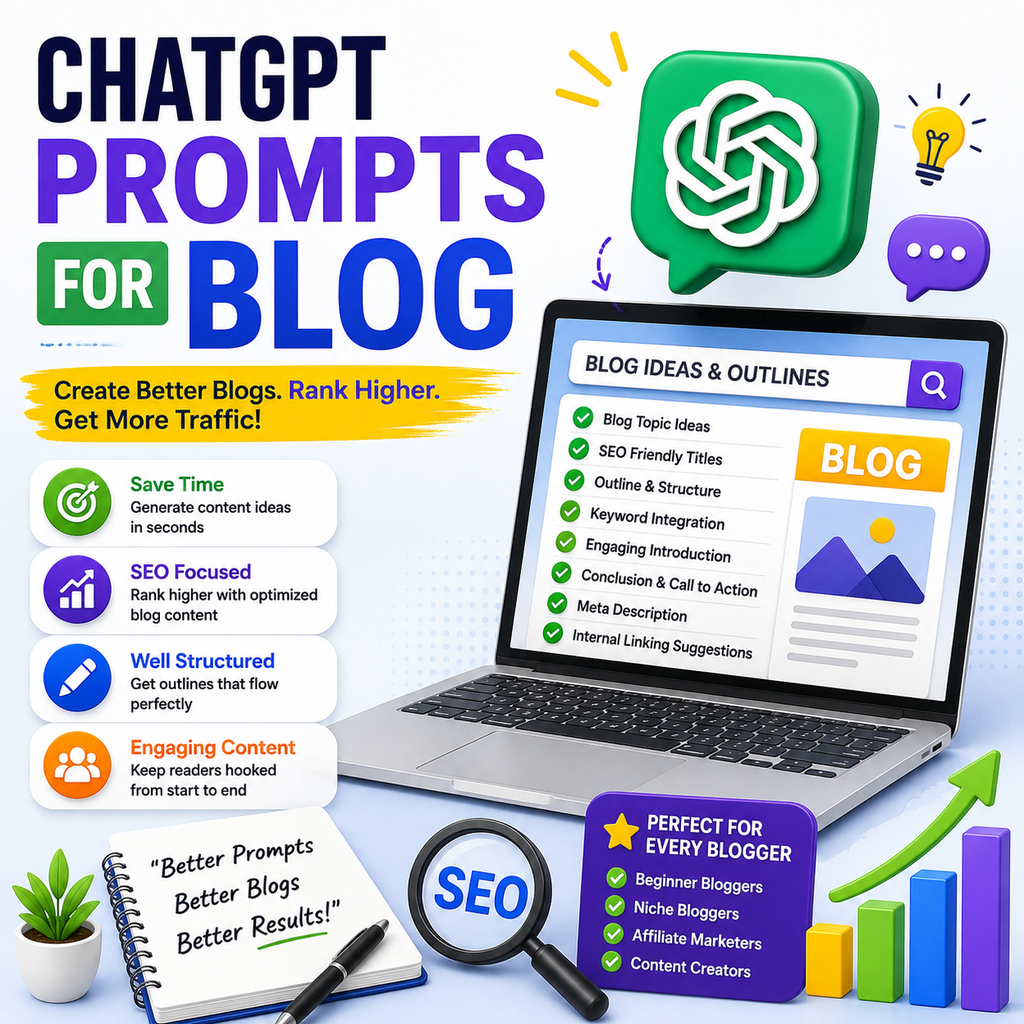
ChatGPT Prompts for SEO can help bloggers, content creators, marketers, and SEO professionals simplify important search optimization tasks and create more focused, search-friendly content. With the right prompts, ChatGPT can assist with keyword research, search intent analysis, keyword clustering, SEO titles, meta descriptions, content outlines, on-page optimization, internal linking, FAQ ideas, and content refreshes. Well-structured prompts that provide clear context, specific instructions, and a defined output format generally produce more useful results than vague requests. For SEO, AEO, and GEO, ChatGPT can also help structure direct answers, question-based content, and information that is easier for search engines and AI-powered answer platforms to understand.
However, ChatGPT should support—not replace—real keyword and performance data from tools such as Google Search Console and dedicated SEO platforms. Whether you are a beginner or an experienced SEO professional, using the right ChatGPT prompts for SEO can save time, improve content quality, and create a more efficient SEO workflow.
What Are ChatGPT Prompts for SEO?
ChatGPT prompts for SEO are specific instructions designed to help ChatGPT perform SEO-related tasks such as keyword research, content planning, title creation, meta descriptions, on-page optimization, competitor analysis, and content optimization.
For example, instead of asking:
“Give me SEO keywords.”
You can use:
“Act as an SEO keyword research specialist. Find relevant primary, secondary, long-tail, and question-based keywords for the topic [TOPIC]. Group them according to search intent and suggest which keyword should be the primary target.”
The second prompt provides much more context, making the output easier to use.
Why Use ChatGPT for SEO?
ChatGPT can assist with repetitive SEO tasks and help you organize your workflow more efficiently.
Some common uses include:
- Keyword research
- Search intent analysis
- Content briefs
- Blog outlines
- SEO titles
- Meta descriptions
- FAQ generation
- Internal linking ideas
- Competitor analysis
- Content optimization
- Schema ideas
- Content gap analysis
- Local SEO content
- Featured snippet optimization
However, ChatGPT should be treated as an SEO assistant, not a replacement for SEO tools, search data, or human judgment. Keyword volume, competition, rankings, backlinks, technical issues, and search performance should be verified with appropriate SEO tools and real search results.
25+ Best ChatGPT Prompts for SEO
1. ChatGPT Prompt for Keyword Research
Use this prompt to generate keyword ideas around your main topic.
Prompt:
Act as an expert SEO keyword researcher. Generate a comprehensive keyword list for the topic “[TOPIC].” Include primary keywords, secondary keywords, long-tail keywords, related terms, semantic keywords, and question-based keywords. Group the keywords by search intent: informational, commercial, transactional, and navigational. Prioritize keywords that closely match the target audience’s needs.
2. ChatGPT Prompt for Long-Tail Keywords
Long-tail keywords can help you target specific searches with clear intent.
Prompt:
Find 30 long-tail keywords related to “[TOPIC].” Focus on specific phrases that users are likely to search when looking for detailed solutions. Categorize them by informational, commercial, and transactional intent. Also provide a short explanation of the search intent behind each keyword.
3. ChatGPT Prompt for Search Intent
Understanding search intent helps you create content that matches what users actually want.
Prompt:
Analyze the search intent behind the keyword “[KEYWORD].” Determine whether the intent is informational, commercial investigation, transactional, or navigational. Explain what type of content would best satisfy the searcher and suggest an ideal content format.
4. ChatGPT Prompt for SEO Content Brief
Create a detailed brief before writing an article.
Prompt:
Act as a senior SEO content strategist. Create a detailed SEO content brief for “[TOPIC].” Include the primary keyword, secondary keywords, search intent, target audience, recommended word count, H1, H2s, H3s, questions to answer, entities to mention, internal linking opportunities, external source suggestions, and a recommended content angle.
5. ChatGPT Prompt for SEO Blog Outline
Prompt:
Create a comprehensive SEO-friendly blog outline for “[TOPIC].” Use one H1, relevant H2 sections, and H3 subsections. Cover the topic comprehensively without unnecessary repetition. Include sections that directly answer common user questions and suggest FAQs based on likely search intent.
6. ChatGPT Prompt for SEO Title Ideas
A compelling title can improve organic click-through rates.
Prompt:
Generate 15 SEO-friendly blog title ideas for “[TOPIC].” Include the primary keyword naturally. Make the titles clear, compelling, specific, and suitable for Google search results. Use numbers, benefits, curiosity, or strong action words where appropriate. Avoid clickbait.
7. ChatGPT Prompt for Meta Description
Prompt:
Write 5 compelling meta descriptions for a page targeting “[PRIMARY KEYWORD].” Keep each description concise and naturally include the primary keyword. Highlight the main benefit of the page and encourage users to click. Avoid keyword stuffing and misleading claims.
8. ChatGPT Prompt for On-Page SEO
Prompt:
Act as an on-page SEO specialist. Review the following content for “[PRIMARY KEYWORD].” Identify opportunities to improve the title, headings, keyword placement, introduction, readability, semantic relevance, internal linking, image alt text, FAQs, and calls to action. Provide specific recommendations without keyword stuffing.
9. ChatGPT Prompt for Content Optimization
Already have an article? Use this prompt to improve it.
Prompt:
Optimize the following article for the primary keyword “[KEYWORD].” Improve topical coverage, clarity, search intent alignment, headings, semantic relevance, readability, internal linking opportunities, and answer-first sections. Preserve useful information and avoid unnatural keyword repetition.
10. ChatGPT Prompt for Semantic SEO
Prompt:
Create a semantic SEO keyword and entity map for “[TOPIC].” Identify related concepts, entities, subtopics, synonyms, questions, attributes, and terminology that a comprehensive article should cover. Organize the results into logical content clusters.
11. ChatGPT Prompt for Featured Snippets
Prompt:
Identify questions related to “[TOPIC]” that could potentially be answered in a featured snippet. For each question, provide a concise answer of approximately 40–60 words followed by a more detailed explanation. Keep the answers factual, direct, and easy to understand.
12. ChatGPT Prompt for AEO Optimization
Answer Engine Optimization helps content provide direct answers to user questions.
Prompt:
Act as an Answer Engine Optimization specialist. Optimize the content below for AI search and answer engines. Identify important questions users may ask, provide concise direct answers, improve heading structure, add definitions where useful, and organize information so search engines and AI systems can easily understand the topic.
13. ChatGPT Prompt for GEO Optimization
Generative Engine Optimization focuses on making content useful and understandable for AI-powered search experiences.
Prompt:
Optimize this article for Generative Engine Optimization. Improve factual clarity, topical depth, entity relationships, direct answers, useful examples, and information structure. Make important claims easy to identify and support. Avoid unnecessary fluff and keyword stuffing.
14. ChatGPT Prompt for Competitor SEO Analysis
Prompt:
Act as a competitive SEO analyst. Analyze the following competitor pages: [URLS OR CONTENT]. Identify their primary topics, keywords, content structure, search intent, unique angles, strengths, weaknesses, missing subtopics, and potential content gaps. Then suggest opportunities for creating a more useful and comprehensive page.
Use actual competitor data and verify important SEO metrics with dedicated tools rather than relying solely on ChatGPT.
15. ChatGPT Prompt for Content Gap Analysis
Prompt:
Perform a content gap analysis for “[TOPIC].” Identify important subtopics, questions, examples, comparisons, statistics, entities, and practical information that a competing article may be missing. Create a prioritized list of content opportunities that could make my page more comprehensive and useful.
16. ChatGPT Prompt for Internal Linking
Prompt:
Act as an SEO internal linking specialist. Review the following article and identify natural internal linking opportunities. For each recommendation, provide the suggested anchor text, target topic, and the sentence where the link could be inserted. Avoid forced or repetitive anchor text.
17. ChatGPT Prompt for Image Alt Text
Prompt:
Generate descriptive and accessibility-friendly alt text for the following images. Keep each alt text concise, accurately describe the image, and naturally include the target keyword only when relevant. Do not keyword stuff.
18. ChatGPT Prompt for FAQ SEO
Prompt:
Generate 10 frequently asked questions related to “[TOPIC].” Focus on genuine questions users are likely to ask. Provide concise, accurate answers suitable for an SEO-friendly FAQ section. Avoid repeating information already covered in the main article.
19. ChatGPT Prompt for Local SEO
Prompt:
Act as a local SEO specialist. Create locally relevant content for “[BUSINESS]” targeting “[CITY/AREA].” Include relevant local search terms, services, customer needs, nearby context, FAQs, and calls to action. Keep the content natural and useful rather than inserting the location repeatedly.
20. ChatGPT Prompt for SEO Product Descriptions
Prompt:
Write an SEO-friendly product description for “[PRODUCT].” Target keyword: “[KEYWORD].” Explain the product’s main features, benefits, ideal customer, use cases, and differentiators. Use clear headings and natural language. Avoid exaggerated claims and keyword stuffing.
21. ChatGPT Prompt for SEO Landing Pages
Prompt:
Create an SEO-focused landing page structure for “[SERVICE/PRODUCT].” Include an SEO-friendly H1, value proposition, benefits, features, trust elements, FAQs, relevant secondary keywords, calls to action, and sections designed to address common customer objections.
22. ChatGPT Prompt for Blog Refresh
Older content can often benefit from updating and expanding.
Prompt:
Audit this existing article for freshness and SEO opportunities. Identify outdated information, missing subtopics, weak sections, unclear explanations, poor headings, internal linking opportunities, and areas that should be expanded or rewritten. Create a prioritized content refresh plan.
23. ChatGPT Prompt for SEO Content Readability
Prompt:
Improve the readability of this article without reducing its depth. Use shorter paragraphs, clear headings, active voice, simple language, bullet points where useful, and smooth transitions. Keep the meaning intact and avoid making the content sound robotic.
24. ChatGPT Prompt for SEO Content Cluster
Prompt:
Create a topical SEO content cluster around “[MAIN TOPIC].” Suggest one pillar page and 15 supporting articles. For each supporting article, provide the target keyword, search intent, suggested title, and how it should internally link to the pillar page.
25. ChatGPT Prompt for SEO Audit
Prompt:
Act as an SEO consultant and audit the following webpage content: [CONTENT/URL]. Review the title, meta description, H1, headings, keyword targeting, search intent, content depth, readability, internal links, external references, image optimization, FAQs, and conversion opportunities. Categorize recommendations as high, medium, or low priority.
26. ChatGPT Prompt for SEO Content Improvement
Use this final prompt when you already have an article but want a complete SEO-focused revision.
Prompt:
Act as a senior SEO content editor. Improve the following article for users and search engines. Preserve accurate information while improving search intent alignment, topical coverage, heading structure, readability, semantic relevance, internal linking opportunities, FAQs, featured-snippet potential, and conversion opportunities. Target keyword: “[KEYWORD].” Do not keyword stuff or add unsupported claims. Return the improved article followed by a list of the major SEO improvements you made.
How to Write Better ChatGPT Prompts for SEO
The quality of your output depends heavily on the quality of your instructions.
A strong SEO prompt usually includes these elements:
1. Give ChatGPT a Role
Instead of simply saying “write an article,” specify the expertise you want.
For example:
Act as a senior SEO strategist with experience in content marketing and search intent analysis.
2. Define the Goal
Tell ChatGPT what you want to achieve.
Examples include:
- Increase organic visibility
- Build topical authority
- Target long-tail searches
- Improve content readability
- Capture featured snippets
- Generate qualified leads
3. Provide the Target Keyword
Always tell ChatGPT the primary keyword when keyword targeting matters.
For example:
Primary keyword: ChatGPT prompts for SEO
4. Define Your Audience
Your audience changes the language and level of detail.
For example:
Target audience: SEO beginners, bloggers, content writers, and digital marketers.
5. Specify the Output Format
Instead of asking for a generic response, specify exactly what you want.
For example:
Use H1, H2, and H3 headings. Include a short introduction, actionable examples, a comparison table, FAQs, and a conclusion.
ChatGPT SEO Prompt Template
You can also create your own prompts using this simple framework:
Act as [ROLE]. Help me [GOAL]. The primary keyword is [KEYWORD]. My target audience is [AUDIENCE]. The search intent is [INTENT]. Include [REQUIRED ELEMENTS]. Use [TONE/STYLE]. Avoid [THINGS TO AVOID]. Format the response as [OUTPUT FORMAT].
For example:
Act as an SEO content strategist. Create a comprehensive article targeting “ChatGPT prompts for SEO.” The audience is SEO professionals, bloggers, marketers, and beginners. Focus on informational intent. Include keyword research prompts, content prompts, on-page SEO prompts, competitor analysis prompts, AEO/GEO prompts, FAQs, and practical examples. Use a clear, conversational tone and H1, H2, and H3 headings. Avoid keyword stuffing and unsupported claims.
Best Practices for Using ChatGPT for SEO
ChatGPT can save time, but you should still apply human judgment.
Verify Keyword Data
ChatGPT can suggest keyword ideas, but it should not be treated as a replacement for real keyword research platforms. Check search volume, competition, trends, SERPs, and related queries using reliable SEO tools.
Analyze the Actual SERP
Search your target keyword and study the pages currently ranking. Look at what users are being shown, what questions appear, and what content formats dominate.
Add First-Hand Experience
Generic AI-generated content can struggle to stand out. Add your own examples, experiments, screenshots, case studies, opinions, or original insights where appropriate.
Avoid Keyword Stuffing
Using a keyword repeatedly does not automatically improve rankings. Focus on covering the topic naturally and answering the user’s questions.
Fact-Check Important Information
Always verify statistics, dates, product specifications, search trends, and other potentially changing information before publishing.
FAQs About ChatGPT Prompts for SEO
Can ChatGPT be used for SEO?
Yes. ChatGPT can assist with many SEO tasks, including keyword ideation, content briefs, outlines, title ideas, meta descriptions, FAQs, internal linking suggestions, competitor analysis, and content optimization.
What is the best ChatGPT prompt for SEO?
There is no single best prompt for every SEO task. The best prompt clearly defines the role, objective, keyword, audience, search intent, requirements, and desired output format.
Can ChatGPT do keyword research?
ChatGPT can generate keyword ideas, related terms, long-tail keywords, and question-based searches. However, keyword volume, competition, trends, and ranking difficulty should be verified using dedicated SEO tools.
Can ChatGPT write SEO-friendly blog posts?
Yes. ChatGPT can help create SEO-friendly outlines and drafts. For the strongest results, provide the target keyword, audience, search intent, content requirements, and unique information that should be included.
Can ChatGPT help with on-page SEO?
Yes. It can review titles, headings, meta descriptions, keyword placement, content structure, readability, FAQs, internal linking opportunities, and other on-page elements.
Can ChatGPT help with AEO and GEO?
Yes. ChatGPT can help structure content around direct questions, concise answers, entities, definitions, and clearly organized information. However, AEO and GEO are broader strategies, so content should still be fact-checked and aligned with real user needs.
Should I use ChatGPT-generated content directly on my website?
It is better to review, fact-check, edit, and add original value before publishing. AI can accelerate content production, but human expertise and editorial judgment help make content more accurate, useful, and distinctive.
Final Thoughts
ChatGPT prompts for SEO can make many parts of the SEO workflow faster and more organized. From keyword research and content planning to on-page optimization, FAQs, internal linking, and content refreshes, the right prompts can turn ChatGPT into a useful SEO assistant.
The most effective approach is not simply generating more content. Instead, use AI to support research, organization, optimization, and brainstorming while combining it with real search data, expert review, original insights, and a strong understanding of your audience.