
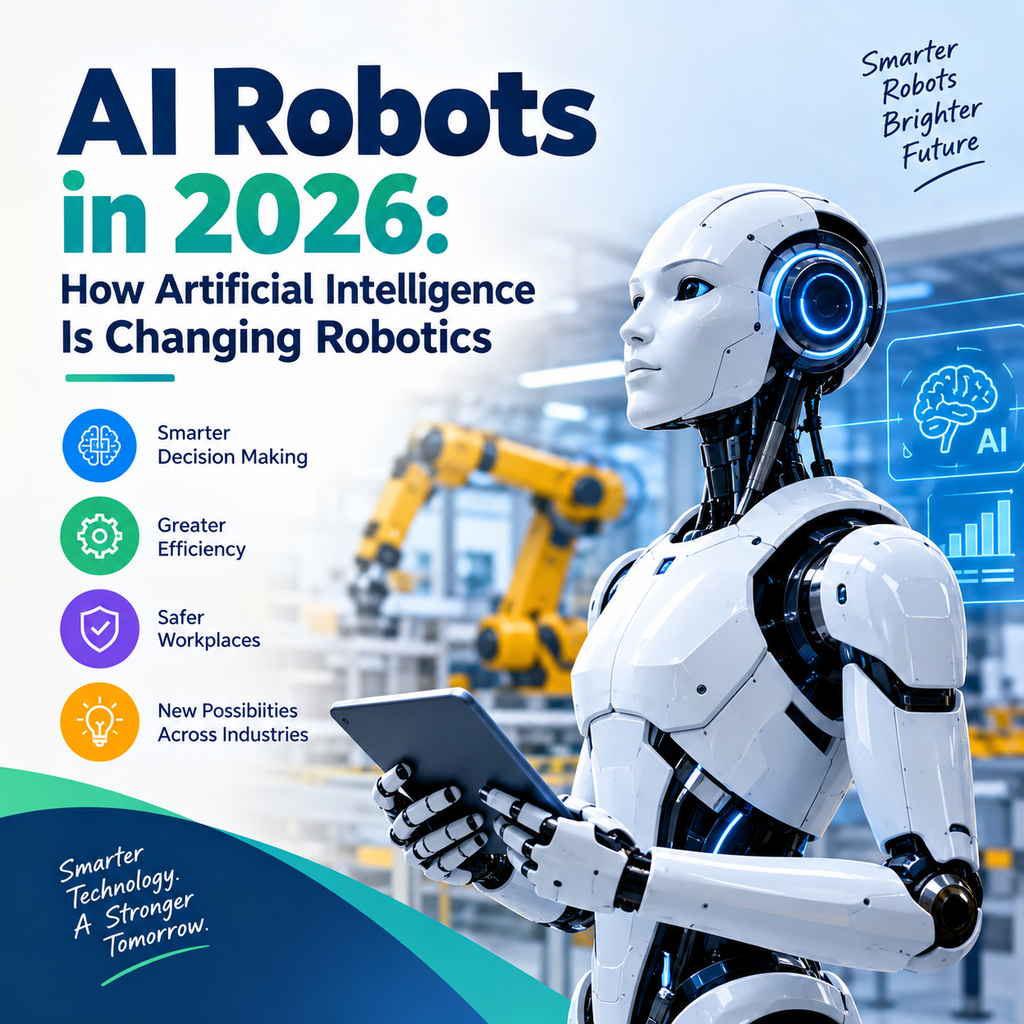
AI robotics is transforming traditional robots into smarter, more adaptable machines that can understand their surroundings, process information, make decisions, and perform tasks with greater autonomy. By combining artificial intelligence with robotics, technologies such as machine learning, computer vision, natural language processing, and advanced sensors are helping robots operate in manufacturing, healthcare, logistics, agriculture, warehouses, and other real-world environments. In 2026, AI-powered robotics is increasingly moving beyond fixed, pre-programmed automation toward systems that can adapt to changing conditions and work more effectively alongside people. For businesses, the main benefits of AI robotics include improved productivity, greater accuracy, enhanced workplace safety, and more efficient automation. As physical AI and autonomous systems continue to develop, AI robotics is expected to play an increasingly important role in the future of intelligent automation and Industry 4.0.
In 2026, AI robotics is becoming one of the most exciting areas of technology. Modern robots are increasingly being designed to understand their surroundings, process information, learn from examples, communicate with humans, and perform more flexible tasks. Instead of simply following a fixed sequence of instructions, AI-powered robots can potentially understand what is happening around them and decide how to respond. This could change industries ranging from manufacturing and logistics to healthcare, agriculture, education, and home automation.
What Is AI Robotics?
AI robotics combines artificial intelligence with robotic systems.
A traditional robot may follow a predefined program:
Instruction → Movement → Task → Repeat
An AI-powered robot can use additional capabilities such as:
Sensors → Perception → AI Processing → Decision → Action
The robot can collect information from cameras, microphones, sensors, and other devices.
AI models can then help interpret that information.
For example, a warehouse robot may detect an object blocking its path and determine another route instead of simply stopping.
This ability to respond to changing situations is one of the biggest differences between traditional automation and AI-powered robotics.
How Do AI-Powered Robots Work?
AI robots typically combine several technologies.
These can include:
- Artificial intelligence
- Computer vision
- Machine learning
- Speech recognition
- Natural language processing
- Sensors
- Motion control
- Navigation systems
- Robotic hardware
Each technology performs a different role.
Sensors
Sensors help robots understand their physical environment.
They can detect things such as:
- Distance
- Movement
- Temperature
- Pressure
- Objects
- Position
Computer Vision
Cameras and computer vision systems allow robots to interpret visual information.
A robot can potentially identify:
- People
- Objects
- Obstacles
- Products
- Signs
- Different environments
AI Models
AI helps the robot interpret information and make decisions.
For example:
“There is an obstacle in front of me, so I should change direction.”
Robotic Movement
The robot’s motors and mechanical components turn decisions into physical actions.
This creates the complete AI robotics loop:
See → Understand → Decide → Act
AI Robots vs Traditional Robots
Traditional robots are usually designed for highly predictable environments.
For example, an industrial robotic arm might repeatedly place the same component in the same location.
It doesn’t necessarily need to understand the entire environment.
AI robots are designed to operate in more unpredictable situations.
A robot in a warehouse may need to deal with:
- Different objects
- Moving workers
- Changing routes
- Unexpected obstacles
- New environments
AI can help the robot adapt to these situations.
This doesn’t mean AI robots can automatically handle every environment.
They still have physical and software limitations.
But their flexibility can be significantly greater.
Humanoid Robots Are Getting More Attention
One of the most visible areas of AI robotics is the development of humanoid robots.
Humanoid robots are designed with human-like physical structures, often including:
- Two arms
- Two legs
- A torso
- A head
- Cameras
- Hands
The idea is practical as well as futuristic.
Many human environments are already designed for human bodies.
Buildings have stairs.
Factories have workstations.
Homes have doors, shelves, tables, and tools.
A robot with a human-like form could potentially interact with these environments without requiring everything to be redesigned.
AI Robots in Manufacturing
Manufacturing has used robots for many years.
AI can make industrial robots more flexible.
Potential applications include:
- Assembly
- Quality inspection
- Packaging
- Sorting
- Material handling
- Welding
- Machine maintenance
Computer vision can help robots identify defects in products.
AI can also help systems detect unusual patterns that may indicate equipment problems.
This could make manufacturing processes more efficient while reducing repetitive manual work.
AI Robots in Warehouses
Warehouses are another major application.
Modern warehouses can contain thousands of products that need to be moved, sorted, packaged, and delivered.
AI robots can potentially assist with:
- Picking items
- Moving packages
- Sorting products
- Inventory management
- Navigation
- Loading and unloading
Instead of following only fixed routes, AI-powered robots can potentially adapt to changing warehouse conditions.
For example, if one path becomes blocked, a robot could calculate another route.
AI Robots in Agriculture
Agriculture is also becoming increasingly automated.
AI-powered robots can potentially help farmers with:
- Crop monitoring
- Weed detection
- Harvesting
- Plant inspection
- Soil analysis
- Precision spraying
- Fruit picking
Computer vision can identify differences between healthy crops and damaged plants.
This could help farmers target resources more efficiently.
Agricultural robotics may become especially valuable as farms face labor shortages and increasing pressure to improve productivity.
AI Robots in Healthcare
Robots can also assist in healthcare environments.
Potential applications include:
- Hospital logistics
- Medication delivery
- Cleaning
- Patient assistance
- Rehabilitation
- Surgical support
- Elder care
Some healthcare robots are designed to support medical professionals rather than replace them.
For example, a hospital robot might transport supplies between departments.
AI can help such systems navigate complex indoor environments.
Healthcare robotics requires particularly strong safety standards because mistakes can have serious consequences.
AI Robots for Elderly Assistance
As populations age, robotic assistants could become increasingly important.
An AI-powered home robot could potentially help with tasks such as:
- Reminders
- Carrying objects
- Basic household assistance
- Communication
- Navigation around the home
- Emergency alerts
A conversational AI system could allow people to interact with a robot using normal language.
Instead of pressing buttons, someone could say:
“Please remind me about my appointment tomorrow.”
The robot could understand the request and respond accordingly.
However, AI robots should complement human care rather than replace meaningful human interaction.
AI Robots in Homes
Home robots have been a long-standing dream.
Robotic vacuum cleaners already demonstrate a simple version of this idea.
Future AI home robots could potentially handle more complicated tasks.
Imagine a robot that can:
- Clean rooms
- Organize objects
- Carry items
- Assist with cooking preparation
- Answer questions
- Monitor household conditions
- Help elderly family members
The challenge is that homes are much more complicated than factories.
Every house is different.
Objects are constantly moved.
People walk around.
Pets create unpredictable situations.
A robot must therefore be capable of handling many different scenarios.
AI Robots Can Understand Natural Language
One of the most important improvements in AI robotics is natural-language interaction.
Traditional robots often require specialized commands.
AI-powered robots can potentially understand instructions such as:
“Please take this box to the kitchen.”
The system needs to identify:
Object: Box
Destination: Kitchen
Action: Move
Then the robot must physically complete the task.
This combines language understanding with computer vision and robotic movement.
That’s a difficult technical problem, but AI is making the interaction much more natural.
AI Robots and Computer Vision
Computer vision is essential for many AI robots.
A robot needs to understand its environment before it can safely interact with it.
For example, imagine asking a robot:
“Bring me the red cup from the table.”
The robot needs to:
- Locate the table.
- Identify the cups.
- Recognize the red cup.
- Navigate toward it.
- Reach the cup.
- Pick it up.
- Bring it to the user.
This requires much more than simple object recognition.
The robot needs to connect language, vision, navigation, and physical movement.
AI Robots Can Learn From Demonstrations
Another interesting development is robot learning.
Instead of manually programming every movement, researchers and developers are increasingly exploring ways for robots to learn tasks from demonstrations or training data.
For example, a robot could observe how a person performs a task and then attempt to reproduce it.
This could make robot programming more flexible.
Instead of saying:
“Move the arm 10 centimeters, rotate it 30 degrees, close the hand…”
a human could potentially demonstrate the task.
The AI system learns the general behavior.
What Are the Benefits of AI Robots?
Automation
Robots can automate repetitive tasks.
Increased Productivity
Machines can potentially operate continuously without fatigue.
Improved Safety
Robots can perform certain dangerous tasks instead of humans.
Greater Flexibility
AI can help robots adapt to changing environments.
Better Accuracy
Robots can perform highly precise physical operations.
Assistance for Humans
AI robots can support workers, caregivers, farmers, and other professionals.
The biggest value may not be replacing humans.
It may be helping humans perform difficult tasks more efficiently.
What Are the Challenges of AI Robotics?
AI robotics also faces major challenges.
High Costs
Advanced robots can be expensive to manufacture and maintain.
Safety
Physical machines can cause harm if they behave incorrectly.
Battery Life
Mobile robots need efficient power systems.
Reliability
A robot must work consistently in real-world environments.
AI Errors
An AI system can misunderstand objects, instructions, or situations.
Maintenance
Robots contain mechanical components that require regular maintenance.
Limited Generalization
A robot trained for one environment may not automatically perform well in a completely different environment.
These challenges mean widespread adoption will take time.
Will AI Robots Replace Human Workers?
This is one of the biggest questions surrounding AI robotics.
The answer is complicated.
Some repetitive tasks will probably become increasingly automated.
However, many jobs involve qualities that robots still struggle to reproduce reliably, such as:
- Human judgment
- Empathy
- Creativity
- Complex communication
- Leadership
- Social understanding
- Responsibility
Rather than completely replacing workers, AI robots may initially change how people perform their jobs.
A warehouse employee might supervise robotic systems.
A farmer might manage agricultural robots.
A technician might maintain autonomous machines.
A healthcare worker might use robots to handle logistics.
The nature of work can change without eliminating the need for people.
AI Robotics and the Future of Jobs
The workforce will likely need new skills as robotics develops.
Important skills may include:
- Robotics programming
- AI system management
- Robot maintenance
- Data analysis
- Computer vision
- Automation
- Safety management
- Human-AI collaboration
This means education will need to evolve alongside technology.
Learning how to work with intelligent machines could become as important as learning how to use traditional software.
AI Robots and Human-Robot Collaboration
One of the most promising concepts is human-robot collaboration.
Instead of designing robots to work completely independently, companies can design systems where humans and robots perform different parts of the same task.
For example:
Human: Makes complex decisions.
Robot: Handles repetitive physical work.
This combination can be powerful.
Humans provide flexibility and judgment.
Robots provide consistency and physical endurance.
The Future of Humanoid AI Robots
Humanoid robots could become increasingly capable over the next several years.
Future systems may become better at:
- Walking
- Balancing
- Picking up objects
- Using tools
- Understanding instructions
- Recognizing environments
- Learning new tasks
However, creating a truly general-purpose humanoid robot is extremely difficult.
The physical world is unpredictable.
A robot must deal with friction, weight, balance, obstacles, humans, animals, weather, and countless other variables.
AI may improve the software side of the problem, but hardware innovation remains equally important.
AI Robotics and Smart Cities
Robots could eventually become part of smart-city infrastructure.
Potential applications include:
- Delivery robots
- Inspection robots
- Infrastructure monitoring
- Waste management
- Security assistance
- Emergency response
- Public transportation support
For example, robots could inspect bridges, tunnels, pipelines, or other difficult-to-access infrastructure.
This could reduce risks for human workers.
AI Robots in Disaster Response
Robots can be particularly useful in dangerous environments.
AI-powered systems could potentially assist during:
- Fires
- Earthquakes
- Floods
- Industrial accidents
- Search-and-rescue operations
A robot could enter an unstable structure where sending a person would be too dangerous.
Sensors and cameras could provide information to rescue teams.
AI could help the robot navigate difficult environments and identify objects or people.
What Will Make AI Robots More Useful?
Several improvements will be important.
Better AI Models
Robots need AI systems that can understand complex physical environments.
Better Sensors
More accurate sensors will improve perception.
Better Batteries
Longer battery life will enable longer operation.
Better Hands
Robotic hands need to become more capable of handling different objects.
Better Learning
Robots need to learn new tasks with less training.
Lower Costs
Affordable hardware will be necessary for widespread adoption.
The combination of these improvements could make robots much more practical.
How Businesses Can Prepare for AI Robotics
Businesses don’t necessarily need to purchase humanoid robots today.
A better approach is to identify repetitive or physically demanding processes.
Ask:
- Which tasks take the most employee time?
- Which tasks are repetitive?
- Which tasks are dangerous?
- Which tasks require high precision?
- Which processes generate unnecessary costs?
Then determine whether automation could solve the problem.
AI robotics should solve a business problem rather than simply become another expensive technology experiment.
Final Thoughts
AI robotics is bringing artificial intelligence into the physical world.
Traditional AI primarily worked with information.
Robotics gives AI the ability to interact with physical environments.
That creates enormous possibilities.
AI robots could help manufacture products, move packages, monitor crops, assist healthcare workers, support elderly people, clean homes, inspect infrastructure, and operate in dangerous environments.
But the technology also creates difficult questions about safety, employment, privacy, cost, and human responsibility.
The future is unlikely to be a world where robots simply replace everyone.
A more realistic future is one where humans and intelligent machines work together.
AI can provide the intelligence.
Robotics can provide the physical capability.
And humans can provide judgment, creativity, responsibility, and purpose.
That combination could make AI robotics one of the most transformative technologies of the next decade.
Author: Akshay Saini
FAQs
What is AI robotics?
AI robotics combines artificial intelligence with robotic hardware to create machines that can perceive their environment, make decisions, learn from information, and perform physical tasks.
What is the difference between AI and robotics?
AI focuses on intelligent software and decision-making, while robotics focuses on physical machines. AI robotics combines both technologies.
What are examples of AI robots?
Examples include warehouse robots, industrial robots, agricultural robots, autonomous delivery machines, healthcare robots, robotic vacuum cleaners, and humanoid robots.
Can AI robots learn new tasks?
Some advanced AI robots can learn tasks from demonstrations, training data, simulations, or repeated interactions. The ability varies significantly between systems.
Will AI robots replace humans?
AI robots may automate some repetitive and dangerous tasks, but many jobs require human judgment, creativity, communication, empathy, and responsibility.
Are humanoid robots useful?
Humanoid robots could be useful in environments designed for humans because their physical form allows them to interact with existing tools and spaces. However, they still face significant technical and economic challenges.
Can AI robots work without humans?
Some robots can operate autonomously for specific tasks, but many advanced systems still require human supervision, maintenance, or intervention.
What is the future of AI robotics?
The future is likely to involve more capable autonomous machines, better human-robot collaboration, improved computer vision, natural-language interaction, and robots that can perform a wider range of physical tasks.

Akshay Saini is an AI and technology writer at KeyArtificial, covering ChatGPT, Google Gemini, AI prompts, AI tools, AI image generation, photo editing trends, and emerging AI developments.
Pingback: AI Coding Assistants in 2026: Benefits, Uses & Future