
Updated AI Tools for Business Owners 2026
Running a business means making decisions, managing customers, generating leads, handling finances, creating content, supervising employees, and finding new ways to grow. Artificial intelligence can now help with many of these tasks. The best AI tools for business owners can automate repetitive work, improve productivity, create marketing content, analyze information, support customers, generate leads, and help entrepreneurs make better decisions.
AI for Business Owners is becoming an essential way to save time, automate repetitive work, improve customer service, and support smarter business decisions. AI tools can help business owners with content creation, marketing, sales, customer support, data analysis, workflow automation, social media management, and productivity without requiring advanced technical skills. For small businesses and startups, the right AI tools can reduce manual workloads and help teams focus more on customers, strategy, and growth. In 2026, businesses are increasingly using AI to improve efficiency, personalize customer experiences, analyze business data, and identify new growth opportunities. Whether you are a small business owner, entrepreneur, startup founder, or local business owner, this guide to AI for Business Owners explains how AI works for business, which AI tools can help, where to use AI automation, and how to choose the right solutions for your business goals.
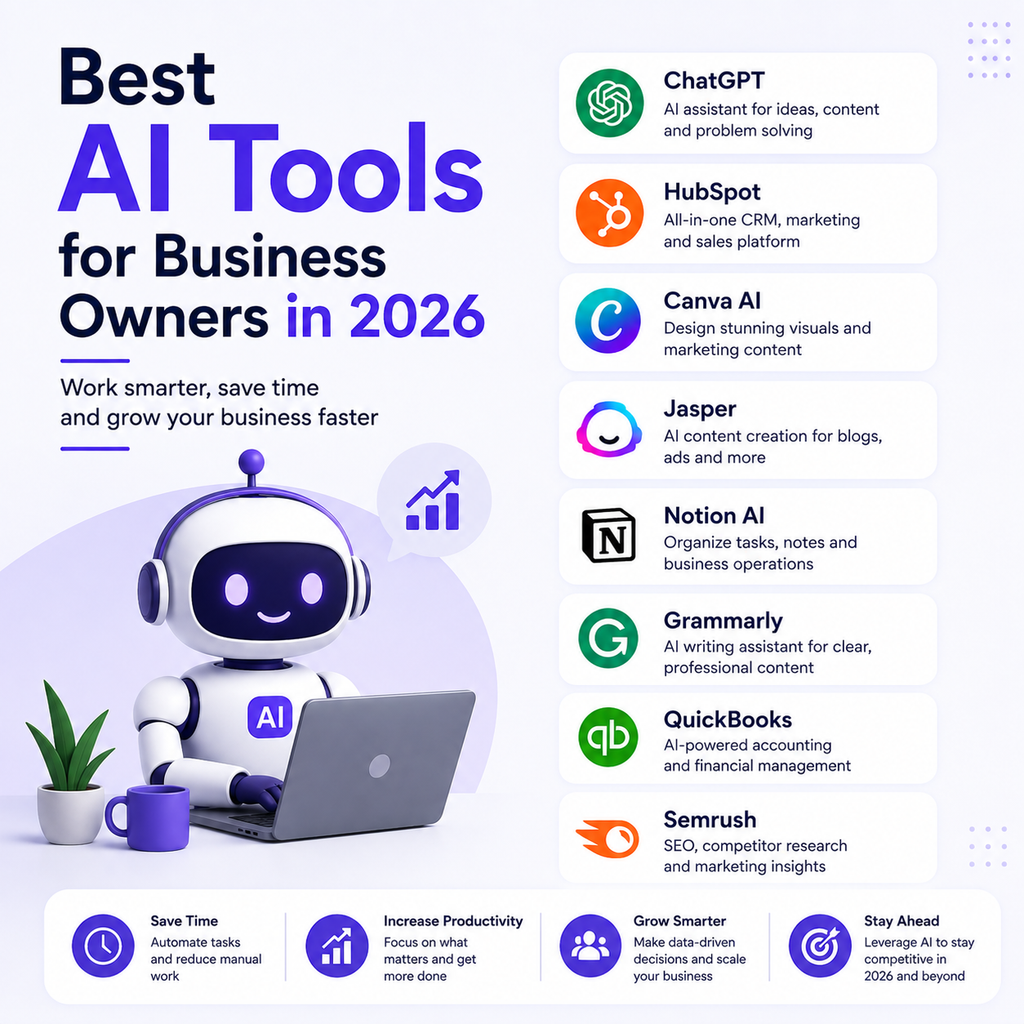
But you do not need dozens of AI subscriptions to benefit from artificial intelligence. The goal is to find the right AI tools for your business, based on your industry, budget, team size, and biggest challenges. This guide covers the 17 best AI tools for business owners in 2026, including options for small businesses, startups, ecommerce companies, agencies, service businesses, and growing organizations.
What Are the Best AI Tools for Business Owners?
If you want the short answer, these are some of the most useful AI tools business owners should consider in 2026:
| AI Tool | Best For | Main Use |
|---|---|---|
| ChatGPT | General business tasks | Research, writing, strategy & productivity |
| Google Gemini | Google Workspace users | Research, content & productivity |
| Microsoft Copilot | Microsoft users | Office productivity & business tasks |
| HubSpot | Sales & marketing | CRM, leads & automation |
| Canva AI | Marketing design | Social media & visual content |
| Grammarly | Business communication | Writing & editing |
| Zapier | Automation | Connecting business apps |
| Notion AI | Business organization | Notes, documents & workflows |
| QuickBooks AI | Business finances | Accounting & financial management |
| Salesforce Agentforce | Enterprise businesses | CRM & AI agents |
| Semrush | Digital marketing | SEO & competitor research |
| Mailchimp | Email marketing | Campaigns & automation |
| ClickUp AI | Project management | Tasks, projects & productivity |
| Perplexity | Business research | Research & information discovery |
| Jasper | Marketing | Content & brand marketing |
| Otter.ai | Meetings | Transcription & summaries |
| DALL·E / AI image tools | Creative work | Images & visual content |
There is no single best AI tool for every business owner.
For many entrepreneurs, a practical starting stack could be:
General AI: ChatGPT or Gemini
Marketing: Canva AI
CRM: HubSpot
Automation: Zapier
Organization: Notion AI or ClickUp AI
SEO: Semrush
Accounting: QuickBooks
What Are AI Tools for Business Owners?
AI business tools are software applications that use artificial intelligence to help entrepreneurs and companies complete tasks, analyze information, automate processes, and make decisions.
Instead of hiring separate tools or manually completing every repetitive activity, business owners can use AI to assist with tasks such as:
Marketing
AI can help create:
- Blog ideas
- Social media posts
- Advertisements
- Email campaigns
- Product descriptions
- Marketing strategies
- SEO content
Sales
AI can assist with:
- Lead research
- Prospect qualification
- Email writing
- CRM updates
- Follow-ups
- Sales forecasting
- Customer analysis
Customer Service
AI can help:
- Answer common questions
- Provide 24/7 support
- Categorize tickets
- Summarize conversations
- Assist human agents
- Route customer requests
Business Administration
AI can assist with:
- Meeting notes
- Documents
- Scheduling
- Data analysis
- Reports
- Research
- Internal communication
Finance
Depending on the software, AI can help businesses organize financial information, automate bookkeeping-related workflows, identify patterns, and create financial reports.
Why Should Business Owners Use AI in 2026?
The biggest advantage of AI is not simply that it can create content.
It can help business owners do more with limited time and resources.
Save Time
AI can handle many repetitive tasks in seconds.
Reduce Manual Work
Automating repetitive workflows allows owners and employees to focus on higher-value activities.
Improve Productivity
AI can help summarize information, organize tasks, draft documents, and accelerate research.
Improve Marketing
Small businesses can create professional marketing materials without needing a large marketing department.
Generate More Leads
AI-powered sales and marketing platforms can help identify prospects and automate parts of the outreach process.
Improve Customer Experience
AI can provide quick answers and help businesses offer support beyond traditional working hours.
Make Better Decisions
AI can analyze large amounts of information and help identify trends, patterns, and opportunities.
17 Best AI Tools for Business Owners in 2026
1. ChatGPT — Best All-Purpose AI Tool for Business Owners
ChatGPT is one of the most versatile AI tools available to business owners.
It can act as a writing assistant, research assistant, brainstorming partner, strategy assistant, data-analysis helper, and productivity tool.
What Business Owners Can Use ChatGPT For
- Business ideas
- Market research
- Content creation
- Email writing
- Customer communication
- Business plans
- SWOT analysis
- Social media ideas
- Ad copy
- Data analysis
- Meeting preparation
Who Should Use ChatGPT?
It is particularly useful for:
- Entrepreneurs
- Freelancers
- Consultants
- Small-business owners
- Marketing teams
- Startup founders
Why Choose ChatGPT?
Its biggest advantage is flexibility. Instead of using it for one specific task, a business owner can use it across many parts of the business.
2. Google Gemini — Best for Google Workspace Users
Google Gemini is particularly useful for businesses already using Google’s ecosystem.
It can assist with research, writing, brainstorming, analysis, and productivity tasks.
Best For
- Google Workspace users
- Entrepreneurs
- Marketing teams
- Office productivity
Common Uses
- Email drafting
- Research
- Document assistance
- Brainstorming
- Data analysis
- Content creation
Why Choose Gemini?
If your business already relies heavily on Gmail, Google Docs, Sheets, Drive, and other Google services, Gemini can fit naturally into the workflow.
3. Microsoft Copilot — Best for Microsoft 365 Businesses
Microsoft Copilot is designed to bring AI assistance into Microsoft’s productivity ecosystem.
Best For
- Microsoft 365 users
- Corporate teams
- Business owners using Word, Excel, PowerPoint, and Outlook
Common Uses
- Document creation
- Email assistance
- Presentations
- Spreadsheet analysis
- Meeting assistance
- Business productivity
Why Choose Microsoft Copilot?
Businesses already using Microsoft 365 can benefit from having AI assistance within familiar applications.
4. HubSpot — Best for Sales and Marketing
HubSpot is an excellent option for business owners who want to connect marketing, sales, CRM, and customer relationships.
Best For
- Small businesses
- Startups
- Growing companies
- Sales teams
- Marketing teams
Common Uses
- CRM management
- Lead generation
- Email marketing
- Marketing automation
- Customer management
- Sales workflows
- Reporting
Why Choose HubSpot?
Instead of keeping customer information in spreadsheets and separate applications, businesses can manage many customer-facing activities from one platform.
5. Canva AI — Best for Business Marketing and Design
Canva is particularly useful for business owners who need professional-looking marketing materials without employing a dedicated designer for every task.
Best For
- Small businesses
- Ecommerce
- Agencies
- Local businesses
- Content creators
Common Uses
- Social media graphics
- Advertisements
- Presentations
- Posters
- Business flyers
- Product images
- Marketing banners
Why Choose Canva AI?
It allows business owners to quickly turn ideas into visual marketing materials.
6. Grammarly — Best for Business Writing
Communication is an important part of running any business.
Grammarly can help improve emails, documents, proposals, website copy, and other business communications.
Best For
- Business emails
- Marketing teams
- Sales teams
- Entrepreneurs
- Professional communication
Common Uses
- Grammar correction
- Rewriting
- Tone adjustment
- Clarity improvement
- Professional writing
Why Choose Grammarly?
It can help businesses communicate more clearly and consistently.
7. Zapier — Best for Business Automation
Zapier connects different applications and allows businesses to automate repetitive workflows.
Best For
- Small businesses
- Entrepreneurs
- Marketing teams
- Operations teams
Common Uses
For example:
New website lead → CRM → email notification → follow-up task
Or:
New customer → spreadsheet → email → CRM record
Why Choose Zapier?
It can reduce the amount of manual data entry required across different business applications.
8. Notion AI — Best for Business Organization
Notion combines documents, databases, notes, project organization, and AI assistance.
Best For
- Startups
- Small teams
- Entrepreneurs
- Remote businesses
Common Uses
- Meeting notes
- Business documentation
- Project planning
- Content calendars
- Company knowledge
- Task management
Why Choose Notion AI?
It can provide a central workspace where business information and AI assistance are available together.
9. QuickBooks — Best for Business Accounting
Financial management is one of the most important responsibilities for business owners.
QuickBooks provides accounting and financial management tools, with AI capabilities increasingly being integrated into financial workflows.
Best For
- Small businesses
- Freelancers
- Entrepreneurs
- Growing companies
Common Uses
- Expense tracking
- Invoicing
- Financial reports
- Cash-flow visibility
- Accounting workflows
Why Choose QuickBooks?
It can help business owners organize financial information and reduce manual accounting work.
Always review AI-generated financial information and maintain appropriate professional oversight for important financial decisions.
10. Salesforce Agentforce — Best for Enterprise AI
Salesforce Agentforce is designed for businesses that want AI agents connected with CRM data and business workflows.
Best For
- Enterprise businesses
- Large sales teams
- Salesforce customers
- Complex organizations
Common Uses
- Customer service
- Lead management
- Sales workflows
- CRM automation
- Customer engagement
Why Choose Salesforce Agentforce?
It is particularly useful for businesses that already operate extensively within the Salesforce ecosystem.
11. Semrush — Best for SEO and Digital Marketing
Semrush is a powerful digital marketing platform that can help businesses understand search visibility, competitors, keywords, and content opportunities.
Best For
- Website owners
- Digital marketers
- Agencies
- Ecommerce businesses
Common Uses
- Keyword research
- Competitor research
- SEO audits
- Content research
- Website analysis
- Marketing research
Why Choose Semrush?
For businesses that depend on organic search traffic, understanding what customers search for can be extremely valuable.
12. Mailchimp — Best for Email Marketing
Email remains an important channel for customer retention and marketing.
Mailchimp provides tools for email campaigns, customer segmentation, automation, and analytics.
Best For
- Small businesses
- Ecommerce
- Startups
- Online businesses
Common Uses
- Email newsletters
- Promotional campaigns
- Customer segmentation
- Automated emails
- Campaign analytics
Why Choose Mailchimp?
It can help business owners build and automate email marketing without requiring advanced technical skills.
13. ClickUp AI — Best for Project Management
ClickUp combines task management, project management, documentation, collaboration, and AI assistance.
Best For
- Teams
- Agencies
- Startups
- Project-based businesses
Common Uses
- Task creation
- Project planning
- Meeting summaries
- Document writing
- Workflow management
- Team collaboration
Why Choose ClickUp AI?
It can help business owners organize projects while using AI to reduce administrative work.
14. Perplexity — Best for Business Research
Business owners constantly need information.
Perplexity can be useful for researching markets, competitors, products, industries, and general business topics.
Best For
- Market research
- Competitor research
- Business research
- Entrepreneurs
Common Uses
- Industry research
- Competitor analysis
- Research summaries
- Fact-finding
- Market exploration
Why Choose Perplexity?
It is designed around research-oriented question answering and can be useful when you need to explore a topic quickly.
Always verify important business information against primary or authoritative sources.
15. Jasper — Best for Marketing Content
Jasper focuses on marketing content and brand communication.
Best For
- Marketing teams
- Agencies
- Content teams
- Growing brands
Common Uses
- Blog content
- Marketing campaigns
- Advertisements
- Social media
- Product descriptions
- Brand messaging
Why Choose Jasper?
Businesses producing a large amount of marketing content may benefit from a platform designed specifically around marketing workflows and brand consistency.
16. Otter.ai — Best for Meetings and Transcription
Meetings can consume a significant amount of a business owner’s time.
AI transcription tools can turn conversations into searchable notes and summaries.
Best For
- Business meetings
- Sales calls
- Interviews
- Remote teams
Common Uses
- Meeting transcription
- Summaries
- Action items
- Conversation notes
- Searchable meeting records
Why Choose Otter.ai?
Instead of manually writing everything discussed in a meeting, teams can use AI to capture and summarize important information.
17. AI Image Generation Tools — Best for Creative Content
AI image generation tools can help businesses create visual concepts for marketing, advertising, social media, presentations, and product campaigns.
Best For
- Marketing teams
- Ecommerce
- Content creators
- Small businesses
- Advertising
Common Uses
- Social media images
- Advertising concepts
- Blog illustrations
- Product campaign visuals
- Creative brainstorming
Why Choose AI Image Tools?
They can dramatically speed up the creative ideation process, especially for businesses that regularly need new visual content.
Best AI Tools for Business Owners by Category
Choosing a tool becomes easier when you start with your business goal.
Best AI Tool for General Business Tasks
ChatGPT is a strong all-purpose option.
Best AI Tool for Google Users
Google Gemini is a natural choice for businesses deeply integrated with Google Workspace.
Best AI Tool for Microsoft Users
Microsoft Copilot is designed for businesses using Microsoft’s productivity ecosystem.
Best AI Tool for Marketing
HubSpot, Canva AI, Jasper, and Semrush cover different areas of marketing.
Best AI Tool for Sales
HubSpot, Salesforce Agentforce, and sales-focused AI platforms can help automate and improve sales workflows.
Best AI Tool for Business Automation
Zapier is a strong option for connecting different applications and automating repetitive processes.
Best AI Tool for Business Research
Perplexity can be useful for fast research and information discovery.
Best AI Tool for Project Management
ClickUp AI and Notion AI are strong options for organizing work and team information.
Best AI Tool for Business Communication
Grammarly can help improve professional writing and communication.
Best AI Tool for SEO
Semrush is a strong choice for businesses that rely on search visibility and digital marketing.
Best AI Tools for Small Business Owners
Small businesses usually have limited budgets and limited employees.
That means AI tools should provide clear value.
Recommended Small Business AI Stack
AI assistant: ChatGPT
CRM: HubSpot
Design: Canva
Automation: Zapier
SEO: Semrush
Email: Mailchimp
Organization: Notion or ClickUp
Accounting: QuickBooks
You do not need to subscribe to all of them.
Start with the tool that solves your biggest problem.
Best AI Tools for Entrepreneurs
Entrepreneurs often have to perform many different roles themselves.
AI can act as a digital assistant across multiple areas.
Useful Entrepreneur AI Tools
- ChatGPT for strategy and content
- Gemini for research and Google Workspace
- Canva for design
- HubSpot for CRM
- Zapier for automation
- Notion for organization
- Perplexity for research
- Grammarly for communication
Best AI Tools for Ecommerce Business Owners
Ecommerce businesses need AI for marketing, customer communication, product content, advertising, and analytics.
Recommended Tools
- ChatGPT
- Canva AI
- HubSpot
- Mailchimp
- Semrush
- AI advertising tools
- Ecommerce-focused customer service AI
Ecommerce AI Use Cases
AI can help with:
- Product descriptions
- SEO content
- Email campaigns
- Social media
- Ad creatives
- Customer questions
- Product research
- Marketing ideas
Best AI Tools for Service Businesses
Service businesses such as agencies, consultants, freelancers, and professional service providers can use AI to improve operations.
Recommended Tools
- ChatGPT
- HubSpot
- Calendaring and scheduling AI
- Grammarly
- Notion AI
- Zapier
- Otter.ai
Common Use Cases
- Proposal writing
- Lead management
- Client communication
- Meeting summaries
- Follow-up emails
- Content creation
- Workflow automation
Best AI Tools for Marketing Your Business
Marketing is one of the areas where AI can provide significant productivity improvements.
Content Creation
Use ChatGPT or Jasper to generate ideas, outlines, drafts, and variations.
Graphic Design
Use Canva AI to create social media graphics, advertisements, presentations, and marketing materials.
SEO
Use Semrush to research keywords, competitors, and search opportunities.
Email Marketing
Use Mailchimp for campaigns, segmentation, and automation.
CRM and Marketing Automation
Use HubSpot to connect leads, campaigns, customer information, and sales activity.
Best AI Tools for Business Automation
Automation becomes especially valuable when your business uses many different applications.
Common AI Automation Workflow
A business could create a workflow such as:
Website form → AI lead qualification → CRM → personalized email → sales notification → follow-up task
Another example:
Customer purchase → CRM update → email confirmation → review request → customer segmentation
The exact workflow depends on your business systems and the permissions available to your automation tools.
What Should Business Owners Look for in AI Tools?
Do not choose AI software simply because it is popular.
Consider the following factors.
Ease of Use
A powerful tool is not useful if your team cannot use it efficiently.
Integration
Check whether it connects with the software you already use.
Automation
Look for opportunities to automate repetitive processes.
Security and Privacy
Understand how the platform handles business and customer information before connecting sensitive data.
Pricing
Consider total cost rather than only the advertised monthly subscription.
Scalability
A tool that works for five employees may not be suitable for 500.
Human Oversight
AI should support important business decisions rather than blindly making them without review.
How to Choose the Right AI Tool for Your Business
Step 1: Identify Your Biggest Business Problem
Ask yourself:
What is taking the most time?
What task is repetitive?
Where are customers experiencing delays?
Where are leads being lost?
What process is difficult to scale?
Step 2: Choose One Specific Use Case
Do not start by trying to automate your entire company.
Start with one task.
For example:
Problem: Writing social media content takes five hours every week.
Solution: Use an AI writing tool to create first drafts and content ideas.
Step 3: Calculate Potential ROI
Estimate:
Time saved + additional revenue + reduced costs − AI expenses
If the result is meaningful, the tool may be worth implementing.
Step 4: Test Before Scaling
Use a free trial or limited implementation where available.
Test the AI using real business scenarios.
Step 5: Measure Results
Track:
- Time saved
- Leads generated
- Conversion rate
- Revenue
- Customer satisfaction
- Cost reduction
- Employee productivity
Common Mistakes Business Owners Make With AI
Buying Too Many AI Tools
More software does not automatically mean better results.
Automating Everything
Some tasks require human judgment and personal relationships.
Trusting AI Without Verification
AI can produce incorrect information.
Important business, legal, financial, medical, or customer-facing information should receive appropriate human review.
Ignoring Data Security
Do not connect sensitive business information without understanding the platform’s security and privacy practices.
Focusing on Tools Instead of Outcomes
The objective is not to “use AI.”
The objective is to save time, improve customer experience, reduce costs, generate revenue, or make better decisions.
How AI Can Help a Business Owner Save Time
Imagine a business owner spends a week handling:
- 5 hours on emails
- 4 hours on social media
- 3 hours on research
- 4 hours on meeting notes
- 3 hours on repetitive data entry
That is 19 hours of administrative work.
AI and automation could potentially reduce some of this workload.
The actual time savings depend on the business, workflow design, data quality, and human review requirements.
This is why businesses should measure their results rather than assuming AI will automatically create savings.
Is AI Worth It for Small Business Owners?
For many small businesses, AI can be worthwhile when it solves a specific and measurable problem.
You do not need an expensive enterprise AI platform.
A small business might begin with:
ChatGPT + Canva + HubSpot + Zapier
Then add specialized tools only when there is a clear business need.
The best approach is start small, measure results, and scale what works.
Frequently Asked Questions About AI Tools for Business Owners
What are the best AI tools for business owners in 2026?
Some of the strongest options include ChatGPT, Google Gemini, Microsoft Copilot, HubSpot, Canva AI, Zapier, Notion AI, Semrush, QuickBooks, Salesforce Agentforce, Mailchimp, ClickUp AI, and Perplexity. The best option depends on your business needs and existing software.
What is the best AI tool for small business owners?
ChatGPT is a strong general-purpose starting point, while HubSpot, Canva, Zapier, and other specialized platforms can handle CRM, design, automation, and marketing needs.
Can AI help me run a small business?
Yes. AI can assist with marketing, sales, customer service, research, content creation, administration, communication, project management, and other business tasks.
What is the best AI tool for business automation?
Zapier is a popular option for connecting different business applications and automating repetitive workflows. Businesses with more complex requirements may need specialized automation or AI-agent platforms.
What is the best AI tool for business marketing?
There is no single winner. HubSpot is useful for CRM and marketing automation, Canva AI for visual content, Semrush for SEO, Jasper for marketing content, and Mailchimp for email marketing.
Can AI replace employees in a small business?
AI can automate certain repetitive tasks, but businesses still need people for judgment, relationships, creativity, leadership, complex problem-solving, and accountability.
How much do AI tools for businesses cost?
Costs vary widely. Some tools offer free plans, while others charge monthly subscriptions, per-user fees, usage-based pricing, or enterprise rates. Always calculate the total cost based on your expected usage.
What AI tools should every business owner have?
There is no universal list. Most business owners can benefit from having an AI assistant, CRM, automation platform, communication tool, and appropriate marketing software. The exact combination should depend on the business.
How do I know whether an AI tool is worth paying for?
Measure the business outcome. If an AI tool saves significant time, generates additional leads, increases conversions, reduces costs, or improves customer experience, it may justify its cost.
Final Verdict: What Are the Best AI Tools for Business Owners?
The best AI tools for business owners are the ones that solve real business problems.
ChatGPT stands out as the best overall AI assistant for brainstorming, writing, research, and everyday business tasks.
Gemini is a strong choice for businesses that rely heavily on Google Workspace and its productivity ecosystem.
Microsoft Copilot works especially well with Microsoft 365, helping users with documents, emails, spreadsheets, presentations, and workplace productivity.
HubSpot brings sales, marketing, CRM, and AI-powered business tools together in one platform.
Canva AI makes it easier to create professional designs, presentations, social media graphics, and other marketing visuals.
Zapier helps businesses automate repetitive tasks and connect different apps without extensive technical knowledge.
Notion AI and ClickUp AI can improve organization by helping teams manage projects, documents, tasks, and workflows.
Semrush is a valuable solution for SEO, keyword research, competitor analysis, and digital marketing intelligence.
Mailchimp supports email marketing campaigns, audience management, automation, and customer communication.
Perplexity is particularly useful for business research, information discovery, and AI-assisted web research.
QuickBooks combines accounting and financial management features with AI-powered tools to simplify business finances.
Salesforce Agentforce is built for enterprise organizations that need advanced CRM capabilities and AI agents.
The most effective strategy is not to collect as many AI tools as possible.
Instead, identify your biggest business bottleneck, choose one AI solution, implement it carefully, measure the results, and expand gradually.
AI should not replace good business strategy. It should make a good business strategy easier to execute.