
AI Tools for Work Smarter and Grow Your Business
Artificial intelligence is changing how businesses find customers, create marketing campaigns, generate leads, personalize communication, and close sales. In 2026, AI is no longer limited to writing blog posts or generating images. Modern AI tools can help sales and marketing teams research prospects, qualify leads, create campaigns, automate follow-ups, analyze customer behavior, optimize advertising, and support revenue growth. But with hundreds of AI products available, choosing the right tools can be difficult.
This guide covers the 15 best AI tools for sales and marketing in 2026, including tools for CRM, lead generation, content creation, email marketing, SEO, advertising, sales automation, and customer engagement.
AI sales and marketing tools help businesses automate tasks, understand customers, and improve marketing performance. From lead generation and customer research to content creation, email campaigns, sales forecasting, and analytics, AI tools can save time and support smarter decisions. They also help marketers identify search intent and create relevant content. When combined with SEO, AEO, and GEO, AI sales and marketing tools can improve online visibility, attract qualified leads, increase engagement, and support long-term business growth.
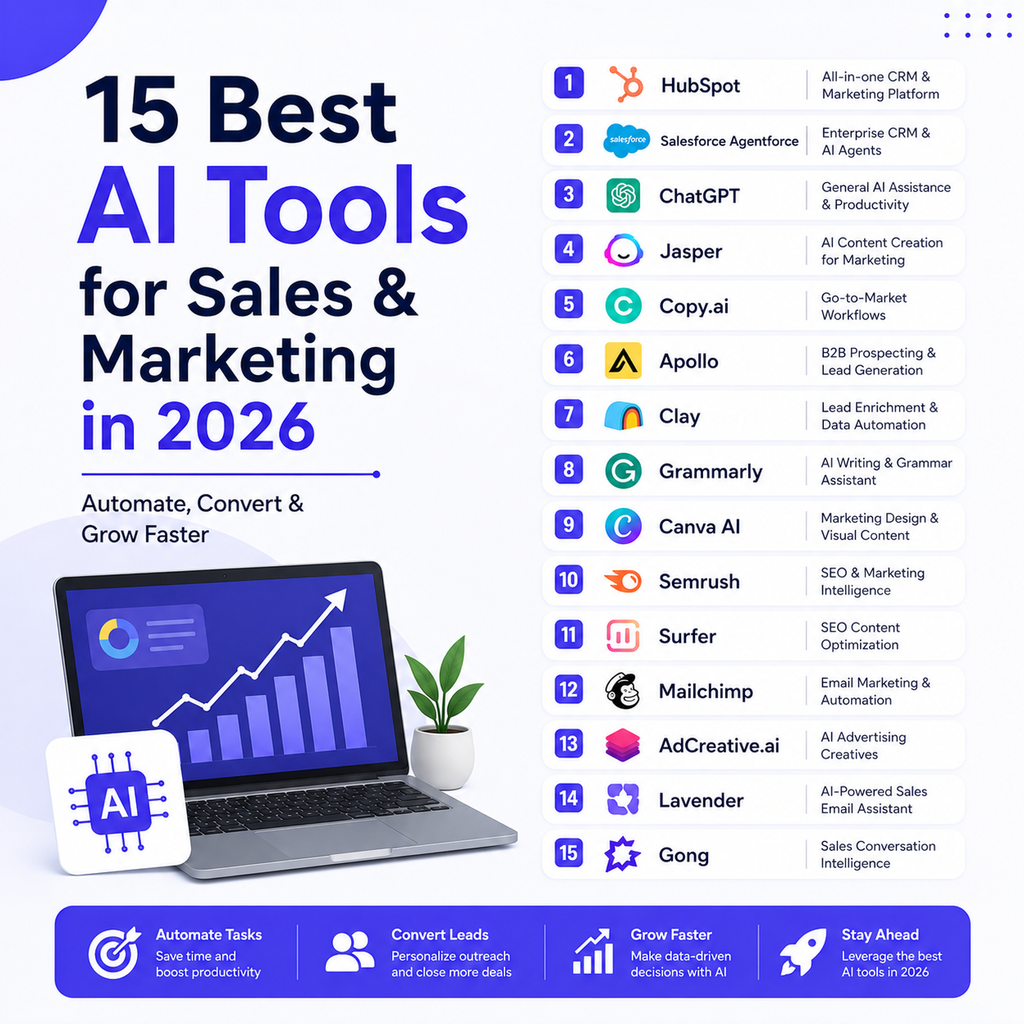
What Are the Best AI Tools for Sales and Marketing?
The best AI tool depends on what you want to accomplish.
| AI Tool | Best For | Main Use |
|---|---|---|
| HubSpot AI | Sales & marketing teams | CRM, content & automation |
| Salesforce Agentforce | Enterprise sales | AI agents & CRM |
| ChatGPT | Marketing & sales content | Research, writing & strategy |
| Jasper | Marketing teams | Brand-focused content |
| Copy.ai | Sales & marketing workflows | GTM automation |
| Apollo | Lead generation | Prospecting & sales intelligence |
| Clay | Lead enrichment | Data & prospect research |
| Grammarly | Business communication | Writing & editing |
| Canva AI | Marketing creatives | Graphics & campaigns |
| Semrush | SEO & marketing | Search & content strategy |
| Surfer | SEO content | Content optimization |
| Mailchimp | Email marketing | Campaigns & automation |
| AdCreative.ai | Advertising | AI ad creatives |
| Lavender | Sales emails | Email personalization |
| Gong | Sales intelligence | Conversation & revenue insights |
For many businesses, the strongest strategy is not choosing one AI tool. It is building an AI-powered sales and marketing stack where each tool handles a specific part of the customer journey.
What Are AI Tools for Sales and Marketing?
AI sales and marketing tools use artificial intelligence to automate, analyze, personalize, or improve activities throughout the customer acquisition process.
These tools can help with:
Sales Tasks
- Finding prospects
- Lead qualification
- Contact research
- Email personalization
- Follow-ups
- CRM management
- Sales forecasting
- Conversation analysis
- Meeting summaries
- Sales recommendations
Marketing Tasks
- Content creation
- SEO research
- Keyword analysis
- Social media content
- Email campaigns
- Advertising
- Audience research
- Marketing automation
- Personalization
- Campaign analysis
The biggest opportunity is using AI to reduce repetitive work while allowing sales and marketing professionals to focus on strategy, creativity, relationships, and decision-making.
How AI Is Changing Sales and Marketing in 2026
AI is moving from simple assistance toward more automated workflows.
Instead of asking AI to perform one isolated task, businesses can connect AI to their CRM, marketing platforms, customer data, and internal workflows.
For example:
A visitor fills out a form → AI analyzes the lead → enriches the contact information → scores the prospect → creates a CRM record → sends a personalized email → schedules follow-up → alerts the sales representative.
This type of workflow can significantly reduce manual work.
AI Copilots
It copilots assist salespeople and marketers with individual tasks.
AI Agents
AI agents can perform multi-step tasks based on instructions, permissions, business rules, and connected data.
Predictive AI
Predictive systems analyze historical and current data to identify patterns, opportunities, and potential outcomes.
Generative AI
Generative AI creates text, images, ideas, emails, advertisements, summaries, and other marketing assets.
15 Best AI Tools for Sales and Marketing in 2026
1. HubSpot AI — Best Overall for Sales and Marketing
HubSpot is one of the strongest options for businesses looking for an integrated sales and marketing platform.
Its AI capabilities work across CRM, marketing, sales, customer service, and content workflows.
Best for
- Small businesses
- Startups
- Growing companies
- Marketing teams
- Sales teams
What you can use it for
- CRM management
- Lead generation
- Marketing automation
- Email campaigns
- Content creation
- Sales assistance
- Customer segmentation
- Reporting
Why choose HubSpot?
HubSpot is especially useful if you want sales and marketing activities connected in one ecosystem rather than relying on many disconnected tools.
2. Salesforce Agentforce — Best for Enterprise Sales
Salesforce Agentforce is designed for businesses that want AI agents connected to CRM data and business processes.
It can help organizations automate customer interactions and sales workflows while operating within the Salesforce ecosystem.
Best for
- Enterprise companies
- Large sales teams
- Salesforce users
- Complex sales processes
Key uses
- Lead qualification
- Customer engagement
- Sales workflows
- CRM automation
- Customer research
- Task automation
Why choose Salesforce Agentforce?
It is particularly compelling for organizations already heavily invested in Salesforce and looking to introduce AI agents into their existing workflows.
3. ChatGPT — Best for Sales and Marketing Strategy
ChatGPT can act as a flexible AI assistant for marketing and sales teams.
It can help brainstorm campaigns, research audiences, write drafts, analyze information, create sales scripts, develop email sequences, summarize documents, and generate content ideas.
Best for
- Marketing strategy
- Content creation
- Sales scripts
- Research
- Brainstorming
- Customer personas
- Campaign planning
Example uses
A marketer could ask AI to:
- Create a campaign strategy
- Develop social media ideas
- Rewrite ad copy
- Generate blog outlines
- Analyze customer feedback
- Create buyer personas
A salesperson could use it to:
- Draft outreach emails
- Prepare meeting questions
- Create sales scripts
- Summarize customer information
- Handle objections
4. Jasper — Best for Marketing Content
Jasper is designed primarily around marketing content and brand-focused workflows.
It can help marketing teams create content while maintaining a consistent brand voice.
Best for
- Marketing departments
- Content teams
- Agencies
- Brand marketing
Key uses
- Blog content
- Ad copy
- Social media
- Marketing campaigns
- Product descriptions
- Brand messaging
Why choose Jasper?
Jasper can be useful when a company produces a large volume of marketing content and wants greater consistency across different channels.
5. Copy.ai — Best for Sales and Marketing Workflows
Copy.ai focuses heavily on go-to-market workflows.
It can help automate repetitive activities across sales and marketing.
Best for
- Sales teams
- Marketing teams
- Revenue teams
- B2B companies
Key uses
- Prospecting
- Outreach
- Lead enrichment
- Content generation
- Sales workflows
- Marketing automation
Why choose Copy.ai?
Its workflow-oriented approach makes it interesting for teams that want to automate processes rather than simply generate individual pieces of content.
6. Apollo — Best for Lead Generation
Apollo combines sales intelligence, prospecting, contact information, and outreach capabilities.
Best for
- B2B sales
- Lead generation
- Prospecting
- Sales development representatives
Key uses
- Finding prospects
- Contact discovery
- Lead lists
- Prospect research
- Email outreach
- Sales intelligence
Why choose Apollo?
It can help sales teams reduce the time spent manually searching for potential customers.
7. Clay — Best for Lead Enrichment
Clay is designed for advanced prospect research and data enrichment.
It can combine information from different sources to help sales teams create more detailed prospect profiles.
Best for
- B2B sales
- Growth teams
- Sales operations
- Lead enrichment
Key uses
- Prospect research
- Lead enrichment
- Account research
- Personalization
- Data workflows
Why choose Clay?
Clay is particularly useful when generic prospect lists are not enough and your sales team needs deeper research and personalization.
8. Grammarly — Best for Business Communication
Grammarly uses AI to help users improve writing, clarity, tone, and communication.
Best for
- Sales emails
- Marketing teams
- Business communication
- Content teams
Key uses
- Email editing
- Grammar correction
- Tone adjustment
- Rewriting
- Professional communication
Why choose Grammarly?
Sales and marketing depend heavily on communication. Clearer emails and marketing copy can make a significant difference to how professional your business appears.
9. Canva AI — Best for Marketing Design
Canva’s AI capabilities make it easier for marketers to create visual content without requiring advanced graphic design skills.
Best for
- Social media
- Advertisements
- Presentations
- Marketing graphics
- Small businesses
Key uses
- Social media posts
- Ad creatives
- Presentations
- Marketing banners
- Images
- Brand assets
Why choose Canva AI?
It is useful for teams that need to produce marketing visuals quickly while maintaining consistent branding.
10. Semrush — Best for SEO and Marketing Intelligence
Semrush is a powerful marketing intelligence platform with AI features across areas such as SEO, content, and marketing research.
Best for
- SEO teams
- Content marketers
- Agencies
- Digital marketers
Key uses
- Keyword research
- Competitor research
- SEO analysis
- Content planning
- Website audits
- Marketing research
Why choose Semrush?
It can help marketers understand search opportunities, competitors, keywords, content performance, and broader digital marketing trends.
11. Surfer — Best for SEO Content Optimization
Surfer focuses on helping marketers optimize content for search engines.
Best for
- Bloggers
- SEO professionals
- Content marketers
- Agencies
Key uses
- Content optimization
- Keyword analysis
- Content planning
- SERP analysis
- SEO recommendations
Why choose Surfer?
It can help content teams turn keyword research into more structured and search-focused content.
12. Mailchimp — Best for Email Marketing
Mailchimp remains a popular option for email marketing and marketing automation.
AI capabilities can help marketers with content, audience targeting, campaign optimization, and other email marketing activities.
Best for
- Small businesses
- Ecommerce
- Email marketers
- Startups
Key uses
- Email campaigns
- Customer segmentation
- Marketing automation
- Campaign analytics
- Email content
Why choose Mailchimp?
It is a practical option for businesses that want email marketing and automation without building a highly complex marketing stack.
13. AdCreative.ai — Best for AI Advertising Creatives
AdCreative.ai focuses on generating and optimizing advertising creatives.
Best for
- Performance marketers
- Ecommerce businesses
- Advertising agencies
- Paid media teams
Key uses
- Ad creative generation
- Marketing visuals
- Ad copy
- Creative testing
- Campaign optimization
Why choose AdCreative.ai?
It can help advertising teams produce multiple creative concepts faster for testing.
14. Lavender — Best for AI Sales Emails
Lavender focuses on improving sales emails.
It analyzes emails and provides suggestions designed to improve clarity, personalization, and engagement.
Best for
- SDRs
- B2B sales
- Sales representatives
- Outbound teams
Key uses
- Email personalization
- Sales email improvement
- Outreach optimization
- Email coaching
Why choose Lavender?
If outbound email is an important part of your sales process, an AI tool focused specifically on sales communication can be useful.
15. Gong — Best for Sales Intelligence
Gong focuses on analyzing sales conversations and customer interactions.
It can help sales organizations identify patterns across calls, meetings, and customer conversations.
Best for
- Sales teams
- Revenue organizations
- Enterprise sales
- Sales leadership
Key uses
- Conversation intelligence
- Sales coaching
- Deal analysis
- Revenue insights
- Sales forecasting
Why choose Gong?
It can help sales managers understand what is happening across customer conversations instead of relying entirely on manual call reviews.
Best AI Tools for Sales and Marketing by Use Case
Different business goals require different AI tools.
Best AI Tool for Lead Generation
Apollo is a strong option for prospect discovery and B2B lead generation.
Clay is better suited to teams that need deeper enrichment and personalized prospect research.
Best AI Tool for Sales Automation
Salesforce Agentforce, HubSpot, and Copy.ai are strong choices for different levels of sales workflow automation.
Best AI Tool for Marketing Content
Jasper and ChatGPT are flexible options for creating marketing content.
Best AI Tool for SEO
Semrush and Surfer are strong choices for SEO research and content optimization.
Best AI Tool for Email Marketing
Mailchimp is a practical option for email campaigns and automation, while Lavender is more specifically focused on sales emails.
Best AI Tool for Marketing Design
Canva AI is a strong choice for marketers who need to create social posts, advertisements, presentations, and other visual assets.
Best AI Tool for Sales Intelligence
Gong is designed specifically around sales conversations and revenue intelligence.
Best AI Sales and Marketing Tools for Small Businesses
Small businesses generally need tools that are easy to use, affordable, and capable of handling multiple tasks.
Recommended Tools
- HubSpot
- ChatGPT
- Canva AI
- Mailchimp
- Grammarly
- Semrush
A small business does not necessarily need 15 different AI subscriptions.
A practical starter stack could be:
CRM: HubSpot
AI assistant: ChatGPT
Design: Canva
Email marketing: Mailchimp
SEO: Semrush
This provides broad coverage without creating an unnecessarily complicated technology stack.
Best AI Tools for B2B Sales
B2B sales teams often have longer sales cycles and need detailed prospect research.
Recommended Tools
- Apollo
- Clay
- Salesforce Agentforce
- HubSpot
- Gong
- Lavender
These tools can help with prospecting, research, outreach, CRM management, sales conversations, and follow-up.
Best AI Tools for Ecommerce Marketing
Ecommerce businesses have different priorities.
They need product content, advertising, email marketing, customer segmentation, SEO, and creative production.
Recommended Tools
- ChatGPT
- Canva AI
- Mailchimp
- Semrush
- AdCreative.ai
- HubSpot
Best AI Tools for Digital Marketing Agencies
Agencies need scalability and consistency because they manage multiple clients.
Recommended Tools
- ChatGPT
- Jasper
- Canva AI
- Semrush
- Surfer
- Copy.ai
The ideal agency stack depends on the services offered, but AI can significantly reduce repetitive research, content, reporting, and creative-production tasks.
AI Sales and Marketing Tools Comparison
| Tool | Sales | Marketing | Lead Generation | Content | SEO | Automation |
|---|---|---|---|---|---|---|
| HubSpot | ✓ | ✓ | ✓ | ✓ | ✓ | ✓ |
| Salesforce Agentforce | ✓ | ✓ | ✓ | ✓ | ||
| ChatGPT | ✓ | ✓ | ✓ | ✓ | ✓ | |
| Jasper | ✓ | ✓ | ✓ | ✓ | ||
| Copy.ai | ✓ | ✓ | ✓ | ✓ | ✓ | |
| Apollo | ✓ | ✓ | ✓ | |||
| Clay | ✓ | ✓ | ✓ | |||
| Grammarly | ✓ | ✓ | ✓ | |||
| Canva AI | ✓ | ✓ | ||||
| Semrush | ✓ | ✓ | ✓ | ✓ | ||
| Surfer | ✓ | ✓ | ✓ | |||
| Mailchimp | ✓ | ✓ | ✓ | ✓ | ||
| AdCreative.ai | ✓ | ✓ | ✓ | |||
| Lavender | ✓ | ✓ | ||||
| Gong | ✓ | ✓ |
What Features Should You Look for in AI Sales and Marketing Tools?
Choosing AI software based only on popularity can be a mistake.
Look for features that solve an actual business problem.
CRM Integration
Your AI tools should connect with your customer data wherever possible.
Workflow Automation
Look for tools that can automate multiple steps instead of completing only one task.
Personalization
AI should help you create relevant customer experiences rather than sending generic automated messages.
Analytics
You need measurable results.
Look for reporting around:
- Leads generated
- Conversion rates
- Email engagement
- Sales pipeline
- Campaign performance
- Revenue
- Customer acquisition cost
Data Security
Before connecting customer or business data to an AI system, review the platform’s privacy, security, data-retention, and access policies.
Human Control
The best AI systems should allow humans to review, edit, approve, or override important outputs.
How to Build an AI Sales and Marketing Stack
You do not need dozens of tools.
Start with the biggest bottleneck in your sales or marketing process.
Step 1: Identify Your Biggest Problem
Ask:
Is your problem lead generation?
Content creation?
SEO?
Email marketing?
Sales follow-up?
Customer data?
Advertising?
Step 2: Choose One Primary AI Tool
Select one tool that directly addresses the problem.
Step 3: Connect Your Existing Systems
Integrate your CRM, website, email platform, advertising accounts, and other relevant systems where appropriate.
Step 4: Automate Repetitive Tasks
Start with predictable activities.
For example:
Lead arrives → AI qualifies → CRM updated → personalized email drafted → sales representative notified.
Step 5: Measure Results
Compare performance before and after implementation.
Step 6: Expand Gradually
Once one workflow produces measurable value, automate another.
Benefits of AI for Sales and Marketing
Save Time
AI can handle many repetitive tasks much faster than manual processes.
Generate More Content
Marketing teams can create initial drafts and creative variations faster.
Improve Lead Qualification
AI can help sales teams identify promising prospects based on defined criteria.
Personalize Outreach
AI can help create personalized messaging at a larger scale.
Improve Decision-Making
AI can analyze large amounts of information and highlight patterns that may be difficult to identify manually.
Scale Marketing Operations
Small teams can potentially manage more marketing activities without increasing headcount at the same rate.
What Are the Risks of Using AI for Sales and Marketing?
Generic AI Content
Publishing large amounts of low-quality AI-generated content can damage customer trust.
Incorrect Information
AI-generated claims should be reviewed before publication or customer communication.
Privacy Problems
Never provide sensitive customer information to an AI system without understanding how that information is processed and protected.
Over-Automation
Automation should improve customer experiences rather than make them feel robotic.
Poor Brand Voice
AI-generated content needs human review to maintain your company’s tone and positioning.
How to Measure AI Sales and Marketing ROI
AI should be measured by business outcomes rather than the number of AI-generated words or images.
Sales Metrics
Track:
- Qualified leads
- Conversion rate
- Sales cycle length
- Pipeline value
- Revenue
- Win rate
Marketing Metrics
Track:
- Organic traffic
- Leads
- Cost per lead
- Conversion rate
- Email engagement
- Advertising ROI
- Customer acquisition cost
AI Productivity Metrics
Track:
- Hours saved
- Tasks automated
- AI-assisted conversations
- Content production time
- Cost per workflow
A simple calculation is:
AI ROI = (Additional revenue + cost savings − AI investment) ÷ AI investment × 100
How to Choose the Best AI Tools for Your Business
The best AI tool is not necessarily the most expensive or most advanced.
Ask these questions before purchasing:
What problem am I solving?
Choose a tool based on a measurable business problem.
Who will use it?
A tool designed for enterprise sales operations may be unnecessary for a small business.
Does it integrate with my current software?
Integration can be more important than having additional AI features.
How much will it actually cost?
Consider subscriptions, usage charges, implementation, integrations, and employee training.
Can I measure the results?
If you cannot measure the improvement, it becomes difficult to justify the investment.
Frequently Asked Questions About AI Tools for Sales and Marketing
Which AI tools are best for sales and marketing?
HubSpot, Salesforce Agentforce, ChatGPT, Jasper, Copy.ai, Apollo, Clay, Semrush, Canva AI, Mailchimp, and Gong are among the major tools worth evaluating in 2026. The right choice depends on your specific sales or marketing requirements.
What is the best AI tool for sales?
For CRM-connected sales automation, HubSpot and Salesforce Agentforce are strong options. Apollo is useful for prospecting, Clay for enrichment, Lavender for sales emails, and Gong for sales intelligence.
What is the best AI tool for marketing?
There is no single best marketing AI tool. ChatGPT and Jasper are useful for content, Semrush for SEO, Canva AI for design, Mailchimp for email marketing, and AdCreative.ai for advertising creatives.
Can AI automate sales?
Yes. AI can automate many parts of the sales process, including prospect research, lead qualification, CRM updates, email drafting, follow-ups, meeting summaries, and certain customer interactions.
However, human involvement remains important for relationship building, negotiation, strategic decisions, and complex deals.
Can AI replace sales and marketing teams?
AI is more likely to change sales and marketing jobs than completely eliminate them. Teams can use AI to automate repetitive work while spending more time on strategy, creativity, relationships, and high-value decisions.
Are AI sales tools worth it for small businesses?
They can be, especially when they solve a specific bottleneck. Small businesses should start with one or two tools that directly save time or generate measurable revenue rather than purchasing a large collection of AI subscriptions.
What is the best AI tool for lead generation?
Apollo is a strong option for B2B prospecting, while Clay is useful for advanced lead enrichment and research. CRM platforms such as HubSpot and Salesforce can also support lead management and qualification.
What is the best AI tool for SEO and marketing?
Semrush is a broad digital marketing and SEO platform, while Surfer focuses more specifically on content optimization. Your choice depends on whether you need broad marketing intelligence or primarily content optimization.
Final Verdict: Which AI Tools Are Best for Sales and Marketing in 2026?
The best AI sales and marketing tools depend on your goals.
HubSpot — A strong all-in-one platform for CRM, marketing, sales, and customer service.
Salesforce Agentforce — Ideal for enterprise CRM, AI-powered agents, and complex business workflows.
ChatGPT — A versatile choice for general AI assistance, research, brainstorming, and content creation.
Jasper — Designed specifically for marketing teams that need AI-powered content creation.
Copy.ai — Useful for go-to-market workflows, sales processes, and marketing operations.
Apollo — A powerful option for B2B prospecting, contact discovery, and sales outreach.
Clay — Helps businesses enrich leads, combine data sources, and build advanced prospecting workflows.
Grammarly — Makes business writing clearer, more professional, and easier to produce with AI assistance.
Canva AI — A practical solution for creating marketing graphics, social media posts, presentations, and visual content.
Semrush — Provides SEO tools, keyword research, competitor insights, and marketing intelligence.
Surfer — Helps marketers optimize SEO content and improve its potential to rank in search results.
Mailchimp — A popular platform for email marketing, automation, audience management, and campaign creation.
AdCreative.ai — Focused on generating AI-powered advertising creatives and marketing visuals.
Lavender — Helps sales professionals write more effective and personalized sales emails.
Gong — Provides sales conversation intelligence to analyze calls, identify insights, and improve sales performance.
The smartest approach is not to automate everything at once.
Start with one repetitive task, choose an AI tool that solves it, measure the result, and then expand your AI workflow.
In 2026, the businesses that benefit most from AI will not necessarily be those using the most tools. They will be the ones using the right AI tools in the right workflows to create measurable improvements in sales, marketing efficiency, customer experience, and revenue.

Umang Pundir
Umang Pundir creates practical and easy-to-understand content about SEO, digital marketing, AI tools, content marketing, social media and online growth strategies.