
Latest AI Tools for Blog Writing 2026
Writing a high-quality blog post takes time. Before publishing an article, you may need to research the topic, understand search intent, create an outline, write the content, edit the draft, optimize it for SEO, and answer common reader questions.
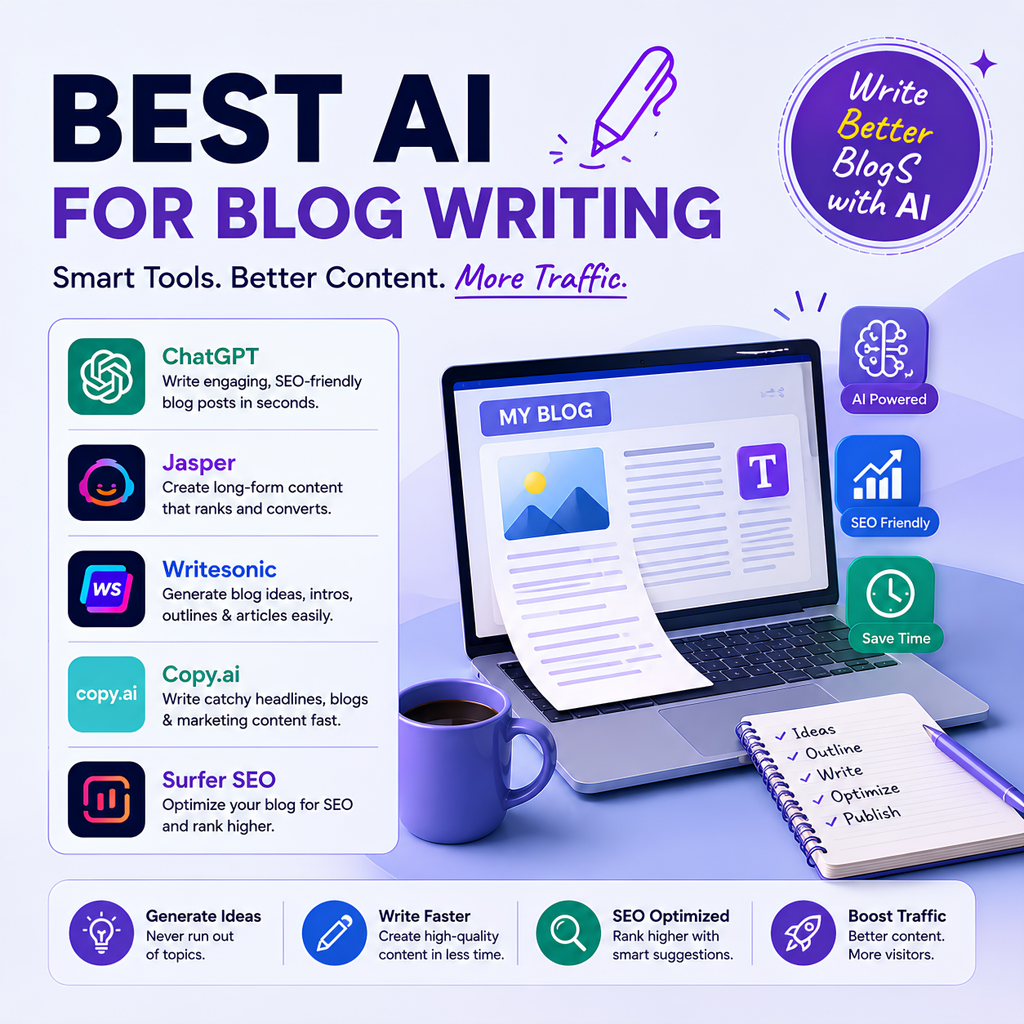
AI writing tools can make this process faster. Today, bloggers, content writers, businesses, freelancers, and marketers use AI to help with:
- Blog topic ideas
- Keyword and topic research
- Content outlines
- First drafts
- Headline ideas
- Content editing
- Grammar improvement
- SEO content planning
- Meta descriptions
- FAQs
- Content updates
However, choosing the best AI for blog writing can be difficult because different AI tools have different strengths. Some tools are better for writing. Others are better for research, SEO, editing, or brainstorming. This guide compares the best AI tools for blog writing in 2026 and explains how to choose the right AI writing assistant for your needs.
What Is the Best AI for Blog Writing?
ChatGPT is one of the best overall AI tools for blog writing because it can help with brainstorming, research planning, outlines, writing, editing, SEO ideas, and content improvement.
However, the best AI tool depends on your workflow.
- ChatGPT: Best overall for blog writing
- Claude: Best for long-form writing and editing
- Gemini: Best for Google-focused workflows
- Jasper: Best for marketing and content teams
- Grammarly: Best for grammar and editing
- Surfer: Best for SEO-focused content optimization
For most bloggers, the best approach is not to depend on AI to write an entire article automatically.
Instead, use AI to speed up different stages of the content creation process.
What Is an AI Blog Writing Tool?
An AI blog writing tool is software that uses artificial intelligence to help create and improve written content.
These tools can assist with different stages of blog creation.
AI Can Help Before Writing
Before writing a blog post, AI can help you:
- Find topic ideas
- Understand a subject
- Identify audience questions
- Create article structures
- Brainstorm unique angles
AI Can Help During Writing
While writing, AI can assist with:
- Creating introductions
- Explaining concepts
- Improving paragraphs
- Generating examples
- Rewriting content
AI Can Help After Writing
After writing, AI can help:
- Improve readability
- Fix grammar
- Remove repetition
- Create meta descriptions
- Generate FAQs
- Suggest content improvements
Why Use AI for Blog Writing?
AI can make the blogging process more efficient.
However, AI should support your writing rather than completely replace your knowledge and expertise.
Save Time
AI can help create a first draft or outline quickly.
Overcome Writer’s Block
When you do not know how to start, AI can suggest multiple ideas.
Improve Content Structure
AI can help organize a topic into logical sections.
Create More Content Ideas
You can generate multiple article ideas around a topic or keyword.
Improve Productivity
AI can reduce the time spent on repetitive writing tasks.
10 Best AI Tools for Blog Writing
1. ChatGPT – Best Overall AI for Blog Writing
ChatGPT is one of the most versatile AI tools for bloggers and content creators.
You can use it throughout the entire blog writing workflow.
What Can ChatGPT Help With?
- Blog topic ideas
- Keyword-related topic ideas
- Content outlines
- Article introductions
- First drafts
- Rewriting
- Editing
- FAQs
- Meta descriptions
- Content repurposing
Example Prompt
Create a detailed blog post outline for the keyword “best AI tools for students.” Include search intent, important headings, beginner-friendly explanations, examples, and frequently asked questions.
Best For
Bloggers, content writers, freelancers, marketers, and businesses.
Why It Is a Strong Choice
ChatGPT can support multiple stages of the content creation workflow, making it useful for people who want one AI assistant for brainstorming, writing, and improving blog content.
2. Claude – Best AI for Long-Form Blog Writing
Claude is a strong AI tool for writers who work with longer articles and detailed content.
It can help with:
- Long-form articles
- Content editing
- Rewriting
- Content analysis
- Summarization
- Improving clarity
Example Prompt
Improve this blog article while keeping the original meaning. Make the content clearer, more engaging, and easier for beginners to understand.
Best For
Long-form content, professional writing, and detailed editing.
Why It Is Useful
Claude can be particularly helpful when you want to analyze or improve a long piece of content.
3. Gemini – Best for Google-Focused Content Workflows
Gemini can help bloggers with brainstorming, outlining, writing, and planning.
It can be useful for:
- Blog ideas
- Content planning
- Topic explanations
- Article outlines
- First drafts
- Summaries
Example Prompt
Generate 20 blog topic ideas for a website about artificial intelligence. Include informational, comparison, beginner, and problem-solving topics.
Best For
Bloggers and content creators who frequently use Google’s ecosystem.
4. Jasper – Best for Marketing Content Teams
Jasper is designed for marketing and business content workflows.
It can be useful for creating:
- Blog content
- Marketing copy
- Social media content
- Brand-focused content
Best For
Marketing teams, businesses, and professional content workflows.
5. Grammarly – Best for Editing Blog Content
Writing a blog post is only one part of content creation.
Editing is equally important.
Grammarly can help improve:
- Grammar
- Spelling
- Clarity
- Tone
- Sentence structure
Best For
Bloggers who want to improve the quality and readability of their writing.
6. Surfer – Best for SEO Content Optimization
SEO-focused content often requires additional optimization beyond writing.
Surfer can support content workflows related to SEO and content optimization.
Best For
Bloggers and SEO professionals focused on improving search-focused content.
Important Tip
SEO optimization should never result in unnatural or keyword-stuffed content.
Always prioritize the reader.
7. Notion AI – Best for Content Planning
Notion AI can be useful for bloggers who want to organize their content workflow.
You can use AI to support:
- Content calendars
- Blog ideas
- Notes
- Article planning
- Content summaries
Best For
Bloggers and teams who need better organization.
8. Copy.ai – Best for Marketing Copy and Blog Ideas
Copy.ai can be useful for generating marketing-focused content ideas and copy.
Potential uses include:
- Blog introductions
- Headlines
- Marketing content
- Social media posts
Best For
Marketers and businesses creating promotional content.
9. Writesonic – Best for AI Content Workflows
Writesonic provides AI writing tools designed to help users create different types of content.
It can support workflows involving:
- Blog writing
- Marketing content
- Content ideas
- SEO content
Best For
Content creators who want a dedicated AI writing platform.
10. Perplexity – Best for Blog Research
Research is an important part of writing useful blog content.
Perplexity can help users explore topics and find information for research.
Best For
Bloggers who need help researching topics before writing.
Important Tip
Always verify:
- Statistics
- Facts
- Dates
- Quotes
- Sources
Never publish research information without checking its accuracy.
Best AI for Blog Writing by Category
Best Overall AI for Blog Writing
ChatGPT
A versatile choice for brainstorming, outlining, writing, editing, and content planning.
Best AI for Long-Form Articles
Claude
A strong option for long-form writing and detailed editing.
Best AI for SEO Blog Writing
ChatGPT and Surfer
ChatGPT can help plan and draft content, while SEO-focused platforms can assist with optimization.
Best AI for Blog Research
Perplexity
Useful for exploring topics and researching information.
Best AI for Editing Blog Posts
Grammarly
Helpful for improving grammar, clarity, and readability.
Best AI for Google Users
Gemini
A useful choice for people who already work heavily within Google’s ecosystem.
How to Use AI to Write a Blog Post
AI works best when you divide the blog writing process into stages.
Step 1: Choose Your Topic
Start by identifying what your audience wants to know.
Example Prompt
Suggest 20 beginner-friendly blog topics related to artificial intelligence tools.
Step 2: Understand Search Intent
Before writing, understand why someone is searching for the topic.
Common search intent types include:
- Informational
- Commercial
- Transactional
- Navigational
Example Prompt
What is the likely search intent behind the keyword “best AI tools for bloggers”?
Step 3: Create a Content Outline
Create a structure before writing.
Example Prompt
Create a complete H1, H2, and H3 outline for an article about “best AI tools for blog writing.”
Step 4: Research the Topic
Collect information from reliable sources.
AI can help create a research framework, but important information should be verified independently.
Example Prompt
Create a research checklist for writing a detailed article about AI blog writing tools.
Step 5: Write the First Draft
Use AI to help create a first draft.
Avoid asking AI to write a generic article without providing context.
Instead, provide:
- Target audience
- Content goal
- Tone
- Experience level
- Required structure
Example Prompt
Write a beginner-friendly section explaining how AI helps bloggers save time. Use simple language and practical examples.
Step 6: Add Human Experience
This is one of the most important steps.
Add:
- Personal experience
- Original examples
- Expert insights
- Case studies
- Unique opinions
AI-generated content becomes more valuable when combined with real human knowledge.
Step 7: Edit the Content
Review the article for:
- Accuracy
- Repetition
- Grammar
- Readability
- Clarity
- Logical structure
Step 8: Optimize for SEO
Make sure your content has:
- A clear H1
- Logical H2 and H3 headings
- Relevant keywords
- Helpful answers
- Internal links
- Meta information
Avoid adding keywords unnaturally.
Best AI Prompts for Blog Writing
Topic Ideas
Generate 30 blog post ideas about [topic]. Include beginner, comparison, how-to, and problem-solving topics.
Outline
Create a detailed H1, H2, and H3 outline for a blog post about [topic].
Introduction
Write an engaging introduction for an article about [topic]. Clearly explain the problem and what readers will learn.
Content Improvement
Improve this paragraph for clarity and readability without changing the meaning.
SEO Content Planning
Create an SEO-focused content brief for the keyword [keyword]. Include search intent, target audience, important subtopics, and user questions.
FAQ Generation
Generate 10 frequently asked questions about [topic] and provide short, direct answers.
Meta Description
Write five compelling meta descriptions for an article about [topic]. Keep them clear, accurate, and user-focused.
How to Write Better AI Prompts for Blog Writing
The quality of your AI-generated content often depends on the quality of your instructions.
Give Context
Instead of:
Write a blog about AI.
Try:
Write a beginner-friendly blog section about AI tools for students. Use simple language and practical examples.
Define Your Audience
Tell the AI who the content is for.
Examples include:
- Beginners
- Students
- Small business owners
- Bloggers
- Marketers
Specify the Tone
You can request a tone such as:
- Professional
- Friendly
- Educational
- Conversational
- Simple
Request a Specific Format
For example:
- H1, H2, and H3 structure
- Bullet points
- Step-by-step instructions
- FAQ section
- Comparison table
AI Blog Writing and SEO
SEO should focus on creating content that answers the reader’s search query.
AI can help with:
- Identifying important subtopics
- Creating content structures
- Generating FAQs
- Improving readability
However, AI should not be used to create large amounts of low-quality content just to target keywords.
High-quality SEO content should be:
- Useful
- Accurate
- Well-structured
- Original
- Easy to understand
AI Blog Writing and GEO
GEO, or Generative Engine Optimization, focuses on creating content that is easy for AI-powered search and answer systems to understand.
A GEO-friendly blog should include:
- Clear headings
- Direct answers
- Definitions
- Practical examples
- Structured sections
- Original insights
Example of a GEO-Friendly Answer
What Is the Best AI for Blog Writing?
ChatGPT is one of the best overall AI tools for blog writing because it can help with brainstorming, outlining, writing, editing, and content planning. The best choice may vary depending on whether you prioritize long-form writing, SEO, research, or editing.
Direct answers make the information easier for users to understand.
AI Blog Writing and AEO
AEO, or Answer Engine Optimization, focuses on answering questions clearly.
Your article should answer questions such as:
- What is the best AI for blog writing?
- Can AI write a complete blog post?
- Is AI content good for SEO?
- How can bloggers use AI?
- Which AI tool is best for long-form content?
- Can AI replace human writers?
Adding clear questions and concise answers can improve the user experience.
Benefits of Using AI for Blog Writing
Faster Content Creation
AI can reduce the time needed to brainstorm and create first drafts.
More Content Ideas
AI can generate multiple ideas around a topic.
Better Organization
AI can help create logical article structures.
Improved Productivity
Repetitive writing tasks can be completed faster.
Help With Editing
AI can identify opportunities to improve clarity and readability.
Limitations of AI Blog Writing
AI is useful, but it also has limitations.
AI Can Make Mistakes
Generated facts may be incorrect.
Always verify important information.
AI Content Can Sound Generic
Without detailed instructions and human editing, AI content may lack personality.
AI Cannot Replace Real Experience
Original knowledge, case studies, and personal experience are valuable.
Quality Control Is Still Necessary
Never publish AI-generated content without reviewing it.
How to Use AI for Blog Writing Responsibly
Follow these best practices:
- Research topics carefully.
- Verify important facts.
- Add original insights.
- Edit every AI-generated draft.
- Avoid publishing copied or repetitive content.
- Protect confidential information.
- Focus on helping readers.
The best approach is:
AI efficiency + human expertise + original research + careful editing.
Frequently Asked Questions About AI for Blog Writin
What is the best AI tool for blog writing?
ChatGPT is one of the best overall AI tools for blog writing because it can help with brainstorming, outlining, writing, editing, and content planning.
Can AI write an entire blog post?
Yes, AI can create a draft of an entire blog post. However, the content should be reviewed, edited, fact-checked, and improved with original human insights before publication.
Is AI-generated blog content good for SEO?
AI-assisted content can be useful for SEO when it is accurate, original, helpful, and written to meet the needs of users. Simply generating large amounts of low-quality content is not a good long-term strategy.
Which AI is best for long-form blog writing?
Claude and ChatGPT are both strong options for long-form blog writing. The best choice depends on your preferred writing style and workflow.
Can beginners use AI for blog writing?
Yes. Beginners can use AI to generate ideas, create outlines, understand topics, improve writing, and create first drafts.
Will AI replace blog writers?
AI can automate and speed up some writing tasks, but human writers still provide expertise, personal experience, creativity, fact-checking, strategy, and original perspectives.
Final Verdict: What Is the Best AI for Blog Writing?
The best AI tool for blog writing depends on your content workflow.
🏆 Best Overall: ChatGPT
A versatile choice for blog ideas, outlines, writing, editing, and content planning.
🥇 Best for Long-Form Writing: Claude
A strong option for detailed writing and editing workflows.
🥇 Best for Google Users: Gemini
Useful for bloggers who work heavily with Google’s ecosystem.
🥇 Best for SEO Optimization: Surfer
Useful for SEO-focused content optimization workflows.
🥇 Best for Grammar and Editing: Grammarly
A helpful tool for improving the final quality of blog content.
Conclusion
AI has changed the way bloggers create content.
Today, AI tools can help with almost every stage of blog writing, from brainstorming and research planning to outlining, drafting, editing, and optimization.
However, the best blog posts are not created by simply copying an AI response.
High-quality content combines:
- AI efficiency
- Human expertise
- Original research
- Real examples
- Accurate information
- Careful editing
For most bloggers, ChatGPT is an excellent starting point because of its versatility. However, using multiple tools for writing, research, SEO, and editing can create a more effective content workflow.

Umang Pundir
Umang Pundir creates practical and easy-to-understand content about SEO, digital marketing, AI tools, content marketing, social media and online growth strategies.