
Artificial intelligence is no longer limited to smartphones, computers, and cloud applications. In 2026, AI is increasingly becoming part of the devices people wear every day. From smart glasses and AI earbuds to intelligent watches and wearable assistants, AI wearables are changing how people interact with technology. Instead of opening an app and typing a command, users can increasingly interact with AI through voice, cameras, sensors, and natural movement. The idea is simple: technology becomes more useful when it is available exactly when you need it.
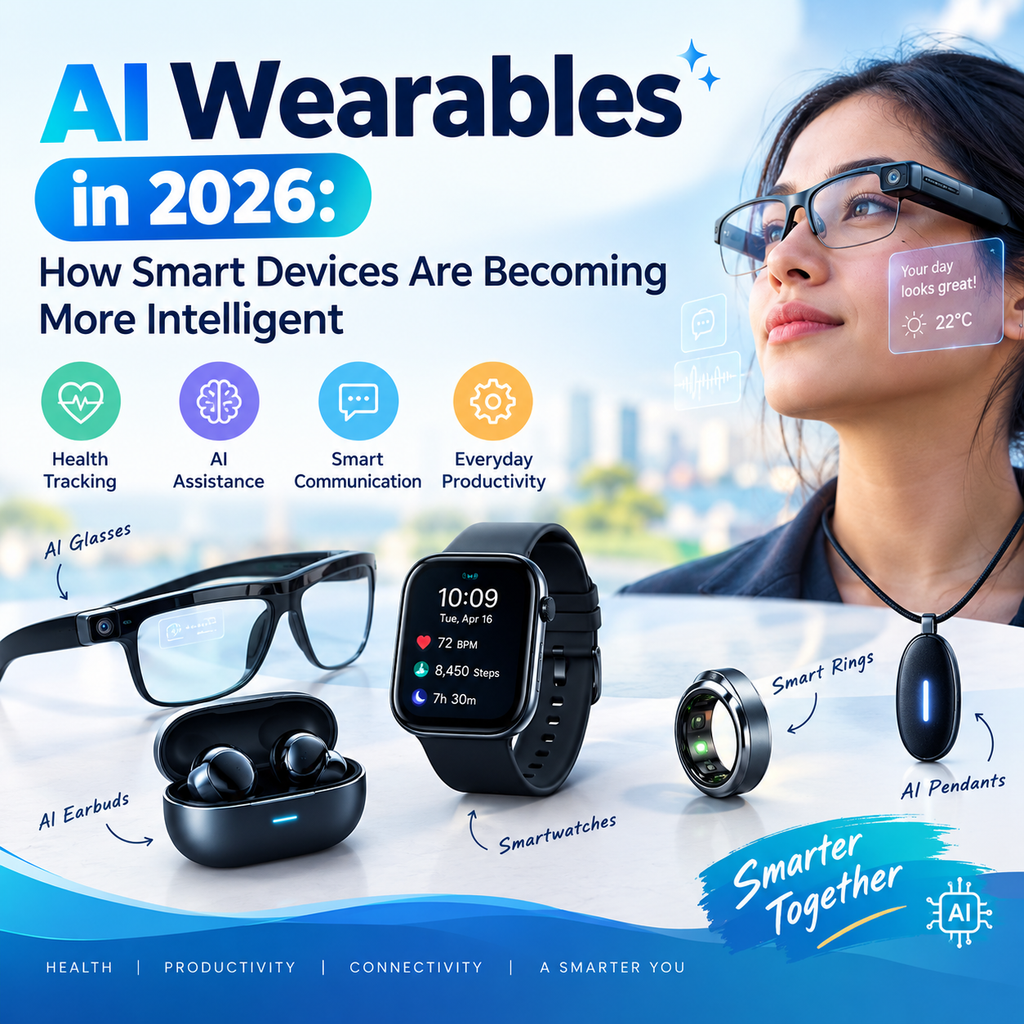
AI wearables are smart body-worn devices that combine artificial intelligence with sensors, cameras, microphones, and connected technology to provide personalized assistance and real-time insights. These devices include AI smart glasses, smart rings, smartwatches, AI earbuds, pendants, and other intelligent wearable technologies. AI wearables can support hands-free assistance, health and activity tracking, productivity, communication, accessibility, and personalized recommendations. Unlike traditional wearables that mainly collect data, AI-powered devices can analyze information and turn it into useful insights or actions. As AI technology continues to advance in 2026, AI wearables are becoming an important part of personal technology, helping users interact with AI more naturally in everyday life.
What Are AI Wearables?
AI wearables are wearable electronic devices that use artificial intelligence to understand information, respond to users, or perform intelligent tasks.
Examples include:
- AI smart glasses
- AI-powered earbuds
- Smartwatches with AI features
- Fitness wearables
- AI-enabled rings
- Smart pendants
- Wearable cameras
- Voice-controlled wearable assistants
Traditional wearable devices mainly collect information such as steps, heart rate, or notifications.
AI-powered wearables can go further by attempting to understand that information and provide useful responses.
For example, instead of simply recording a voice memo, an AI wearable could potentially summarize it, identify important points, or turn it into a task list.
How Do AI Wearables Work?
AI wearables combine several technologies.
A typical device may include:
Sensors + Microphones + Cameras + Connectivity + AI Models + Software
Sensors collect information from the user’s environment or body.
Microphones can capture voice commands.
Cameras can understand visual information.
Connectivity allows the wearable to access online services.
AI models process the information and generate a response.
For example, imagine wearing AI glasses while visiting a new city.
You could ask:
“What building am I looking at?”
The device could use its camera and AI system to identify the building and provide information through audio.
The goal is to make interaction feel natural rather than requiring constant interaction with a phone.
AI Smart Glasses
Smart glasses are one of the most interesting categories in wearable AI.
Unlike traditional glasses, AI-powered glasses can include:
- Cameras
- Microphones
- Speakers
- Voice assistants
- AI capabilities
- Smartphone connectivity
This allows users to interact with digital information while keeping their hands free.
Imagine walking through a museum and asking:
“Tell me more about this painting.”
Instead of searching manually, the wearable could potentially analyze what you’re looking at and provide an explanation.
This is one reason AI glasses are receiving so much attention.
AI Earbuds
Wireless earbuds are also becoming smarter.
Traditional earbuds are mainly designed for music and phone calls.
AI-powered earbuds can potentially support:
- Voice assistants
- Real-time translation
- Conversation summaries
- Noise management
- Personalized audio
- Voice commands
- AI-based productivity features
Because earbuds already sit close to the user’s ears, they are naturally suited to audio-based AI interactions.
You could ask an AI assistant a question without taking your phone out of your pocket.
AI Smartwatches
Smartwatches already collect a large amount of information.
They can track:
- Steps
- Exercise
- Sleep
- Heart rate
- Location
- Notifications
- Activity patterns
AI can make this information easier to understand.
Instead of looking at several charts, users could ask questions such as:
“How was my activity this week?”
The AI could summarize the available information in a conversational format.
However, wearable health information should not automatically be treated as medical advice. AI-generated interpretations can be incorrect, and important health decisions should be discussed with qualified professionals.
AI Wearables for Productivity
AI wearables could become useful productivity tools.
Consider a business meeting.
Instead of manually writing notes, an AI-enabled wearable could potentially capture the conversation, create a transcript, summarize important points, and identify follow-up tasks.
A simplified workflow could look like:
Meeting → Recording → AI transcription → Summary → Action items
This could save significant time for professionals.
Students could also use wearable AI for learning and organization, depending on the device and its capabilities.
AI Wearables for Translation
Language translation is another promising use case.
Imagine having a conversation with someone who speaks another language.
An AI wearable could potentially listen to the conversation and provide translated speech through its speakers.
Future systems may make conversations across languages feel more natural.
This could be useful for:
- Travelers
- International businesses
- Students
- Tourists
- Customer service
- Multilingual families
Real-time translation still has limitations, especially with accents, background noise, slang, and complicated conversations.
But the direction is clear: translation is moving closer to becoming an everyday wearable feature.
AI Wearables and Accessibility
AI wearables may also provide important accessibility benefits.
For people with certain visual or hearing challenges, AI-powered devices could potentially assist with understanding the surrounding environment.
For example, a wearable camera could potentially describe objects or read visible text aloud.
An AI assistant could also help users interact with digital information through voice instead of a touchscreen.
The exact usefulness depends on the technology and individual needs, but accessibility could become one of the most meaningful applications of wearable AI.
AI Wearables for Content Creators
Content creators are another potential audience.
Smart glasses with cameras can make first-person recording much easier.
Instead of holding a smartphone, creators can potentially record while:
- Walking
- Traveling
- Cycling
- Shopping
- Exploring events
- Demonstrating products
AI can then assist with the content workflow.
For example:
Record → AI selects moments → Generate captions → Create short clips → Publish
This could make content production faster.
However, creators should always consider privacy when recording other people in public or private environments.
AI Wearables and Personalized AI Assistants
One of the biggest possibilities is the development of a more personal AI assistant.
A smartphone-based chatbot usually knows only what you tell it during an interaction.
A wearable AI assistant could potentially understand more context based on the information the device is allowed to access.
For example, it might know:
- Where you’re going
- What you’re looking at
- What you’re listening to
- What reminders you have
- What you asked earlier
- What information you want assistance with
This could make AI feel much more personal.
But it also creates a major question:
How much information should an AI assistant know about you?
Privacy Is a Major Concern
The biggest challenge for AI wearables may not be technology.
It may be privacy.
A device with a microphone and camera can potentially collect highly sensitive information.
Users may be comfortable with their phone recording something when they intentionally use the camera.
A wearable camera is different because it can be present throughout the day.
Important questions include:
- When is the camera active?
- Is audio being recorded?
- Where is data stored?
- Is information sent to the cloud?
- Who can access the data?
- How long is data retained?
- Can users delete it?
- Can other people tell when they are being recorded?
These questions need clear answers.
Convenience should not come at the cost of privacy.
AI Wearables and Battery Life
Another challenge is battery life.
AI features can require significant computing power.
A wearable needs to remain:
- Lightweight
- Comfortable
- Cool
- Energy efficient
- Reliable
Nobody wants a smart device that needs charging every few hours.
Future AI wearables will likely need more efficient chips and better ways of deciding when AI processing should happen locally and when it should happen in the cloud.
On-Device AI vs Cloud AI
There are two major approaches to AI processing.
On-Device AI
The AI runs directly on the wearable.
Advantages include:
- Faster responses
- Better privacy
- Reduced internet dependence
- Lower latency
But on-device AI is limited by the wearable’s processing power and battery.
Cloud AI
The wearable sends information to remote servers where larger AI models process it.
Advantages include:
- More powerful AI models
- Greater processing capability
- Easier model updates
But it can require an internet connection and raises additional privacy considerations.
Future devices will likely combine both approaches.
Are AI Wearables Replacing Smartphones?
Probably not immediately.
Smartphones still offer:
- Large displays
- Powerful processors
- High-quality cameras
- Large batteries
- Thousands of applications
- Advanced multitasking
Wearables have a different advantage.
They are always accessible.
You don’t need to pull them out of your pocket.
The future may therefore be less about replacing smartphones and more about creating a connected ecosystem.
For example:
AI Glasses + Smartphone + Earbuds + Smartwatch + Cloud AI
Each device could handle a different part of the interaction.
AI Wearables for Everyday Life
Imagine a typical day with an advanced AI wearable.
In the morning, it could summarize your schedule.
While traveling, it could provide navigation instructions through audio.
At work, it could help organize meeting notes.
While shopping, it could provide product information.
During exercise, it could provide activity feedback.
In the evening, it could summarize your important tasks.
The technology would become less like an app and more like an invisible digital assistant.
That is the long-term vision behind many AI wearable concepts.
What Are the Benefits of AI Wearables?
Hands-Free Interaction
Users can access information without constantly holding a phone.
Real-Time Assistance
AI can potentially respond to situations as they happen.
Personalized Experiences
Wearables can provide context-aware assistance.
Improved Accessibility
Voice and visual AI features can make information easier to access.
Better Productivity
AI can assist with meetings, reminders, notes, and communication.
Faster Content Creation
Creators can capture and process content more efficiently.
What Are the Challenges?
AI wearables still face several challenges.
Privacy
Continuous cameras and microphones create legitimate concerns.
Battery Life
Power-hungry AI features can reduce operating time.
Accuracy
AI can misunderstand speech, images, or situations.
Cost
Advanced wearable technology can be expensive.
Social Acceptance
People may feel uncomfortable around devices that can record audio or video.
Internet Dependence
Some features may require cloud connectivity.
Security
A wearable containing personal information must be protected from unauthorized access.
The Future of AI Wearables
The next generation of AI wearables could become much smaller and more capable.
Instead of having a screen for everything, many interactions could happen through:
Voice + Audio + Vision + AI
Not need to search for information manually.
Simply ask for it.
Not need to type notes.
Speak them.
Not need to open a translation app.
Hear the translation directly.
The technology could become increasingly invisible.
And ironically, the best AI wearable may be the one you eventually stop thinking about as a “technology device.”
Final Thoughts
AI wearables are becoming an important part of the next generation of personal technology.
Smart glasses, earbuds, watches, rings, and other wearable devices can combine sensors with AI to provide more natural and contextual assistance.
The biggest opportunity is convenience.
The biggest challenge is trust.
For AI wearables to become truly mainstream, they need to be useful, accurate, affordable, comfortable, secure, and transparent about privacy.
The future isn’t necessarily about carrying more technology.
It may be about making technology less noticeable while making it more useful.
Author: Akshay Saini
FAQs
What are AI wearables?
AI wearables are wearable devices that use artificial intelligence to provide intelligent features such as voice assistance, image understanding, translation, personalization, and automated analysis.
What are examples of AI wearables?
Examples include AI smart glasses, AI earbuds, smartwatches, smart rings, wearable cameras, and other devices with integrated AI capabilities.
Can AI wearables replace smartphones?
They are unlikely to completely replace smartphones in the near future. Instead, they are more likely to work alongside smartphones as hands-free AI interfaces.
Are AI wearables safe?
They can be safe when designed and used responsibly, but privacy, security, data collection, and recording capabilities are important considerations.
Can AI wearables translate languages?
Some AI-enabled wearable devices can support translation features. The quality depends on the device, AI model, languages, internet connection, and surrounding environment.
Can AI wearables help with productivity?
Yes. Depending on the device, AI wearables can assist with reminders, voice notes, meeting summaries, communication, navigation, and other productivity tasks.
Will AI glasses become popular?
AI glasses have significant potential because they combine hands-free access with cameras, microphones, speakers, and AI. Their mainstream adoption will depend on price, battery life, privacy, comfort, and real-world usefulness.

Akshay Saini is an AI and technology writer at KeyArtificial, covering ChatGPT, Google Gemini, AI prompts, AI tools, AI image generation, photo editing trends, and emerging AI developments.
Pingback: AI Personalization in 2026: Benefits, Uses & Future
Pingback: AI Robots in 2026: How AI Is Changing Robotics