
AI in E-Commerce: How Artificial Intelligence Is Transforming Online Shopping
Online shopping has changed the way people discover, compare, and purchase products. E-commerce businesses now serve customers across different locations and time zones, creating huge amounts of data about searches, products, purchases, reviews, and customer behavior.
Artificial intelligence in transportation planning is transforming how cities and transport agencies manage traffic, routes, and public mobility. AI can analyze large amounts of transportation data to predict traffic patterns, optimize routes, improve public transit schedules, and support smarter infrastructure decisions. It can also help reduce congestion, travel time, fuel consumption, and transportation costs. From smart cities to logistics and public transportation, artificial intelligence in transportation planning enables data-driven decisions, improves efficiency, and supports safer, more sustainable, and connected transportation systems.
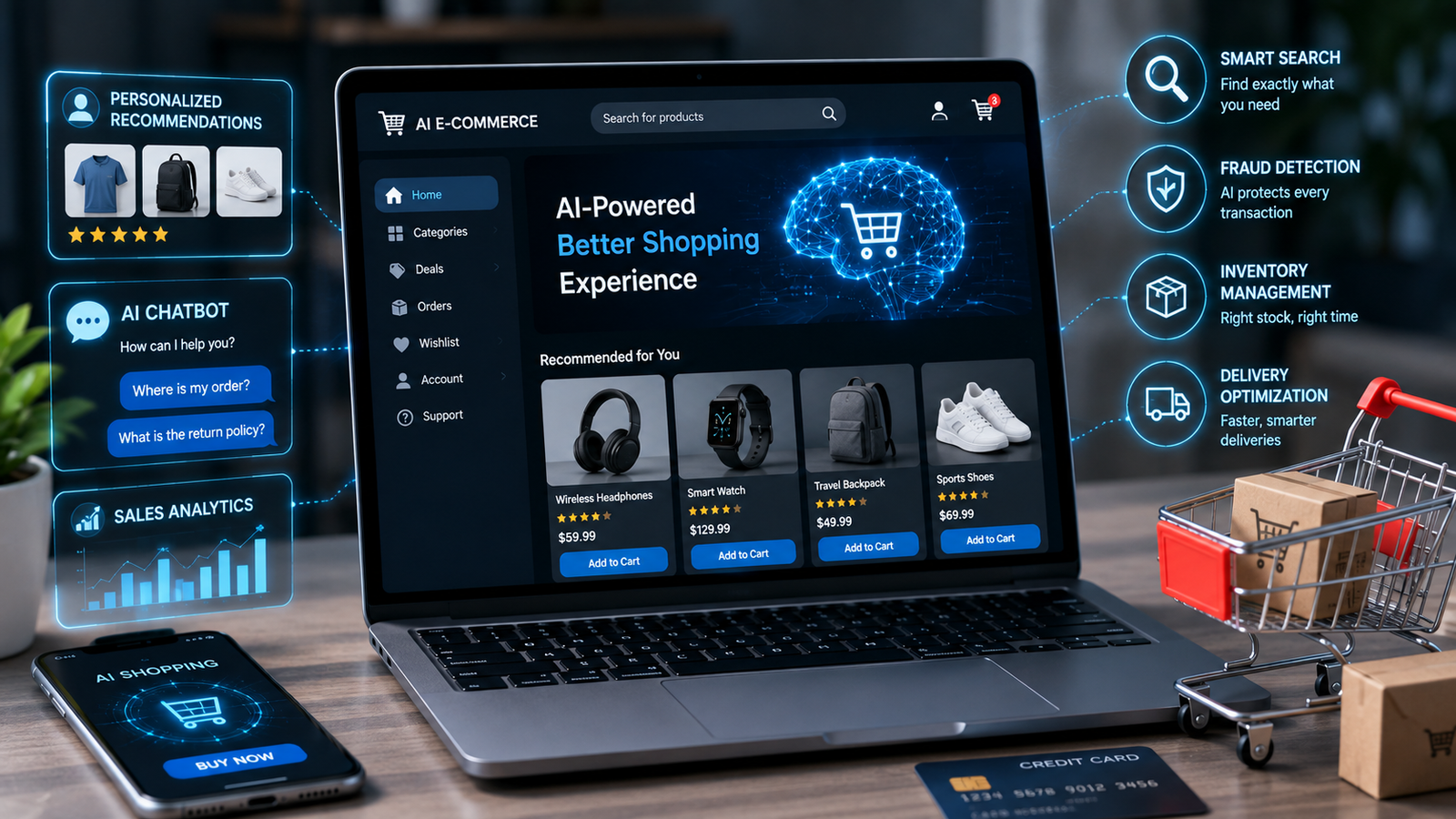
Managing all this information manually is difficult. This is where AI in e-commerce is becoming increasingly useful.
Artificial intelligence can analyze customer behavior, personalize product recommendations, improve customer support, detect fraud, optimize prices, manage inventory, and help businesses create better shopping experiences.
From the moment a customer opens an online store to the final purchase, AI can influence many parts of the e-commerce journey.
What Is AI in E-Commerce?
AI in e-commerce refers to the use of artificial intelligence, machine learning, natural language processing, computer vision, and data analytics in online shopping and digital commerce.
E-commerce businesses can use AI to analyze information such as:
- Customer searches
- Product views
- Purchase history
- Shopping preferences
- Product reviews
- Inventory data
- Website activity
- Customer questions
- Sales trends
AI can use this information to identify patterns and provide automated recommendations or insights.
Why Is AI Important for E-Commerce?
Online stores can have thousands or even millions of products.
Customers often want to find the right product quickly.
At the same time, businesses need to understand what customers want, maintain inventory, answer questions, prevent fraud, and increase sales.
AI can help automate many of these activities.
Instead of treating every customer exactly the same, AI allows businesses to create more personalized experiences.
AI-Powered Product Recommendations
Product recommendations are one of the most visible applications of AI in e-commerce.
When customers browse an online store, they may see recommendations such as:
- Products you may like
- Similar products
- Frequently purchased together
- Customers also viewed
- Recommended for you
AI can analyze browsing behavior, previous purchases, product characteristics, and other signals to generate recommendations.
For example, if someone frequently searches for running shoes, an AI system may recommend running socks, sports clothing, or related accessories.
How AI Personalizes Online Shopping
Personalization means showing customers information or products that are more relevant to their interests.
AI can analyze individual behavior and create personalized experiences.
For example, two customers visiting the same online store may see different recommendations based on their previous activity.
Personalization can be applied to:
- Product recommendations
- Search results
- Homepage content
- Offers
- Emails
- Notifications
- Advertisements
The objective is to make the shopping experience more relevant.
AI for E-Commerce Search
Search is extremely important for online stores.
A customer may search for something using different words than the product name.
For example, a customer might type:
“black shoes for office”
while the actual product listing may say:
“formal black leather footwear.”
AI-powered search systems can understand the meaning behind search queries rather than relying only on exact keyword matches.
This can help customers find relevant products more easily.
AI and Visual Search
Visual search allows customers to search using an image instead of words.
A customer may upload a photograph of a product they like.
AI-powered computer vision can analyze the image and identify visual characteristics.
The system can then search for similar products.
Visual search can be particularly useful for:
- Fashion
- Furniture
- Home decoration
- Accessories
- Shoes
- Consumer products
AI for Customer Service
Customer support is another important area for AI in e-commerce.
Online stores receive questions about:
- Product details
- Shipping
- Returns
- Payments
- Order status
- Availability
- Discounts
AI chatbots can answer many common questions instantly.
This can reduce the workload of customer-service teams while providing customers with quick responses.
AI Chatbots for Online Stores
An AI chatbot can communicate with customers using natural language.
For example, a customer might ask:
“Where is my order?”
The chatbot can potentially access relevant order information and provide a status update if the system is properly integrated.
Customers may also ask:
“Do you have this shirt in medium?”
An AI-powered system can help provide information based on available inventory data.
AI and Generative AI in E-Commerce
Generative AI is creating new possibilities for online businesses.
E-commerce companies can use generative AI to assist with:
- Product descriptions
- Marketing content
- Customer-service responses
- Email drafts
- Product comparisons
- Advertising ideas
- Social media content
This can reduce the time required to create certain types of content.
However, businesses should review AI-generated content for accuracy before publishing it.
AI for Product Descriptions
Large online stores may have thousands of product listings.
Writing unique descriptions for every product can require significant time.
Generative AI can help create draft descriptions using information such as:
- Product name
- Features
- Specifications
- Materials
- Size
- Intended use
Human review remains important because incorrect product information can negatively affect customers.
AI for Product Photography
AI-powered image tools can assist e-commerce businesses with product visuals.
Depending on the technology, AI can help with:
- Background removal
- Image enhancement
- Image resizing
- Product background creation
- Image categorization
- Visual editing
This can help businesses prepare product images more efficiently.
AI for Inventory Management
Managing inventory is a major challenge for e-commerce businesses.
Too much inventory can increase storage costs.
Too little inventory can result in products becoming unavailable.
AI can analyze:
- Historical sales
- Current demand
- Seasonal patterns
- Product popularity
- Promotions
- Inventory levels
This can help businesses make better inventory decisions.
AI for Demand Forecasting
Demand can change quickly.
A product may become popular because of a trend, advertisement, season, or social media discussion.
AI can analyze historical and real-time information to estimate potential demand.
Businesses can use demand forecasts to plan purchasing and inventory.
Forecasts are not guarantees, but they can provide useful information for planning.
AI for Price Optimization
Pricing is another important part of e-commerce.
Businesses need to balance customer demand, competition, costs, and profit margins.
AI can analyze pricing and sales information to identify patterns.
Depending on the business model, AI can support decisions about:
- Product prices
- Discounts
- Promotions
- Bundles
- Pricing strategies
Human oversight is important when implementing automated pricing systems.
AI and Dynamic Pricing
Dynamic pricing involves adjusting prices according to changing conditions.
For example, prices may change based on demand, inventory, promotions, or other business factors.
AI can analyze these variables and help businesses determine suitable pricing strategies.
However, companies need to use pricing systems responsibly and transparently.
AI for Fraud Detection
Online businesses face various types of fraud.
Examples include:
- Stolen payment information
- Fake accounts
- Suspicious transactions
- Account takeovers
- Refund abuse
AI can analyze transaction patterns and identify unusual activity.
For example, if a transaction differs significantly from a customer’s normal behavior, an AI system may flag it for additional review.
AI for Payment Security
Payment security is essential for online shopping.
AI can analyze transactions and identify patterns associated with suspicious activity.
This can provide another layer of protection alongside:
- Encryption
- Authentication
- Payment security systems
- Account protection
- Fraud monitoring
AI should complement established security practices rather than replace them.
AI for Customer Behavior Analysis
Every interaction with an online store can produce useful information.
AI can analyze:
- Pages viewed
- Search queries
- Products clicked
- Time spent on pages
- Cart activity
- Purchase history
These insights can help businesses understand customer preferences.
For example, if many customers view a product but rarely purchase it, the business may investigate whether the issue is related to price, product information, shipping, or customer concerns.
AI for Cart Abandonment
Many online shoppers add products to their carts but do not complete purchases.
AI can analyze shopping behavior to identify patterns associated with cart abandonment.
Businesses can then test strategies such as:
- Reminder emails
- Personalized recommendations
- Product information
- Shipping notifications
- Customer support
Businesses should avoid excessive messaging because too many notifications can negatively affect the shopping experience.
AI for Email Marketing
AI can help e-commerce companies personalize email campaigns.
Instead of sending the same message to every customer, businesses can create different campaigns based on customer interests.
AI can help determine:
- Which products to recommend
- Which customers may be interested
- When messages should be sent
- Which content may be relevant
This can make email marketing more targeted.
AI for Customer Reviews
Product reviews provide valuable information for both customers and businesses.
AI can analyze large numbers of reviews and identify common themes.
For example, an e-commerce company may discover that customers frequently mention:
- Product quality
- Size issues
- Shipping problems
- Packaging
- Durability
This can help businesses identify areas for improvement.
AI-Based Sentiment Analysis
Sentiment analysis uses AI to identify whether customer feedback is generally positive, negative, or neutral.
For large stores, manually reading every review can be difficult.
AI can summarize broad patterns across many reviews.
However, automated sentiment analysis can misunderstand sarcasm, context, or unusual language, so businesses should treat results as analytical assistance.
AI for Product Categorization
Large e-commerce websites need to organize products into categories.
AI can help classify products based on their characteristics.
For example, a system may analyze a product listing and determine that it belongs under:
Electronics → Audio → Headphones
Automated categorization can save time and improve consistency.
AI for Product Tagging
AI can also generate or suggest product tags.
For a fashion product, tags could include:
- Casual
- Cotton
- Full sleeve
- Men’s clothing
- Summer wear
These tags can improve search and filtering.
AI for Recommendation Engines
Recommendation engines use algorithms to suggest products that customers may find useful.
A recommendation system can use different approaches.
Collaborative Filtering
This approach analyzes patterns among customers.
If customers with similar shopping behavior purchased certain products, those products may be recommended to another customer with similar interests.
Content-Based Recommendations
This approach focuses on product characteristics.
If a customer views several products with similar features, the system may recommend related products.
Hybrid Recommendations
Some systems combine multiple methods to improve recommendations.
AI for Supply Chain Management
E-commerce depends on efficient supply chains.
AI can analyze information related to:
- Suppliers
- Inventory
- Warehouses
- Transportation
- Customer demand
- Delivery times
This can help businesses identify potential delays and improve planning.
AI in Warehousing
Warehouses can use AI to improve operations.
AI can help determine:
- Where products should be stored
- Which products are frequently ordered
- How workers or robots should move through the warehouse
- Which orders should be processed first
Combining AI with robotics can increase warehouse automation.
AI-Powered Warehouse Robots
Robots can assist with tasks such as:
- Moving products
- Sorting packages
- Transporting inventory
- Scanning items
AI helps these systems process information about their surroundings and tasks.
Human workers can continue to handle activities that require judgment, supervision, and flexibility.
AI for Delivery Optimization
After an order is placed, it needs to reach the customer.
AI can analyze delivery information and help optimize routes.
Factors may include:
- Traffic
- Delivery locations
- Vehicle capacity
- Delivery priorities
- Distance
- Time windows
Efficient route planning can potentially reduce delivery time and transportation costs.
AI for Predictive Delivery
AI can analyze logistics data to estimate delivery times.
Customers can receive more useful delivery estimates when systems have reliable information about:
- Warehouse processing
- Carrier schedules
- Traffic
- Delivery routes
Delivery predictions can change when unexpected events occur.
AI for Returns Management
Returns can be expensive for e-commerce businesses.
AI can analyze return patterns and identify products or situations associated with unusually high return rates.
For example, a business may discover that a particular product frequently gets returned because customers misunderstand its size.
The company can then improve product descriptions, images, sizing information, or customer guidance.
AI and Personalized Offers
AI can help businesses create more relevant offers.
For example, customers who frequently purchase fitness products may receive recommendations related to sports accessories.
Personalization should be used responsibly.
Businesses need to consider privacy, transparency, and customer preferences.
AI and Customer Retention
Getting a new customer can be expensive.
Keeping existing customers is therefore important for many online businesses.
AI can analyze customer activity and identify patterns that may indicate reduced engagement.
Businesses can then use appropriate strategies to improve customer experience.
AI for E-Commerce Advertising
AI can help businesses optimize digital advertising campaigns.
It can analyze:
- Customer segments
- Campaign performance
- Product interest
- Conversion patterns
- Advertising costs
This can help marketers understand which campaigns are performing well.
AI can also help generate advertising ideas and variations for testing.
AI for Social Commerce
Social media has become an important channel for discovering products.
AI can analyze social content and customer interactions to identify emerging interests.
Businesses can use these insights to understand which products or topics may be gaining attention.
However, trends can change quickly, so AI predictions should be evaluated carefully.
AI for Voice Shopping
Voice technology allows customers to interact with online stores using spoken commands.
A customer might ask:
“Find wireless headphones under my budget.”
AI-powered systems can understand the request and return relevant products.
Voice commerce can make shopping more convenient, particularly when users are interacting with devices hands-free.
AI and Augmented Reality Shopping
AI can work alongside augmented reality technologies to create interactive shopping experiences.
For example, customers may use their smartphone camera to visualize how certain furniture might look in a room.
In fashion and beauty, virtual try-on technologies can help customers preview products digitally.
These technologies can make online shopping more interactive.
AI for Customer Segmentation
Not every customer has the same needs.
AI can divide customers into groups based on behavior and characteristics.
Examples may include:
- Frequent buyers
- New customers
- Discount-focused shoppers
- High-value customers
- Inactive customers
Businesses can use these segments to create more relevant strategies.
AI and E-Commerce Analytics
AI can turn large amounts of business data into useful insights.
Businesses can analyze:
- Sales
- Revenue
- Conversion rates
- Customer behavior
- Product performance
- Advertising results
- Inventory
AI-powered analytics can help identify patterns that may be difficult to detect manually.
Benefits of AI in E-Commerce
AI can provide several potential benefits to online businesses.
Better Personalization
Customers can receive more relevant product recommendations.
Faster Customer Support
AI chatbots can answer many routine questions quickly.
Improved Inventory Planning
AI can help forecast demand and manage stock.
Fraud Detection
AI can identify unusual transaction patterns.
Better Search
AI can understand customer queries and improve product discovery.
Operational Efficiency
Automation can reduce repetitive manual work.
Better Customer Insights
AI can analyze large amounts of behavioral data.
Improved Marketing
AI can support customer segmentation and campaign optimization.
Challenges of AI in E-Commerce
AI also creates challenges that businesses need to consider.
These include:
- Data privacy
- Cybersecurity
- Incorrect recommendations
- Algorithmic bias
- Implementation costs
- Poor-quality data
- Customer trust
- Over-automation
Businesses should focus on responsible implementation rather than using AI for every possible task.
Data Privacy and AI
E-commerce companies collect significant amounts of customer information.
This may include:
- Names
- Addresses
- Purchase history
- Search behavior
- Device information
- Payment-related information
Businesses need appropriate safeguards to protect customer data.
AI systems should also be designed with privacy and responsible data handling in mind.
AI Accuracy Matters
An AI system may recommend an irrelevant product or misunderstand a customer’s question.
In some cases, incorrect information can negatively affect purchasing decisions.
Businesses should therefore test AI systems and provide ways for customers to access human support when necessary.
Human Support Still Matters
AI can automate many customer-service tasks, but human support remains important.
Some customer problems are too complicated for automated systems.
A useful approach is:
AI handles routine questions → Complex issues go to humans
This can combine automation with personalized assistance.
How Small E-Commerce Businesses Can Use AI
AI is not only useful for large companies.
Small online businesses can start with simple applications such as:
- AI writing assistants
- Customer-service chatbots
- Product recommendation tools
- Image editing
- Sales analytics
- Inventory forecasting
- Email personalization
Businesses should start with one specific problem and measure the results.
How to Implement AI in an Online Store
A practical AI adoption process can include:
Step 1: Identify a Business Problem
Determine what needs improvement.
Step 2: Collect Reliable Data
AI requires useful and relevant information.
Step 3: Select the Right AI Tool
Choose a solution that matches the business requirement.
Step 4: Test Before Full Deployment
Start with a limited implementation.
Step 5: Measure Results
Track relevant metrics such as customer satisfaction, conversion rates, costs, or response times.
Step 6: Keep Human Oversight
Ensure customers can receive human assistance when required.
Step 7: Improve Continuously
AI systems should be monitored and updated as customer behavior changes.
The Future of AI in E-Commerce
The relationship between AI and online shopping is likely to become deeper.
E-commerce platforms may increasingly combine:
AI + Generative AI + Computer Vision + Automation + Data Analytics
Customers may receive highly personalized shopping experiences.
AI assistants may help users discover and compare products through natural conversations.
Businesses may automate more of their operations while keeping human teams focused on strategy and complex customer needs.
AI Shopping Assistants
AI shopping assistants may become an important part of online commerce.
Instead of searching through hundreds of products, customers could explain what they need in natural language.
For example:
“I need a lightweight laptop for office work with good battery life.”
An AI shopping assistant could help narrow down suitable options based on the customer’s requirements.
Customers should still compare specifications, prices, warranties, and reviews before purchasing.
AI and Hyper-Personalization
Personalization may become increasingly detailed.
Instead of simply recommending products based on previous purchases, AI systems may consider multiple signals to create more relevant shopping experiences.
However, businesses need to balance personalization with privacy.
Customers should not feel that their online behavior is being monitored excessively.
AI and Autonomous E-Commerce Operations
Some routine e-commerce activities may become increasingly automated.
For example:
Customer Search → AI Recommendation → Automated Support → Order Processing → Inventory Update → Delivery Optimization
AI can potentially connect these stages into a more intelligent system.
Human employees can continue to oversee important decisions and handle unusual situations.
Final Thoughts
AI in e-commerce is changing how businesses sell products and how customers discover, compare, and purchase them.
From personalized recommendations and AI chatbots to visual search, fraud detection, inventory forecasting, pricing optimization, warehouse automation, and delivery planning, artificial intelligence can influence almost every stage of the online shopping experience.
However, successful AI adoption is not simply about adding more automation.
Businesses need reliable data, strong security, responsible privacy practices, accurate information, and human oversight.
The most effective e-commerce strategies will likely combine AI efficiency with human creativity and judgment.
As artificial intelligence continues to evolve, online stores can become more personalized, responsive, efficient, and convenient while giving businesses better tools to understand and serve their customers.
FAQs
What is AI in e-commerce?
AI in e-commerce refers to using artificial intelligence, machine learning, computer vision, natural language processing, and data analytics to improve online shopping and business operations.
How is AI used in online shopping?
AI is used for product recommendations, search, customer service, fraud detection, pricing, inventory management, personalized marketing, product categorization, and delivery optimization.
How does AI recommend products?
AI can analyze customer behavior, product information, browsing activity, purchase history, and other signals to recommend products that may be relevant to a customer.
Can AI improve e-commerce customer service?
Yes. AI chatbots and virtual assistants can answer many routine questions about products, orders, shipping, returns, and availability.
How does AI help e-commerce businesses manage inventory?
AI can analyze sales history, demand patterns, product popularity, and inventory levels to help businesses forecast demand and plan stock.
Can AI detect online shopping fraud?
AI can analyze transaction and account behavior to identify unusual patterns that may indicate potentially fraudulent activity.
What is visual search in e-commerce?
Visual search allows customers to upload an image and use AI-powered computer vision to find visually similar products.
How does generative AI help e-commerce?
Generative AI can assist with product descriptions, marketing content, customer-service drafts, product comparisons, advertising ideas, and other content-related tasks.
Is AI useful for small online businesses?
Yes. Small businesses can use AI for customer support, content creation, product recommendations, analytics, image editing, email marketing, and inventory planning.
What are the disadvantages of AI in e-commerce?
Potential challenges include privacy concerns, inaccurate recommendations, poor-quality data, implementation costs, cybersecurity risks, algorithmic bias, and excessive automation.
Will AI replace e-commerce employees?
AI may automate some repetitive tasks, but humans will remain important for strategy, creativity, customer relationships, decision-making, and handling complex problems.
What is the future of AI in e-commerce?
The future may involve more intelligent shopping assistants, personalized experiences, automated operations, visual search, AI-powered analytics, smarter logistics, and deeper integration between AI and online shopping platforms.

Akshay Saini is an AI and technology writer at KeyArtificial, covering ChatGPT, Google Gemini, AI prompts, AI tools, AI image generation, photo editing trends, and emerging AI developments.
Pingback: AI in Space Exploration: Uses, Benefits & Future of Space