
Ai for Competitor Analysis
Competitor analysis in 2026 is no longer limited to manually checking a few websites and comparing their products. Modern businesses need to understand competitor keywords, backlinks, top-performing pages, paid campaigns, content strategies, social media activity, market positioning, audience messaging, pricing, and search visibility. Artificial intelligence can make this process faster by helping marketers collect, organize, summarize, and compare large amounts of competitive data. So, which AI tools are best for competitor analysis? Some of the most useful tools include Semrush, Ahrefs, Similarweb, ChatGPT, Claude, Google Gemini, SpyFu, BuzzSumo, Visualping, and Crayon.
Each tool is useful for a different type of competitive research. Semrush and Ahrefs are strong for SEO and keyword analysis. Similarweb helps compare website traffic and digital presence. SpyFu focuses heavily on search competitors. BuzzSumo is useful for content research. ChatGPT and Claude can help organize and interpret exported data, while Crayon focuses more broadly on competitive intelligence. The best competitor analysis process does not rely on one platform. It combines reliable data, AI-assisted analysis, human judgment, and ongoing monitoring. This guide explains the best AI tools for competitor analysis in 2026, what each tool is best for, how to use them effectively, and how competitor research can support SEO, AEO, GEO, content marketing, paid media, and broader digital marketing strategy.
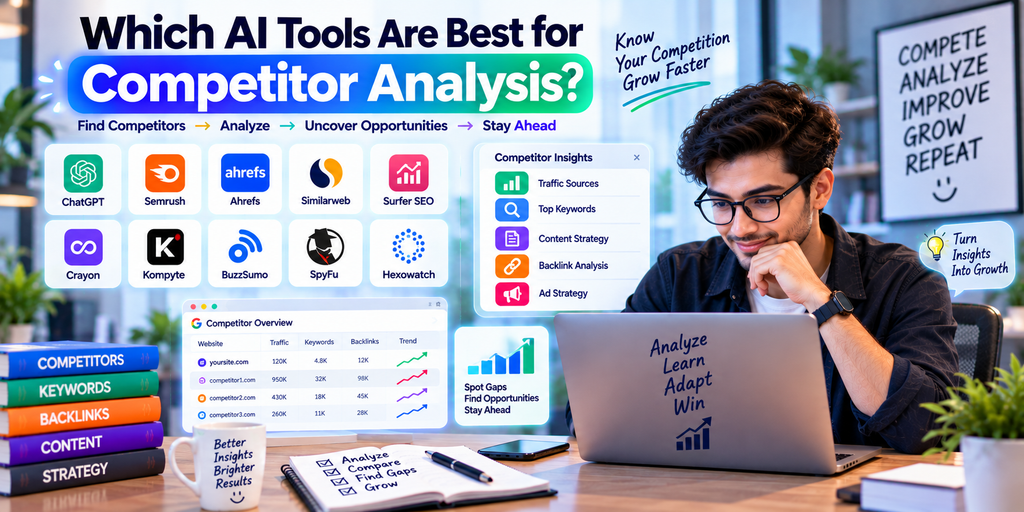
Which AI Tools Are Best for Competitor Analysis?
The best AI tools depend on the type of competitor analysis you need.
| Tool | Best For |
|---|---|
| Semrush | SEO, keywords, PPC and competitor gaps |
| Ahrefs | Backlinks, organic keywords and top pages |
| Similarweb | Website traffic and digital market comparison |
| ChatGPT | Competitive data analysis and strategic summaries |
| Claude | Large reports and competitor document analysis |
| Google Gemini | Research and competitor topic exploration |
| SpyFu | SEO and PPC competitor research |
| BuzzSumo | Content and topic competitor analysis |
| Visualping | Monitoring competitor website changes |
| Crayon | Competitive intelligence and market monitoring |
For most SEO and digital marketing teams, a strong combination is Semrush or Ahrefs for data plus ChatGPT or Claude for analysis.
An effective AI keyword strategy helps businesses discover the right keywords, understand search intent, and create content that performs across modern search platforms. By using AI to analyze keyword relevance, competition, related search terms, and user intent, marketers can build a smarter SEO strategy focused on attracting qualified traffic. An AI-powered keyword strategy also supports AEO (Answer Engine Optimization) by identifying conversational questions and providing clear, direct answers that search engines and AI assistants can easily understand.
At the same time, GEO (Generative Engine Optimization) helps optimize content for AI-powered search experiences such as Google AI results and other generative search platforms. The best approach combines primary keywords, long-tail keywords, semantic terms, question-based queries, and location-specific phrases naturally throughout high-quality content. This creates a comprehensive AI keyword strategy for SEO, AEO, and GEO that improves topical relevance, search visibility, user engagement, and the potential to appear in traditional and AI-driven search results.
What Is Competitor Analysis?
Competitor analysis is the process of researching businesses, websites, products, campaigns, and content that compete for the same audience.
What Can Competitor Analysis Reveal?
It can help you understand:
- Competitor keywords
- Organic rankings
- Backlinks
- Top-performing content
- Paid search activity
- Social media strategies
- Product positioning
- Content gaps
- Pricing changes
- Website updates
- Traffic sources
- Audience messaging
Why Is Competitor Analysis Important?
Competitor research can reveal opportunities that are difficult to see by analyzing your own website alone.
What Competitor Analysis Should Not Become
It should not become copying.
The goal is to understand the market and identify better opportunities.
How Can AI Improve Competitor Analysis?
Competitor analysis can involve large amounts of data.
Artificial Inteligence can help summarize and organize that information much faster.
AI Can Help With
- Competitor categorization
- Keyword clustering
- Content-gap analysis
- Messaging comparison
- SWOT analysis
- Product comparisons
- Review analysis
- Social content summaries
- Positioning analysis
- Opportunity prioritization
AI Is Best Used After Data Collection
Dedicated platforms should usually provide the raw data.
Then Use AI for Interpretation
For example:
Semrush Export → ChatGPT Analysis → Keyword Clusters → Opportunity List → Content Plan
1. Semrush – Best Overall Tool for Digital Competitor Analysis
Semrush is one of the most comprehensive platforms for researching digital competitors.
What Can Semrush Analyze?
Semrush can help with:
- Organic keywords
- Competitor rankings
- Keyword gaps
- Backlinks
- Paid search
- Advertising research
- Traffic insights
- SERP competitors
- Content opportunities
Why Is Semrush Useful?
It combines several types of competitor research in one platform.
Best Semrush Workflow
Competitor Domain → Organic Keywords → Keyword Gap → Backlinks → Top Pages → Opportunities
2. Ahrefs – Best for Backlink and Organic Competitor Analysis
Ahrefs is particularly useful for analyzing SEO competitors.
What Can Ahrefs Help With?
It can support:
- Organic keyword research
- Backlink analysis
- Content gaps
- Top pages
- Competing domains
- SERP analysis
- Broken-link opportunities
Why Are Competitor Backlinks Important?
Backlinks can reveal which websites reference competitors and which types of content attract links.
Best Ahrefs Use Case
Use it to identify:
- Competitor link sources
- High-performing pages
- Missing keyword topics
- Linkable assets
- Content opportunities
3. Similarweb – Best for Website Traffic Comparison
Similarweb helps compare digital traffic and market presence.
What Can Similarweb Help Analyze?
Depending on the available data, it can provide insights into:
- Website traffic
- Traffic channels
- Referral sources
- Geographic distribution
- Audience behavior
- Competitor comparisons
Why Is Traffic Comparison Useful?
Search rankings alone do not show the full digital marketing picture.
Competitors May Get Traffic From Other Channels
These may include:
- Direct
- Referral
- Social
- Paid search
- Display
4. ChatGPT – Best for Analyzing Competitor Data
ChatGPT is useful after collecting competitive information.
What Can ChatGPT Help With?
It can assist with:
- Summarizing competitor data
- Keyword clustering
- Content-gap analysis
- SWOT frameworks
- Messaging comparisons
- Strategy summaries
- Content ideas
- Opportunity prioritization
Example Use Case
Export competitor keywords from an SEO tool.
Ask ChatGPT to group them into:
- Informational
- Commercial
- Transactional
- Brand terms
Important Limitation
Do not rely on ChatGPT to invent current competitor traffic, rankings, or financial data.
Use verified data first.
5. Claude – Best for Large Competitor Reports
Claude can be useful when you have large amounts of competitor content or documentation to review.
What Can Claude Help Analyze?
Claude can assist with:
- Long competitor reports
- Website copy
- Product descriptions
- Content libraries
- Positioning documents
- Reviews
- Large keyword exports
Why Is Claude Useful?
Long-context analysis can make it easier to compare large amounts of written information.
Best Claude Workflow
Collect Data → Upload or Paste → Categorize → Compare → Summarize → Prioritize
6. Google Gemini – Best for Competitor Research and Topic Exploration
Gemini can be useful for broad research and competitor topic exploration.
What Can Gemini Help With?
It can assist with:
- Market research
- Topic discovery
- Competitor questions
- Content themes
- Messaging comparisons
- Research summaries
When Should You Use Gemini?
Use it when exploring a market before moving into deeper SEO or traffic analysis.
Example
Market → Competitors → Positioning Themes → Content Topics → SEO Validation
7. SpyFu – Best for SEO and PPC Competitor Research
SpyFu focuses heavily on search marketing competition.
What Can SpyFu Help With?
It can support:
- Competitor keywords
- Paid keywords
- SEO keywords
- Ad history
- PPC research
- Ranking comparisons
Who Should Use SpyFu?
It can be useful for:
- SEO marketers
- PPC specialists
- Agencies
- Competitive search teams
Why Search Competitor Data Matters
Your business competitors and your Google search competitors may not always be the same.
8. BuzzSumo – Best for Competitor Content Research
BuzzSumo is useful for understanding which types of content perform strongly in a market.
What Can BuzzSumo Help Analyze?
It can assist with:
- Popular content
- Content themes
- Engagement
- Competitor publishing
- Influential topics
- Content ideas
Why Is Content Competitor Analysis Important?
A competitor may perform well because of a strong content strategy rather than only SEO.
Look for Patterns
Analyze:
- Formats
- Topics
- Headlines
- Frequency
- Engagement
9. Visualping – Best for Monitoring Competitor Website Changes
Competitors frequently change landing pages, pricing pages, product pages, and offers.
Visualping can help monitor changes.
What Can You Monitor?
Possible examples include:
- Pricing updates
- Product changes
- New offers
- Landing pages
- Feature updates
- Messaging changes
Why Is Change Monitoring Useful?
It can help identify strategic shifts quickly.
Do Not Overreact to Every Change
Not every website update is strategically important.
10. Crayon – Best for Broader Competitive Intelligence
Crayon focuses on competitive intelligence beyond basic SEO.
What Can Crayon Help With?
It can support:
- Competitor monitoring
- Messaging changes
- Market updates
- Sales enablement
- Competitive intelligence
- Product positioning
Who Should Consider Crayon?
It may be useful for:
- Larger marketing teams
- Product marketers
- Sales teams
- Competitive intelligence teams
Crayon vs SEO Tools
Semrush and Ahrefs focus heavily on search.
Crayon focuses more broadly on competitive market intelligence.
Best AI Tools for Different Competitor Analysis Tasks
| Competitor Analysis Task | Recommended Tools |
|---|---|
| SEO Competitor Research | Semrush, Ahrefs |
| Backlink Analysis | Ahrefs, Semrush |
| Keyword Gaps | Semrush, Ahrefs |
| PPC Competitor Research | Semrush, SpyFu |
| Website Traffic Comparison | Similarweb |
| Content Analysis | BuzzSumo, ChatGPT |
| Strategic Summaries | ChatGPT, Claude |
| Market Research | Gemini, Similarweb |
| Website Change Monitoring | Visualping |
| Competitive Intelligence | Crayon |
| Large Report Analysis | Claude |
| SERP Competitor Analysis | Ahrefs, Semrush |
How to Find Your Real Competitors
Before using any competitor tool, define the right competitors.
Business Competitors
These companies sell similar products or services.
SEO Competitors
These websites rank for the same keywords.
Content Competitors
These websites publish content for the same audience.
Paid Search Competitors
These advertisers bid on similar commercial keywords.
Why This Distinction Matters
A company can compete with you in Google without directly competing with your business.
Example
A software company may compete in search results with review sites, publishers, and blogs.
How to Analyze Competitor Keywords With AI
Keyword analysis is one of the most valuable forms of competitor research.
Step 1: Identify Competitors
Use Semrush, Ahrefs, or search results.
Step 2: Export Their Ranking Keywords
Collect:
- Keyword
- Position
- Search volume
- URL
- Intent
Step 3: Use AI to Organize Them
ChatGPT or Claude can cluster keywords into themes.
Step 4: Find Gaps
Look for relevant terms where competitors rank and you do not.
Prioritize Carefully
Do not target every missing keyword.
Choose Keywords That Match Your Business
Relevance matters more than volume alone.
How to Perform a Competitor Content Gap Analysis
A content gap is a useful topic competitors cover but your website does not.
Use Semrush or Ahrefs
Compare your domain with competitors.
Then Categorize Opportunities
Group gaps into:
- Existing page updates
- New supporting articles
- New pillar pages
- Commercial pages
- FAQs
Use AI for Prioritization
Ask ChatGPT or Claude to group and rank opportunities based on relevance.
Validate With SERP Research
Always inspect current search results before creating content.
How to Analyze Competitor Backlinks
Backlink research can reveal how competitors earn authority.
Use Ahrefs or Semrush
Analyze:
- Referring domains
- Linked pages
- Anchor text
- Link growth
- Broken links
Ask Why the Link Exists
Was it earned through:
- Data?
- Original research?
- A tool?
- A guide?
- PR?
- A resource page?
Recreate the Value, Not the Link
Create something worth linking to.
How to Analyze Competitor Content With AI
Competitor content analysis can reveal what topics and formats perform well.
Collect Competitor Pages
Use Ahrefs, Semrush, BuzzSumo, or manual research.
Analyze
- Titles
- Headings
- Content formats
- Topics
- Examples
- FAQs
- CTAs
Use AI to Compare Patterns
AI can help identify repeated themes.
Look for Missing Opportunities
Ask what competitors consistently fail to explain.
That can become your advantage.
How to Analyze Competitor SEO Strategy
SEO competitor analysis should look beyond individual keywords.
Review
- Keyword clusters
- Site structure
- Topic coverage
- Internal linking
- Backlinks
- Top pages
- Content freshness
Build a Competitor SEO Map
Categorize competitors by:
- Strongest topics
- Weakest topics
- Linkable assets
- Commercial pages
Use the Map to Find Openings
Focus where you can create meaningfully better content.
How to Analyze Competitor PPC Campaigns
Paid search competitors can reveal commercial keyword opportunities.
Use Semrush or SpyFu
Look for:
- Paid keywords
- Ad copy
- Landing pages
- Repeated campaigns
- Offer language
Why Repeated Ads Matter
Long-running campaigns may indicate commercially important areas.
Do Not Assume They Are Profitable
Competitor activity does not prove campaign performance.
How to Analyze Competitor Social Media Content
Competitor social media analysis can reveal audience preferences.
Review
- Platforms
- Post frequency
- Content formats
- Engagement
- Topics
- Hooks
- CTAs
Use AI to Summarize Patterns
AI can help categorize:
- Educational content
- Promotional content
- Entertainment
- Case studies
- Product posts
Find White Space
Look for valuable topics competitors rarely cover.
How to Analyze Competitor Messaging
Messaging explains how competitors position themselves.
Review Their
- Homepage
- Product pages
- Ads
- Social bios
- Sales pages
- Email messaging
Compare
- Main promise
- Target audience
- Pain points
- Benefits
- Differentiators
Use AI for a Messaging Matrix
Create columns for:
Competitor → Audience → Promise → Benefit → Proof → CTA
How to Perform a Competitor SWOT Analysis With AI
SWOT stands for:
- Strengths
- Weaknesses
- Opportunities
- Threats
Provide Verified Data
AI should analyze evidence, not assumptions.
Example Inputs
Provide:
- Traffic data
- SEO data
- Product features
- Reviews
- Pricing
- Content performance
Then Ask AI to Summarize
The output can help structure strategic thinking.
SWOT Is a Framework, Not a Fact
Human judgment is still required.
How to Monitor Competitors Over Time
Competitor analysis should not be a one-time project.
Monitor Important Changes
Track:
- New content
- Ranking changes
- Backlinks
- Pricing
- Product launches
- Messaging changes
- Website updates
Useful Tools
Semrush
Ahrefs
Visualping
Crayon
Focus on Meaningful Changes
Do not waste time monitoring every minor update.
Competitor Analysis for SEO
Competitor analysis can improve SEO strategy by revealing real opportunities.
Analyze
- Ranking keywords
- Topic clusters
- Backlinks
- Content gaps
- SERPs
- Site structure
Build Better Content
Do not simply create longer versions of competitor articles.
Create a Better Answer
Improve:
- Clarity
- Accuracy
- Examples
- Structure
- Original insights
Competitor Analysis for AEO
AEO focuses on answering user questions clearly.
Analyze Competitor Questions
Look at:
- FAQ sections
- Question headings
- Featured answers
- Common user queries
Identify Missing Questions
Use competitor research to discover unanswered or poorly answered questions.
Create Direct Answers
Use:
Question → Answer → Explanation → Example
Competitor Analysis for GEO
GEO focuses on visibility within generative and AI-driven discovery environments.
Analyze Competitor Authority Signals
Look for:
- Original data
- Expert authors
- Research
- Citations
- Comparisons
- Unique frameworks
Why This Matters
Distinctive information is more valuable than generic summaries.
Build Citation-Worthy Assets
Examples include:
- Studies
- Data
- Benchmarks
- Expert commentary
- Original comparisons
How to Build a Competitor Analysis Workflow
A repeatable workflow makes competitive research more useful.
Step 1: Define the Goal
Decide whether you are researching:
- SEO
- PPC
- Content
- Products
- Social media
- Market positioning
Step 2: Identify Competitors
Choose direct and search competitors.
Step 3: Collect Data
Use the appropriate platforms.
Step 4: Organize the Data
Use spreadsheets or AI.
Step 5: Identify Patterns
Look for strengths and weaknesses.
Step 6: Find Gaps
Identify opportunities competitors miss.
Step 7: Prioritize
Rank opportunities by business value and difficulty.
Step 8: Create an Action Plan
Turn insights into:
- New pages
- Content updates
- Link-building campaigns
- Product improvements
- PPC tests
Complete Workflow
Goal → Competitors → Data → AI Analysis → Gaps → Priorities → Action → Monitoring
Data Should Lead to Decisions
Collecting competitor data without acting on it has little value.
Best AI Competitor Analysis Stack for Beginners
Beginners do not need every competitive intelligence tool.
Simple Stack
ChatGPT for analysis.
A basic SEO tool for keyword research.
Google search for manual competitor review.
Add Advanced Tools Later
Consider Semrush, Ahrefs, or Similarweb when deeper data is needed.
Start With a Small Competitor Set
Three to five strong competitors may be enough to begin.
Best AI Competitor Analysis Stack for Small Businesses
Small businesses should focus on the areas that affect growth.
Recommended Setup
SEO: Semrush or Ahrefs
Analysis: ChatGPT or Claude
Traffic Research: Similarweb when needed
Monitoring: Visualping
Why This Works
It covers:
- Search competition
- Strategy analysis
- Traffic insights
- Website changes
Avoid Paying for Data You Do Not Use
Tool value depends on action.
Best AI Competitor Analysis Stack for Agencies
Agencies often require deeper research and reporting.
Suggested Stack
Semrush
Ahrefs
Similarweb
ChatGPT or Claude
BuzzSumo
Agencies May Need
- Multi-domain comparisons
- Keyword gaps
- Backlink audits
- PPC analysis
- Content research
- Client reporting
Standardize Reports
Create repeatable competitor-analysis templates.
Free vs Paid Competitor Analysis Tools
Both free and paid tools have a place.
Free Options
Possible options include:
- Google search
- AI assistant free plans
- Google Trends
- Limited SEO tool access
- Manual social research
Paid Tools
Examples include:
- Semrush
- Ahrefs
- Similarweb
- SpyFu
- BuzzSumo
- Crayon
When Should You Pay?
Upgrade when you need:
- Larger datasets
- Historical data
- Backlink analysis
- Advanced keyword research
- Monitoring
- Team workflows
Measure the Value of the Insight
A tool is worth paying for when its insights improve decisions.
Common Competitor Analysis Mistakes
Competitor data can be powerful, but it is easy to misuse.
Copying Competitors
The goal is differentiation.
Choosing the Wrong Competitors
Search competitors may differ from business competitors.
Trusting Estimated Data as Exact
Third-party traffic estimates are not perfect.
Focusing Only on Keywords
Competitors also compete through:
- Brand
- Content
- Product
- Pricing
- Distribution
- Customer experience
Ignoring Search Intent
A keyword gap is only useful if the intent matches your business.
Collecting Too Much Data
Prioritize actionable information.
Not Monitoring Changes
Markets change.
Letting AI Invent Facts
Use AI to analyze verified data rather than create unsupported competitor claims.
Frequently Asked Questions About AI Competitor Analysis
Which AI Tool Is Best for Competitor Analysis?
Semrush is a strong all-around option for SEO and digital competitor research. Ahrefs is excellent for backlinks and organic search, while ChatGPT and Claude are useful for analyzing exported data.
What Is the Best AI Tool for SEO Competitor Analysis?
Semrush and Ahrefs are among the strongest options for SEO competitor research.
Can ChatGPT Analyze Competitors?
Yes.
ChatGPT can analyze competitor data, website copy, keyword exports, positioning, and content strategies when you provide reliable information.
What Is the Best Tool for Competitor Keywords?
Semrush, Ahrefs, and SpyFu are useful for competitor keyword research.
What Is the Best Tool for Competitor Backlinks?
Ahrefs and Semrush are strong choices for backlink analysis.
What Is the Best Tool for Competitor Traffic?
Similarweb can provide useful traffic estimates and digital-channel comparisons.
Can AI Find Competitor Content Gaps?
Yes.
AI can help organize content-gap data from Semrush, Ahrefs, or manual research.
Can AI Monitor Competitors Automatically?
Some platforms can monitor rankings, backlinks, website changes, or competitive intelligence over time.
Should I Copy Competitor Keywords?
No.
Use them for research and prioritize only terms that match your audience, products, and strategy.
How Often Should I Perform Competitor Analysis?
Major competitor research can be performed periodically, while important rankings, content changes, pricing, or market activity can be monitored more frequently depending on your industry.
Final Verdict: Which AI Tools Are Best for Competitor Analysis?
The best AI tools for competitor analysis depend on what you are trying to understand.
Semrush is one of the strongest all-around platforms for broad SEO and digital competitor research.
Backlinks, organic keywords, content gaps, and top-performing pages can be explored effectively with Ahrefs.
Similarweb provides broader digital market insights when comparing website traffic and acquisition channels.
SEO and PPC keyword research can be strengthened with SpyFu, particularly when identifying search competitors.
BuzzSumo is useful for analyzing competitor content, popular topics, and audience interest.
Website changes can be monitored with Visualping to help you notice important updates.
Larger marketing, product, and sales teams may find Crayon useful for broader competitive intelligence.
ChatGPT and Claude become especially valuable when you already have reliable data and need help organizing information, comparing competitors, identifying patterns, and turning research into an actionable strategy.
The strongest approach in 2026 is not to copy what competitors are doing.
Start by studying competitor data to understand the market.
Next, let AI help analyze and organize the information more efficiently.
Finally, validate promising opportunities with reliable SEO and marketing tools.
Then create something more useful, more differentiated, and more relevant to your audience.
Related AI Marketing Guides
What Are the Best AI Tools for Digital Marketing in 2026?
Explore AI tools for SEO, content marketing, social media, automation, research, advertising, and digital marketing workflows.
Which AI Tools Are Best for SEO in 2026?
Compare tools for keyword research, content optimization, technical SEO, backlinks, and competitor analysis.
What Are the Best AI Tools for Keyword Research?
Discover AI and SEO tools for finding keywords, search intent, long-tail opportunities, keyword gaps, and topic clusters.
Which AI Tools Are Best for Content Marketing?
Explore AI tools for content research, writing, optimization, design, repurposing, and distribution.
What Are the Best AI Tools for Writing SEO Blog Posts?
Learn which AI tools can help with research, outlines, drafting, editing, SEO optimization, and content updates.
Which AI Tools Can Help Improve Google Rankings?
Explore AI and SEO tools that can support keyword strategy, backlinks, technical SEO, content quality, and organic visibility.
What Are the Best AI Tools for Social Media Marketing?
Compare tools for social strategy, content creation, scheduling, video, engagement, and campaign management.
Which AI Tools Are Best for Creating Social Media Content?
Discover tools for captions, graphics, videos, carousels, scripts, hooks, and social media content production.
What Are the Best AI Tools for SEO Content Optimization?
Explore tools for search intent, topical coverage, content gaps, structure, readability, and on-page SEO.