
30+ Prompts For Email Marketing
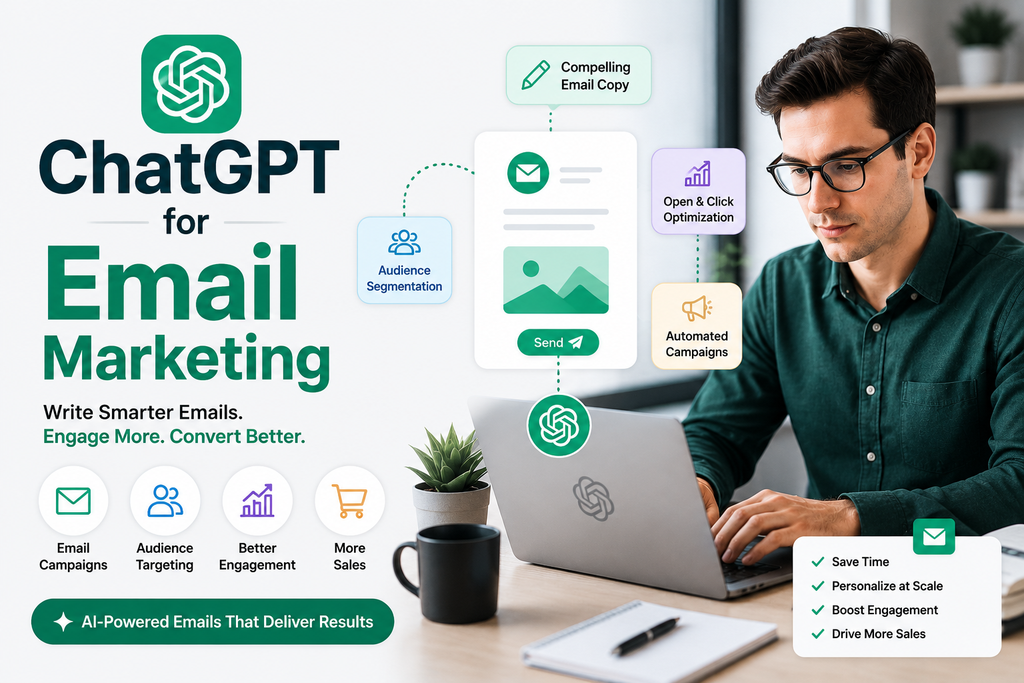
Email marketing can be one of the most effective ways to communicate with customers, nurture leads, promote products, and build long-term relationships. But creating emails consistently can be challenging. You need subject lines that attract attention, copy that keeps readers interested, clear calls to action, useful content, and campaigns that match different stages of the customer journey. This is where ChatGPT can help. You can use ChatGPT for email marketing to brainstorm campaign ideas, draft emails, generate subject-line variations, create welcome sequences, improve calls to action, personalize messaging, and plan A/B tests.
Hi, I’m Gurudeep Singh, and in this guide, I’ll show you practical ways to use ChatGPT for email marketing, along with 30+ prompts you can customize for your own campaigns.
ChatGPT for email marketing helps businesses create engaging emails, improve subject lines, and connect with the right audience. Marketers can use ChatGPT to write personalized campaigns, promotional emails, newsletters, follow-ups, and customer messages faster. It can also suggest relevant keywords, calls to action, and content ideas based on search intent. By combining AI-powered content with SEO, AEO, and GEO strategies, businesses can improve communication, increase engagement, and build a stronger digital presence across search engines and AI-powered platforms.
How Can You Use ChatGPT for Email Marketing?
ChatGPT can help with email marketing by generating subject lines, email drafts, welcome sequences, newsletters, promotional campaigns, abandoned-cart emails, re-engagement emails, CTAs, personalization ideas, and A/B testing variations.
For example:
Prompt:
“Act as an email marketing specialist. Write a promotional email for [product/service] targeting [audience]. The main customer problem is [problem], and the key benefit is [benefit]. Use a [friendly/professional/conversational] tone. Include 5 subject-line options, preview text, email copy, and one clear CTA. Do not invent product claims, discounts, or guarantees.”
The key is to give ChatGPT enough information about your audience, offer, goal, and brand voice.
What Is ChatGPT for Email Marketing?
Using ChatGPT for email marketing means using AI to assist with different parts of an email campaign.
It can help you:
- Brainstorm campaign concepts
- Generate subject-line variations
- Draft email copy
- Create welcome sequences
- Write newsletters
- Generate CTA ideas
- Develop promotional emails
- Create follow-up emails
- Brainstorm personalization strategies
- Rewrite existing emails
- Plan email sequences
- Generate A/B testing ideas
ChatGPT works best as an email marketing assistant, rather than a completely automated replacement for your marketing strategy.
You provide the business knowledge, audience insights, product facts, brand voice, and campaign data. ChatGPT helps turn that information into ideas and drafts.
Why Use ChatGPT for Email Marketing?
The biggest advantage is speed.
Instead of staring at a blank page trying to create another email, you can give ChatGPT a detailed brief and quickly generate a first draft or several ideas.
Generate More Ideas
If you’re struggling to find newsletter topics or campaign concepts, ChatGPT can help you brainstorm possibilities.
Create Multiple Variations
Instead of writing one subject line, you can generate 10 or 20 alternatives and select the strongest ones for testing.
Maintain a Consistent Structure
You can define your preferred tone, email format, audience, and CTA before generating a draft.
Repurpose Existing Content
A blog post, webinar, video, case study, or product guide can become the basis of an email campaign.
Speed Up First Drafts
ChatGPT can create a starting point that you can then edit using your own expertise and customer knowledge.
30+ Best ChatGPT Prompts for Email Marketing
Replace anything inside [brackets] with information relevant to your campaign.
1. Write a Marketing Email
Prompt:
“Act as an experienced email copywriter. Write a marketing email for [product/service] targeting [audience]. The goal is [objective]. Focus on [primary benefit]. Use a [tone] brand voice and finish with one clear CTA. Include subject line and preview text.”
Best for: Creating a general email campaign.
2. Generate Email Subject Lines
Prompt:
“Generate 20 email subject lines for an email about [topic/offer]. The audience is [audience]. Create direct, benefit-focused, curiosity-based, question-based, and urgency-based variations. Avoid clickbait and misleading claims.”
3. Generate Personalized Subject Lines
Prompt:
“Create 15 subject-line ideas for [campaign]. Show how personalization fields such as [first name/company/product category] could be naturally incorporated. Avoid personalization that feels intrusive.”
4. Write Email Preview Text
Prompt:
“Create 10 preview-text options to accompany this subject line: [subject line]. The email is about [topic]. Make each option complement the subject rather than repeat it.”
5. Create a Welcome Email
Prompt:
“Write a welcome email for new subscribers to [brand/newsletter]. Explain what they can expect, introduce our primary value proposition, provide one immediately useful tip or resource, and end with a simple CTA.”
6. Create a Welcome Email Sequence
Prompt:
“Create a 5-email welcome sequence for [business]. Our subscribers are [audience], and our main offer is [offer]. For each email, provide the purpose, subject line, main message, CTA, and recommended timing.”
A welcome sequence should build the relationship gradually instead of trying to sell aggressively in every email.
7. Write a Newsletter
Prompt:
“Write an email newsletter for [brand] targeting [audience]. The main topic is [topic]. Start with a concise hook, explain the topic clearly, provide practical value, and finish with a relevant CTA to [action].”
8. Generate Newsletter Ideas
Prompt:
“Generate 30 newsletter topic ideas for [business/industry]. Our audience is [audience]. Divide the ideas into educational, industry insights, practical tips, product-related, customer-focused, and engagement categories.”
9. Create a Promotional Email
Prompt:
“Write a promotional email for [product/service]. Our target audience is [audience], and the offer is [offer]. Explain the problem, show how the offer helps, communicate the terms accurately, and finish with a clear CTA.”
Never ask AI to invent a discount, deadline, scarcity claim, customer result, or guarantee.
10. Write a Product Launch Email
Prompt:
“Write a product launch email introducing [product] to [audience]. Explain what the product is, who it is for, what problem it addresses, its verified key features and benefits, and the next step. Use only the product information I provide: [details].”
11. Create a Product Launch Sequence
Prompt:
“Create a 5-email launch sequence for [product]. Include anticipation, announcement, education, objection handling, and final reminder emails. For each email, provide the objective, subject line, key message, CTA, and recommended timing.”
12. Write a Discount Email
Prompt:
“Write a promotional email for our verified [percentage/amount] discount on [product]. The promotion runs from [start date] to [end date]. Clearly explain eligibility and terms using only the information provided. Do not create additional scarcity or urgency claims.”
13. Create a Limited-Time Offer Email
Prompt:
“Write an email promoting this limited-time offer: [verified offer details]. Clearly state when it ends, what customers receive, eligibility requirements, and the CTA. Use urgency only where supported by the provided facts.”
14. Write an Abandoned Cart Email
Prompt:
“Write an abandoned-cart email for customers who added [product/category] to their cart but did not complete checkout. Use a helpful, low-pressure tone. Remind them what they were considering, address likely questions, and provide a clear return-to-cart CTA.”
15. Create an Abandoned Cart Sequence
Prompt:
“Create a 3-email abandoned-cart sequence for [store/product]. For each email, provide the timing, objective, subject line, key message, and CTA. Do not invent discounts or scarcity.”
16. Write a Re-Engagement Email
Prompt:
“Write a re-engagement email for subscribers who haven’t engaged with our emails recently. Remind them what value they can receive from [brand/newsletter], invite them to update their preferences, and give them a clear choice about staying subscribed.”
17. Create a Re-Engagement Sequence
Prompt:
“Create a 3-email re-engagement campaign for inactive subscribers to [brand]. Make each email meaningfully different and include a value reminder, preference option, and final confirmation message.”
18. Write a Lead Nurturing Email
Prompt:
“Write a lead-nurturing email for someone interested in [topic/product] but not yet ready to purchase. Focus on solving [customer problem], provide useful information, and naturally guide the reader toward [next step].”
19. Create a Lead Nurturing Sequence
Prompt:
“Create a 7-email lead-nurturing sequence for [product/service]. Our leads are [audience]. Move them from initial awareness toward an informed purchase decision using education, trust building, problem solving, objection handling, and appropriate CTAs.”
20. Write an Educational Email
Prompt:
“Write an educational email teaching [audience] how to [solve problem]. Explain the process simply, provide actionable steps, avoid unnecessary promotion, and finish with a relevant next step.”
21. Turn a Blog Post Into an Email
Prompt:
“Turn the following blog article into a concise email for [audience]. Don’t summarize every section. Select the most useful insight, explain why it matters, and encourage readers to visit the complete article: [paste article].”
22. Turn a Video Into an Email
Prompt:
“Create an email based on this video transcript: [transcript]. Identify the most valuable takeaway for [audience], explain it briefly, and encourage readers to watch the complete video.”
23. Write a Follow-Up Email
Prompt:
“Write a follow-up email for someone who [previous action]. The objective is [goal]. Keep it concise, reference the previous interaction naturally, provide useful context, and include one clear next step.”
24. Create Customer Onboarding Emails
Prompt:
“Create a 5-email onboarding sequence for new customers of [product/service]. Help customers understand how to get started, achieve early value, discover important features, avoid common mistakes, and know where to get support.”
25. Write a Customer Feedback Email
Prompt:
“Write a short customer feedback email for users of [product/service]. Ask about their experience without leading them toward positive responses. Keep the survey request simple and explain how their feedback will be used.”
26. Write a Survey Email
Prompt:
“Create an email inviting [audience] to complete a survey about [topic]. Explain why their feedback matters, approximately how long the survey takes using the information I provide, and include one clear CTA.”
27. Generate Email CTA Ideas
Prompt:
“Generate 20 CTA options for an email promoting [offer/content]. Group them into direct, benefit-focused, low-commitment, educational, and purchase-focused CTAs. Keep them concise and accurate.”
28. Improve an Existing Email
Prompt:
“Review this marketing email for clarity, relevance, tone, structure, value proposition, CTA strength, unnecessary wording, and potential trust issues. First explain the problems, then provide an improved version without adding unsupported claims: [paste email].”
29. Shorten an Email
Prompt:
“Reduce this marketing email by approximately [percentage] while preserving its core message, essential details, brand voice, and CTA. Remove repetition and unnecessary sentences: [paste email].”
30. Personalize an Email for Different Audiences
Prompt:
“Adapt this email for these three customer segments: [segment 1], [segment 2], and [segment 3]. Keep the core offer unchanged, but adjust the pain points, benefits, examples, and CTA framing to match each segment: [email].”
31. Create Email A/B Tests
Prompt:
“Create 10 meaningful A/B testing ideas for this email campaign: [details]. Include tests for subject lines, preview text, opening hook, email length, CTA, offer presentation, and content structure. For each test, state the hypothesis and primary metric.”
32. Create an Email Marketing Calendar
Prompt:
“Create a 30-day email marketing calendar for [business]. Our audience is [audience], and our goals are [goals]. Include send date, email topic, audience segment, campaign objective, CTA, and measurement metric.”
33. Create a Seasonal Email Campaign
Prompt:
“Create an email campaign for [holiday/event/season] for [business]. Our audience is [audience]. Suggest campaign concepts, timing, subject lines, content themes, and CTAs without inventing offers or discounts.”
34. Write a Testimonial-Based Email
Prompt:
“Using only the following verified customer testimonial, create a marketing email showing how [product/service] helped this customer. Do not alter the meaning, exaggerate the result, or invent additional customer claims: [testimonial].”
35. Analyze Email Marketing Results
Prompt:
“Analyze the following email campaign data: [paste data]. Identify patterns, potential problems, and experiments worth testing. Separate direct observations from hypotheses. Do not assume causation without sufficient evidence.”
Best ChatGPT Prompt for Email Marketing
If you want one reusable prompt for creating marketing emails, use this template:
Prompt:
“Act as an experienced email marketing strategist and copywriter.
Business: [business]
Product/service: [product]
Target audience: [audience]
Customer problem: [problem]
Primary benefit: [benefit]
Campaign objective: [goal]
Offer: [offer]
Brand voice: [voice]
Desired CTA: [CTA]
Create a marketing email containing:
- Five subject-line options
- Three preview-text options
- Opening hook
- Main email copy
- One primary CTA
- Optional P.S.
- Two alternative messaging angles
Use only the product and offer information I provide. Do not invent statistics, testimonials, discounts, deadlines, guarantees, features, or customer results.”
This format gives ChatGPT the context needed to produce a much more relevant first draft.
How to Write Better ChatGPT Prompts for Email Marketing
A simple framework is:
Role + Audience + Goal + Context + Offer + Tone + Constraints + Output
Role
Tell ChatGPT what expertise you want it to apply.
Example:
“Act as an email marketing strategist.”
Audience
Explain exactly who will receive the email.
Instead of:
“Customers”
Try:
“Existing customers who purchased our beginner course during the last six months.”
Goal
Every email should have a clear purpose.
Examples include:
- Get a click
- Read an article
- Complete a purchase
- Register for an event
- Download a guide
- Start a free trial
- Complete onboarding
Context
Tell ChatGPT what happened before the email.
For example:
“This person downloaded our beginner SEO guide three days ago.”
Offer
Provide accurate information about the product, discount, trial, event, or resource.
Tone
Define your brand voice.
For example:
“Friendly, helpful, straightforward, and conversational.”
Constraints
Tell ChatGPT what it must not do.
For example:
“Don’t invent customer testimonials, statistics, product features, or discounts.”
Output
Specify exactly what you need.
For example:
“Give me five subject lines, two preview-text options, a 150-word email, and three CTA options.”
How to Use ChatGPT for Email Marketing Step by Step
Step 1: Define the Campaign Goal
Before writing anything, determine what you want subscribers to do.
Your goal might be to:
- Visit an article
- Register
- Purchase
- Reply
- Complete onboarding
- Download something
- Learn about a new feature
One email usually benefits from having one primary objective.
Step 2: Define the Audience
Don’t send the same message to everyone simply because ChatGPT makes content creation easy.
Consider:
- New subscribers
- Existing customers
- Prospects
- Active users
- Inactive subscribers
- Different interests
- Previous purchases
- Customer journey stage
Step 3: Provide Accurate Information
Give ChatGPT the facts it needs.
This may include:
- Product information
- Pricing
- Promotion details
- Customer problems
- Features
- Benefits
- Brand guidelines
- Testimonials
- Relevant research
Step 4: Generate Multiple Variations
Instead of requesting one subject line, request 10.
Instead of creating one CTA, ask for five alternatives.
AI is particularly useful for generating variations quickly.
Step 5: Edit the Output
Check the draft for:
- Accuracy
- Brand voice
- Repetition
- Unnecessary words
- Unsupported claims
- Relevance
- CTA clarity
Don’t automatically send the first output ChatGPT produces.
Step 6: Test Your Emails
The strongest subject line cannot be reliably identified just by asking AI.
Test appropriate variations with real subscribers.
Depending on your campaign and platform, you might test:
- Subject line
- Preview text
- CTA
- Offer
- Email length
- Send time
- Content format
Step 7: Analyze Real Results
Use your email platform’s actual campaign data.
Relevant metrics can include:
- Delivery rate
- Open rate
- Click-through rate
- Conversion rate
- Unsubscribe rate
- Spam complaint rate
- Revenue per recipient
Be careful when interpreting individual metrics. For example, privacy features and email-client behavior can affect the reliability of open-rate data.
ChatGPT Email Marketing Use Cases
Subject Line Brainstorming
ChatGPT can quickly generate multiple approaches to the same subject.
You can request:
- Direct
- Curiosity-based
- Benefit-focused
- Question-based
- Personalized
- Educational
Then test suitable options rather than assuming which one will win.
Email Copywriting
ChatGPT can turn a detailed campaign brief into a first draft.
Your job is to ensure the final email accurately represents your business.
Email Sequences
One of the most useful applications is planning multi-email sequences.
Examples include:
- Welcome sequences
- Lead nurturing
- Product launches
- Onboarding
- Re-engagement
- Abandoned carts
- Educational sequences
Email Personalization
ChatGPT can help adapt a core message for different customer segments.
Personalization should still be based on appropriate data and respect applicable privacy requirements.
Email Testing
ChatGPT can help create testing hypotheses and copy variations.
Actual campaign results should determine which version performs better.
ChatGPT for Email Marketing: Example
Imagine you run an online course teaching graphic design.
A vague prompt might be:
“Write an email selling my course.”
ChatGPT has almost no context.
A better prompt would be:
“Act as an email copywriter for an online education business.
We sell a beginner graphic design course for people who want to learn practical design skills but feel overwhelmed by professional software.
The course includes [verified course details].
Our target audience is beginners aged 18–35.
Write a promotional email focused on helping beginners get started.
Use a supportive, conversational tone.
Include 5 subject-line options, preview text, approximately 200 words of email copy, and one CTA.
Use only the course information provided and don’t invent testimonials, student results, discounts, or guarantees.”
The second prompt gives ChatGPT a much clearer brief.
Mistakes to Avoid When Using ChatGPT for Email Marketing
1. Asking for Generic Emails
Avoid:
“Write a sales email.”
Give ChatGPT information about the reader, offer, goal, and brand.
2. Publishing Without Editing
AI-generated emails can sound generic or include details you didn’t provide.
Always review the final draft.
3. Inventing Scarcity
Don’t create fake messages such as:
“Only three spots remaining!”
unless that information is accurate.
4. Inventing Testimonials
Never ask ChatGPT to create fake customer experiences that appear genuine.
Use verified testimonials.
5. Overusing Clickbait
A subject line may increase curiosity while damaging trust if the email doesn’t deliver what was promised.
6. Ignoring Segmentation
Different subscribers have different needs.
AI makes it easier to adapt messaging for relevant audience segments.
7. Measuring Success With AI Opinions
Don’t ask ChatGPT which email “will definitely convert better.”
Use actual A/B testing and campaign data.
Can ChatGPT Improve Email Open Rates?
ChatGPT can help you brainstorm stronger subject lines, preview text, segmentation approaches, and testing ideas.
However, it cannot guarantee a higher open rate.
Email performance can depend on factors such as:
- Audience quality
- Sender reputation
- Relevance
- Subject line
- Deliverability
- Frequency
- Timing
- Subscriber relationship
The better approach is to use ChatGPT to generate testable ideas, then evaluate those ideas with real campaign data.
Can ChatGPT Write Email Subject Lines?
Yes.
Subject-line generation is one of the simplest ways to use ChatGPT for email marketing.
Instead of asking for random subject lines, tell ChatGPT the:
- Audience
- Email topic
- Main benefit
- Brand voice
- Campaign goal
Then request several different angles.
For example:
“Generate 15 subject lines for an email teaching small business owners how to improve local SEO. Create five direct, five curiosity-based, and five benefit-focused options. Keep them accurate and avoid clickbait.”
Can ChatGPT Personalize Marketing Emails?
Yes, ChatGPT can help create different versions of an email for different customer segments.
For example, the same software product might be positioned differently for:
- Freelancers
- Agencies
- Small businesses
- Enterprise teams
However, personalization should be based on appropriate customer information rather than invented assumptions.
Can ChatGPT Create Email Automation Sequences?
Yes.
ChatGPT can help you plan the content and messaging for automated sequences such as:
Welcome sequence: Introduce new subscribers to your brand.
Lead nurturing: Educate potential customers over time.
Abandoned cart: Encourage shoppers to return to an incomplete purchase.
Onboarding: Help new customers use a product successfully.
Re-engagement: Reconnect with inactive subscribers.
ChatGPT can help draft the sequence, but your email marketing platform handles the actual automation and delivery.
Frequently Asked Questions
Is ChatGPT good for email marketing?
Yes. ChatGPT can help with brainstorming, subject lines, email drafts, newsletters, sequences, CTAs, personalization ideas, and A/B testing. Human review and real campaign data remain important.
How do I use ChatGPT for email marketing?
Start by giving ChatGPT information about your business, audience, campaign objective, offer, brand voice, and CTA. Then request a specific deliverable such as subject lines, an email draft, or a complete sequence.
Can ChatGPT write marketing emails?
Yes. ChatGPT can draft promotional, educational, welcome, onboarding, re-engagement, follow-up, newsletter, and other marketing emails based on the information you provide.
What is the best ChatGPT prompt for email marketing?
A strong prompt specifies the audience, campaign objective, product or offer, customer problem, primary benefit, brand voice, CTA, constraints, and desired output.
Can ChatGPT write cold emails?
ChatGPT can help draft outreach messages, but businesses should ensure their campaigns comply with applicable anti-spam, privacy, consent, and marketing laws and platform policies.
Can ChatGPT create email subject lines?
Yes. You can use ChatGPT to generate multiple subject-line approaches, including direct, benefit-focused, question-based, and curiosity-based variations.
Can ChatGPT create email sequences?
Yes. ChatGPT can help structure welcome, nurturing, launch, onboarding, abandoned-cart, educational, and re-engagement sequences.
Can ChatGPT automate email marketing?
ChatGPT can help create the content and logic for campaigns, but email marketing software is generally required to manage subscriber data, triggers, scheduling, delivery, analytics, and automation workflows.
Will ChatGPT increase email conversions?
ChatGPT can help generate and improve ideas, but it cannot guarantee conversion improvements. Use controlled testing and real campaign data to determine what works for your audience.
Final Thoughts
Using ChatGPT for email marketing can make brainstorming, drafting, and testing ideas significantly faster.
You can use it to create subject-line variations, newsletters, welcome emails, promotional campaigns, lead-nurturing sequences, abandoned-cart emails, CTAs, and A/B testing ideas.
But the strongest workflow isn’t simply:
ChatGPT → Generate → Send
A better workflow is:
Understand your audience → Create a clear brief → Generate with ChatGPT → Edit → Verify → Test → Measure → Improve
ChatGPT provides the speed.
Your customer knowledge, brand voice, marketing strategy, and real performance data provide the direction.
Use the prompts in this guide as starting templates, customize them for your audience, and continue refining your email campaigns based on what your subscribers actually respond to.