
ChatGPT for Customer Support
Customer expectations are changing quickly. People want fast answers, helpful communication, and support that is available whenever they need it. For businesses, providing high-quality customer support while managing a growing number of questions can be challenging. ChatGPT can help businesses improve their customer support workflows by assisting with common questions, creating response drafts, summarizing conversations, organizing information, and helping support teams respond more efficiently. When used correctly, ChatGPT can support human customer service agents without replacing the human judgment needed for complex or sensitive customer issues. In this guide, we explain how businesses can use ChatGPT for customer support, its benefits, practical use cases, limitations, and best practices.
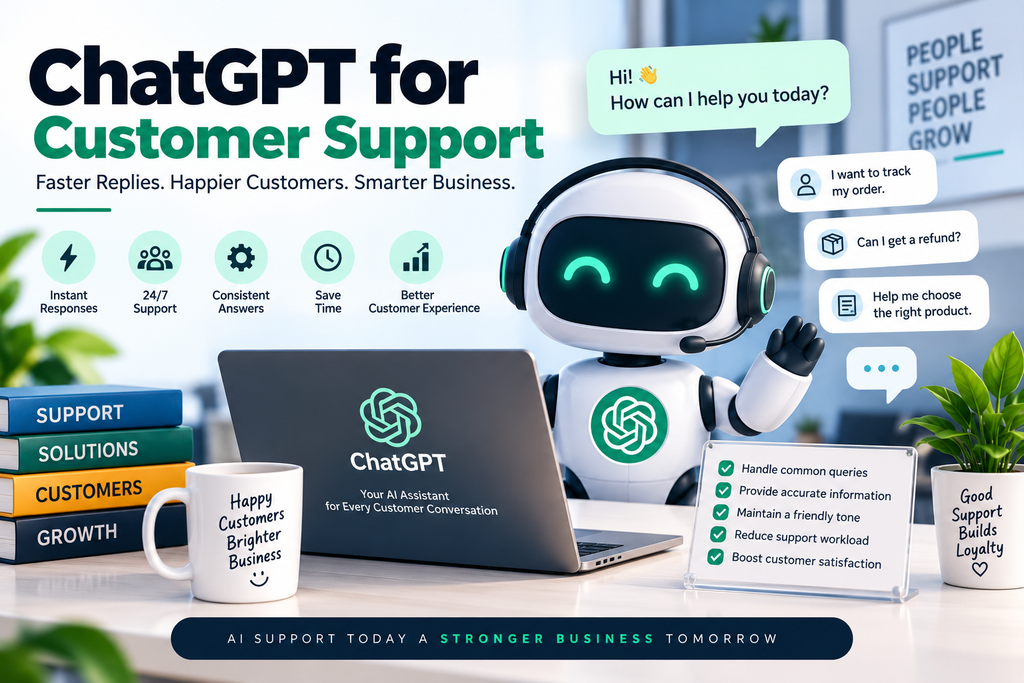
ChatGPT for customer support helps businesses respond to customer questions quickly, consistently, and efficiently. It can assist with FAQs, product information, troubleshooting, order-related queries, and personalized customer conversations. By automating repetitive support tasks, businesses can save time while improving the overall customer experience. ChatGPT can also help create clear, conversational answers that support SEO, AEO, and GEO strategies. When used effectively, it can improve customer engagement, provide faster assistance, and strengthen a brand’s digital presence.
What Is ChatGPT for Customer Support?
ChatGPT is an AI assistant that can understand natural-language questions and generate conversational responses.
For customer support, businesses can use it to assist with routine communication and support operations.
Depending on how it is configured, ChatGPT can help customers and support agents with tasks such as:
- Answering frequently asked questions
- Drafting customer replies
- Explaining products and services
- Summarizing support conversations
- Creating troubleshooting instructions
- Organizing customer feedback
- Generating support documentation
- Helping agents find relevant information
- Translating or rewriting support messages
The exact capabilities depend on the business’s setup, connected systems, and information provided to the AI.
Why Use ChatGPT for Customer Support?
Customer support teams often receive many repetitive questions.
Customers may ask about product features, pricing, order processes, account settings, return policies, or basic troubleshooting.
ChatGPT can help handle or prepare responses to these common questions, allowing support teams to spend more time on issues that require human attention.
Provide Faster Responses
One of the biggest advantages of AI-assisted customer support is speed.
ChatGPT can generate response drafts quickly, helping support agents reduce the time spent writing repetitive messages.
For automated support experiences, AI can also provide immediate answers to common questions when the appropriate information is available.
Reduce Repetitive Work
Support agents may answer similar questions hundreds of times.
ChatGPT can help create standardized responses for frequently asked questions while allowing agents to personalize them when necessary.
Improve Support Team Productivity
Instead of spending time writing every response from scratch, agents can use ChatGPT to create an initial draft.
The agent can then review, correct, and personalize the response before sending it.
Support Customers Around the Clock
AI-powered support experiences can potentially provide assistance outside normal business hours.
However, businesses should clearly communicate when customers are interacting with AI and provide a way to reach human support when necessary.
How Businesses Can Use ChatGPT for Customer Support
ChatGPT can support several stages of the customer service process.
Answer Frequently Asked Questions
Businesses can use AI to answer common questions about products, services, policies, and processes.
For example, a customer might ask how to change an account setting or how a particular product feature works.
If the relevant information is available to the system, ChatGPT can provide a clear explanation.
Create Customer Response Drafts
Support agents can give ChatGPT the relevant customer question and ask it to create a professional response.
The agent can then review the response and make any necessary changes.
This can be especially useful for repetitive requests.
Troubleshooting Assistance
ChatGPT can help create step-by-step troubleshooting instructions for common technical problems.
For example, it could organize a troubleshooting process into simple steps that customers can follow.
For complicated technical problems, human support should remain available.
Summarize Customer Conversations
Long customer conversations can take time to review.
ChatGPT can help summarize important details, including:
- Customer’s main problem
- Steps already attempted
- Relevant product information
- Questions that remain unanswered
- Possible next steps
This can make it easier for another support agent to understand the situation.
Create Help Center Content
Businesses can use ChatGPT to help draft FAQs, support articles, setup guides, and troubleshooting documentation.
Human experts should review the content to ensure that instructions are accurate and up to date.
Benefits of ChatGPT for Customer Support
Using ChatGPT as part of a customer support strategy can provide several advantages.
Faster Support Operations
AI can reduce the time required to write and organize responses.
This can help teams handle routine requests more efficiently.
Consistent Communication
Businesses can create response guidelines and prompts that encourage consistent tone and structure across customer interactions.
Better Agent Efficiency
Support agents can use AI for drafting, summarizing, rewriting, and organizing information.
This allows agents to focus more attention on complex customer problems.
Scalable Customer Support
As a business grows, the number of customer questions can increase.
AI-assisted workflows can help businesses manage larger volumes of routine requests without requiring every interaction to be handled manually.
ChatGPT Customer Support Prompts
Well-designed prompts can help support agents get more useful responses from ChatGPT.
Customer Reply Prompt
A simple prompt could ask ChatGPT to create a professional and friendly response based on the customer’s question and the company’s support policy.
The agent should provide the relevant information and review the generated response before sending it.
Troubleshooting Prompt
For technical support, a prompt can instruct ChatGPT to organize troubleshooting instructions into clear, numbered steps and avoid suggesting actions that are not supported by the company’s documentation.
Conversation Summary Prompt
For long support conversations, ChatGPT can be asked to summarize the customer’s issue, previous troubleshooting steps, important details, and recommended next actions.
How to Set Up ChatGPT for Customer Support
Businesses should create a clear support workflow before introducing AI.
Identify Common Customer Questions
Start by reviewing existing support requests.
Identify questions that appear frequently and determine which ones can safely be handled with AI assistance.
Create a Reliable Knowledge Base
AI responses are more useful when they are based on accurate business information.
Create organized documentation covering products, services, policies, troubleshooting procedures, and frequently asked questions.
Define Escalation Rules
Not every customer issue should be handled by AI.
Create clear rules for when a conversation should be transferred to a human support agent.
Examples may include complex complaints, sensitive account issues, billing disputes, security concerns, or situations requiring human judgment.
Test Before Launching
Test the system using realistic customer questions.
Check whether the AI provides accurate, relevant, and appropriately worded answers.
Best Practices for Using ChatGPT in Customer Support
AI should be implemented carefully to maintain customer trust and service quality.
Always Review Important Responses
For important customer interactions, support agents should review AI-generated responses before sending them.
AI can sometimes misunderstand context or provide incorrect information.
Keep Business Information Updated
Customer support information changes over time.
Product features, prices, policies, and procedures should be kept current so that AI-assisted responses do not rely on outdated information.
Maintain a Human Escalation Option
Customers should have a clear way to reach a human when AI cannot resolve their problem.
Human support is particularly important for complicated, sensitive, or unusual situations.
Protect Customer Information
Businesses should carefully consider privacy and security when using AI for customer support.
Avoid unnecessarily exposing sensitive customer information and follow applicable privacy requirements and company policies.
Match Your Brand Voice
Customer support responses should sound consistent with the business.
Businesses can establish guidelines for tone, language, formatting, and communication style.
Limitations of ChatGPT for Customer Support
ChatGPT can be useful, but it is not a perfect customer support solution.
AI Can Make Mistakes
AI-generated responses can sometimes contain inaccurate or incomplete information.
This is why important answers should be verified.
AI May Misunderstand Context
Customer conversations can contain complex details, unclear language, or unusual situations.
Human agents may be better equipped to understand complicated cases.
Not Every Problem Should Be Automated
Some customer interactions require empathy, judgment, negotiation, or access to systems that AI may not have.
Businesses should decide carefully which support tasks are appropriate for automation.
ChatGPT vs Traditional Customer Support
Traditional customer support usually depends heavily on human agents.
ChatGPT introduces an additional layer of AI assistance that can help with repetitive tasks and information processing.
The strongest approach for many businesses is not necessarily AI instead of humans, but AI combined with human support.
AI Handles Routine Work
AI can assist with repetitive questions, summaries, drafts, and basic information.
Humans Handle Complex Problems
Human agents can focus on cases requiring judgment, empathy, detailed investigation, or exceptions to standard processes.
This combination can create a more efficient support workflow.
How to Measure AI Customer Support Performance
Businesses should track performance after introducing AI.
Useful metrics can include:
- Average response time
- Customer satisfaction
- Resolution rate
- Escalation rate
- Number of support requests
- Agent productivity
- Response accuracy
- Customer feedback
These metrics can help businesses understand whether AI is actually improving the customer experience.
Common Mistakes to Avoid
Businesses can make several mistakes when introducing AI customer support.
Automating Everything
Not every support task should be automated.
Keep human agents involved where their judgment and communication skills are important.
Using Outdated Information
AI cannot compensate for inaccurate or outdated business documentation.
Keep the knowledge base regularly updated.
Not Testing AI Responses
Launching an AI support workflow without proper testing can lead to incorrect answers and frustrated customers.
Hiding the Use of AI
Businesses should consider being transparent about AI-assisted interactions and make human support accessible when needed.
The Future of ChatGPT for Customer Support
AI customer support is likely to become more capable as AI systems improve.
Future support workflows may combine conversational AI, business knowledge, automation, analytics, and human agents into a single system.
More Personalized Support
AI may help businesses provide more context-aware responses based on customer needs and previous interactions, where appropriate and permitted.
Smarter Support Automation
AI could help automate more routine processes while escalating complicated cases to human agents.
AI Assistants for Support Teams
Instead of interacting directly with customers in every situation, AI may increasingly work behind the scenes as an assistant for human support agents.
It can help agents find information, summarize conversations, draft responses, and organize next steps.
Final Thoughts
ChatGPT can be a valuable tool for modern customer support teams.
It can help businesses respond faster, reduce repetitive work, create support content, summarize conversations, and improve agent productivity.
However, successful AI customer support requires more than simply adding a chatbot to a website.
Businesses should use accurate information, establish clear escalation rules, protect customer data, review important responses, and maintain access to human support.
The best customer support strategy combines the speed and efficiency of AI with the judgment, empathy, and expertise of human agents.
When implemented thoughtfully, ChatGPT can become a powerful part of a customer support workflow and help businesses deliver faster, more consistent, and more efficient customer experiences in 2026 and beyond.